Trust: The Essential Infrastructure of Finance

As finance becomes more digital, interconnected and cross-border, trust remains the essential infrastructure linking institutions, markets and societies. In a faster and more complex financial system, its value is becoming not only more visible, but more strategic.
The foundations of a modern financial system are easy to identify: banking networks, payment platforms, data centers, cybersecurity systems and digital channels. Yet beneath all of them lies something more fundamental — trust.
Every financial relationship begins with an act of confidence. A depositor entrusts a bank with personal savings. A company relies on a financial institution to support its growth. An investor commits capital based on the quality and credibility of available information. Banks transact with one another on the expectation that obligations will be honoured, systems will remain secure and institutions will act with discipline.
Trust is not an abstract value surrounding finance. It is one of the conditions that make finance possible. It also carries real economic consequences, shaping financial relationships, influencing the commitment of capital and helping determine how institutions and markets respond when conditions become uncertain.
Trust in a Faster Financial System
Unlike capital, trust does not appear as a separate line on a balance sheet. It cannot be acquired instantly, nor can it be secured through technology alone. It is built gradually through sound governance, prudent management, regulatory consistency, institutional transparency and the repeated delivery of commitments.
Its value is often clearest when conditions are difficult. During periods of uncertainty, markets, institutions and customers look for clarity, stability and reassurance. Confidence built over years can then become an important source of resilience.
For banks, maintaining that confidence has become more complex. The relationship between a customer and a financial institution is no longer confined to a branch, a relationship manager or a signed document. It now extends across mobile applications, digital payments, automated decisions, interconnected platforms and data-driven services.
As banking becomes faster and more sophisticated, expectations rise with it. Customers want convenience without compromising security, innovation without weakening accountability and personalisation without surrendering control over their information. Businesses expect institutions to understand rapidly changing markets while continuing to provide reliable access to capital and essential banking services. Investors look beyond financial performance to the quality of governance, resilience and long-term decision-making.
Speed, however, works in both directions. Digital finance allows institutions to serve customers more efficiently, but it can also shorten the distance between a loss of confidence and its financial consequences. Information moves quickly, customers can act immediately and markets can respond almost in real time. Preserving trust has become an operational priority as much as a reputational one.
Technology Raises the Standard
Digital transformation illustrates this clearly. Technology can make financial services more efficient, accessible and responsive, but the success of digital banking ultimately depends on confidence in the systems behind it.
A seamless application has limited value if customers are uncertain about how their information is protected. Speed is insufficient if payments are not secure, decisions cannot be explained or services cannot be maintained during disruption. The more banking becomes digital, the more institutions must demonstrate that convenience and resilience can advance together.
The same principle applies to artificial intelligence.
AI can improve operational efficiency, strengthen financial crime detection, enhance risk assessment and support customer service. Its sustainable adoption, however, depends on strong governance, appropriate human oversight, reliable data and clear accountability for how technology is used.
The central question is not simply how quickly financial institutions adopt new technologies, but how responsibly they do so. The greatest advantage may not go to the institutions that move first, but to those that give customers, regulators and markets the greatest confidence in how innovation is governed.
Kuwait and the Collective Dimension of Trust
In Kuwait, trust has long been central to the development and resilience of the banking sector. Under the regulatory oversight and guidance of the Central Bank of Kuwait, banks operate within a framework that emphasises financial stability, prudent supervision, sound governance and the resilience and integrity of the banking system.
Kuwaiti banks have built enduring relationships with individuals, businesses and institutions over many years. These relationships are supported by institutional continuity, experienced leadership and established governance frameworks. They also reflect an important principle: confidence in banking is not created by individual institutions in isolation.
This collective dimension matters. Banks, regulators, payment providers, technology companies and customers depend increasingly on one another. A weakness in one part of the system can affect confidence elsewhere, while effective coordination can strengthen the resilience of the sector as a whole.
Cooperation is not separate from competition. Banks will continue to compete in products, services, pricing and innovation, but they share an interest in maintaining market confidence, strengthening cybersecurity awareness, supporting financial literacy, combating fraud and safeguarding the integrity of the financial system.
At the Kuwait Banking Association, we recognise that sustaining trust is a collective responsibility. Our role is to support dialogue and coordination across the banking community and help translate individual experience into sector-wide strength. Initiatives such as the Let’s Be Aware campaign, undertaken with the Central Bank of Kuwait and Kuwaiti banks, demonstrate how coordinated public awareness can help customers recognise financial risks, understand their rights and responsibilities, and engage with banking services more confidently.
For Kuwait, this institutional credibility has a wider significance. As the country deepens its economic and investment relationships, confidence in the strength, governance and reliability of its financial system can support engagement with international investors and partners. A sound banking system is not only a source of domestic stability; it can also strengthen a country’s broader economic proposition.
Trust Across Borders
Trust also has an international dimension. As finance becomes more cross-border, institutions must operate across different markets, regulatory environments and business cultures. Capital may move rapidly, but meaningful partnerships still require time, credibility and mutual understanding.
The strongest international financial relationships are not built around transactions alone. They take shape when institutions understand one another’s priorities, communicate openly and establish confidence before opportunities arise.
In this context, trust increasingly functions as strategic capital. It can lower barriers to cooperation, support the exchange of knowledge and enable institutions to pursue opportunities with greater confidence. It allows markets to connect not merely through technology, but through relationships capable of withstanding change.
This matters at a time when the global financial system is becoming more technologically integrated while economic and geopolitical conditions are, in some respects, more fragmented. Credibility, consistency and institutional strength carry greater weight in such an environment, particularly when investors and financial institutions are making long-term decisions across borders.
The financial industry will continue to evolve. New technologies will emerge, operating models will change and the boundaries between banking, technology and data will become more fluid. Yet the fundamental requirement will remain unchanged: people and institutions will place their money, information and ambitions where they have confidence that these assets will be handled responsibly.
Trust should be approached with the same discipline as infrastructure: designed carefully, governed continuously, tested regularly and strengthened collectively. It is neither a communications exercise nor a promise made only in moments of uncertainty. It is the cumulative outcome of decisions made every day.
In finance, trust may be invisible, but everything visible depends upon it.
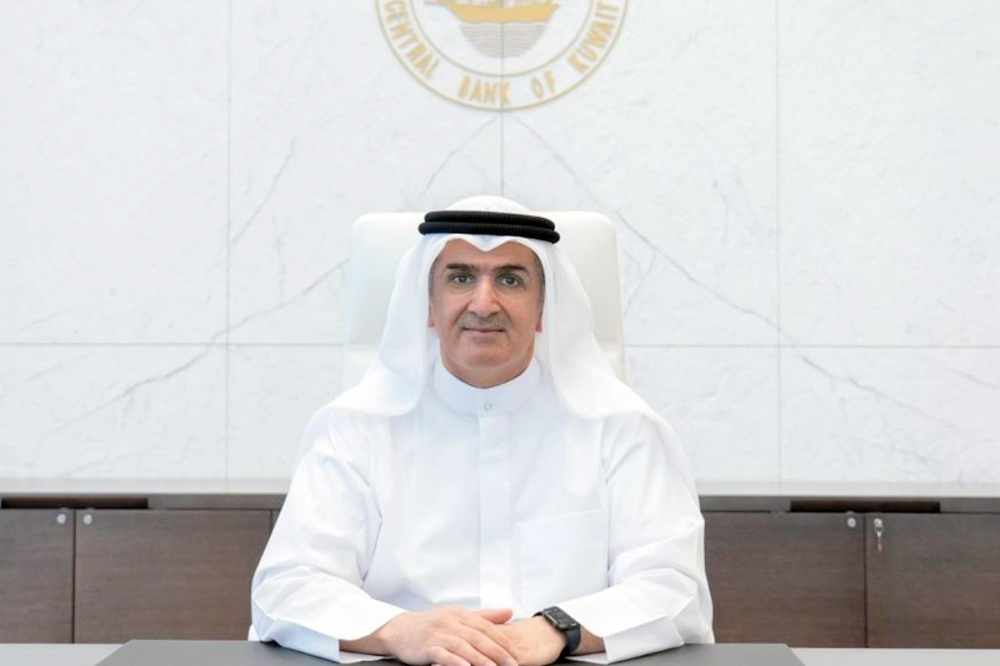
H.E. BASEL AHMAD AL-HAROON The Banking Sector Approaches the Current Environment from a Position of Strength
- Both policy arms are directed toward the same objective: maintaining confidence and safeguarding the overall stability of the financial system.
- Banking-sector soundness indicators as at the second quarter of 2026 remain comfortably above regulatory minima.
- The banking sector approaches the current environment from a position of strength, underpinned by robust capital, liquidity and asset-quality buffers.
- The objective is not to constrain credit, but to ensure that it is extended responsibly.
- Policymakers must form a view of the economy in real time and cannot defer assessment until the full data set becomes available.
- The regulatory approach rests on the principle that innovation and financial stability are complementary.
- Kuwait remains committed to working closely with regional partners to develop interoperable cross-border payment arrangements.
Central Bank of Kuwait Governor Basel Ahmad Al-Haroon sets out how monetary and macroprudential policy, forward-looking supervision, strong banking-sector buffers and continued investment in payments, cybersecurity and responsible innovation are supporting monetary and financial stability while strengthening Kuwait’s position as a trusted and competitive regional financial center.
Kuwait enters the next phase of financial-sector development with stable monetary conditions and a banking system supported by strong capital, liquidity and asset-quality indicators. The Central Bank of Kuwait’s policy framework combines monetary policy, macroprudential oversight and risk-based supervision to preserve confidence and maintain the resilience of financial intermediation through changing economic conditions.
In this exclusive interview with Al Masaref, H.E. Basel Ahmad Al-Haroon, Governor of the Central Bank of Kuwait, discusses the Bank’s approach to monetary and financial stability, emerging supervisory risks, real-time economic assessment, artificial intelligence and cloud regulation, cybersecurity, payments modernisation and the policy priorities required to enhance Kuwait’s attractiveness as a regional financial center.
MONETARY AND FINANCIAL STABILITY
How does the Central Bank of Kuwait deploy and coordinate its monetary and macroprudential policies to safeguard monetary and financial stability, particularly during periods of economic stress?
The Central Bank of Kuwait’s mandates of monetary stability and financial stability are closely interrelated and mutually reinforcing. Monetary stability preserves the purchasing power of the Kuwaiti dinar, anchors confidence, and supports private investment and consumption. Financial stability ensures that financial intermediation continues to function efficiently and remains resilient through periods of economic and financial stress.
Monetary policy is conducted within a forward-looking framework. The Bank continuously monitors domestic and international developments, together with a suite of early-warning indicators that may signal a change in economic conditions. It then assesses the transmission of those developments to the Kuwaiti economy, forms a view on the trajectory of key macroeconomic variables, and acts as required through its policy instruments-most notably the policy interest rate, liquidity-management operations, and the management of foreign-exchange reserves.
This monetary framework is complemented by a two-tier prudential architecture. At the macroprudential level, supervision focuses on developments and risks across the financial system as a whole. At the microprudential level, attention is directed to the soundness and resilience of individual banks. The Bank employs risk-based supervision, scenario analysis and stress testing to identify vulnerabilities and to assess the capacity of banks and the wider financial system to withstand adverse conditions, including operational risks such as cybersecurity threats.
Once risks are identified, the Bank can respond through prudential buffers, liquidity and capital requirements, regulatory limits, and targeted supervisory measures. These instruments may be preventive or corrective, depending on the nature and severity of the risk.
Coordination between monetary and macroprudential policy is particularly important in periods of stress. Both policy arms are directed toward the same objective: maintaining confidence and safeguarding the overall stability of the financial system.
Against this policy backdrop, how would you assess Kuwait’s monetary and financial conditions, particularly in terms of price and currency stability, the attractiveness of the Kuwaiti dinar, and the resilience of the banking sector?
Kuwait’s monetary and financial conditions remain broadly stable. Price developments have been contained. Domestic inflation stood at 2.2 per cent in June 2026, compared with 3.5 per cent in the United States and 2.8 per cent in the euro area over the same period. This differential indicates that the transmission of global inflationary pressures to domestic prices has been relatively limited.
The Kuwaiti dinar has continued to maintain relative stability against major currencies. Its attractiveness is also evident in the deposit market. As at July 2026, the interest rate on KD-denominated deposits exceeded those on USD deposits. Resident private sector KD deposits, which account for around 70 per cent of total resident deposits, increased by 1.5 per cent year on year to KD 39 billion. These developments indicate that depositors have continued to hold a substantial share of their savings in the domestic currency.
Credit conditions remain supportive of economic activity. In July 2026, credit facilities extended by local banks to residents grew by 4.8 per cent year on year to KD 55 billion. Growth was broad-based across personal facilities (4.6 per cent), real estate (4.3 per cent) and industry (11.5 per cent), underscoring the banking sector’s continued capacity to perform its intermediation role.
Banking-sector soundness indicators as at the second quarter of 2026 remain comfortably above regulatory minima. The capital adequacy ratio stood at 18.2 per cent against a regulatory minimum of 12.0 per cent. The regulatory liquidity ratio was 20.7 per cent, and the non-performing loan ratio was 1.5 per cent-among the lowest in the region. Profitability indicators were likewise solid, with return on assets at 1.4 per cent and return on equity at 10.7 per cent.
Taken together, these indicators point to stable monetary conditions and a banking sector operating with material buffers above its regulatory requirements.
Kuwait’s banks maintain strong capital, liquidity and asset-quality indicators. Which emerging risks and developments require the closest supervisory attention to preserve the sector’s resilience?
The banking sector approaches the current environment from a position of strength, underpinned by robust capital, liquidity and asset-quality buffers. Vigilant monitoring is nonetheless required in several areas:
- Geopolitical and global economic developments that could affect market conditions, funding costs and credit quality.
- Cyber and operational risks, which continue to intensify in scale and sophistication.
- Governance, data and model risks associated with the adoption of artificial intelligence and other advanced technologies.
- Climate-related financial risks, including both physical and transition exposures.
The Bank’s supervisory approach remains forward-looking and risk-based. Through vigilant prudential supervision, effective macroprudential measures, systematic stress testing and continuous monitoring of emerging vulnerabilities, the objective is to ensure that credit growth remains sustainable and is underpinned by prudent lending standards. This will help preserve the sector’s resilience while enabling banks to continue supporting Kuwait’s sustainable economic growth.
SUPERVISION, RESILIENCE AND REAL-TIME POLICY
How is the Central Bank ensuring that credit growth supports productive economic activity without creating excessive leverage, sectoral concentration or asset-price risks? What supervisory priorities will shape the next phase of banking oversight, particularly in risk governance, provisioning, liquidity and recovery planning?
The Central Bank of Kuwait has established a comprehensive regulatory and supervisory framework designed to ensure that credit growth supports productive economic activity while preserving financial stability.
The objective is not to constrain credit, but to ensure that it is extended responsibly-on the basis of sound credit assessment, demonstrated repayment capacity and sustainable cash flows.
Excessive leverage, sectoral concentration and asset-price risks are addressed through prudent exposure limits, including the general ceiling of 15 per cent of a bank’s capital base for total exposure to a single customer or interlinked group. These microprudential limits are reinforced by a robust macroprudential framework, which the Bank stands ready to recalibrate proactively as economic and financial conditions evolve.
The next phase of banking oversight will remain forward-looking, balanced and risk-based. Four priorities will be particularly prominent:
1 – Risk governance. Supervisory attention will focus on whether risk-management frameworks are adequately forward-looking, and on banks’ ability to aggregate consistent risk data across business lines and geographical exposures.
2 – Provisioning and credit-risk recognition. Banks are expected to identify deterioration at an early stage, apply prudent and forward-looking assumptions, and maintain provisions that adequately reflect expected credit losses.
3 – Liquidity. Supervision will continue to assess the stability and concentration of funding sources, maturity mismatches, reliance on significant depositors and foreign-currency liquidity, and banks’ capacity to withstand market-wide stress.
4- Recovery planning. Recovery planning will continue to gain importance as a practical component of banks’ resilience frameworks.
Collectively, these measures are intended to maintain an appropriate balance: empowering banks to finance viable households, businesses and development projects, while preventing excessive leverage and concentrated exposures from undermining long-term financial stability.
How does the Central Bank ensure a timely and forward-looking assessment of economic and financial developments when some key data are not yet available?
Comprehensive official statistics take time to compile and validate. Policymakers, however, must form a view of the economy in real time and cannot defer assessment until the full data set becomes available.
To bridge this information gap, the Bank draws on a range of higher-frequency and survey-based sources that complement official statistics:
Monthly payments data, which underpin the Household Spending Indicator and the Bank’s inflation-nowcasting framework, and allow shifts in consumption and near-term inflation to be observed at higher frequency.
The CBK Purchasing Managers’ Index, which provides timely insight into conditions in the non-oil private sector.
The Consumer Inflation Expectations Index, which informs the Bank’s assessment of how households view the inflation outlook.
The Financial Stability Outlook, which assesses emerging risks and vulnerabilities in the financial system.
The Financial Conditions Index, which combines a broader range of financial indicators to monitor overall financial conditions.
These indicators feed into the Bank’s macroeconomic forecasting framework, which brings developments in growth, inflation and other key variables into a coherent view of the outlook. The framework allows the Bank to assess current conditions and the path of the economy over both the short and the longer term.
These tools provide a more timely and forward-looking picture of the economy and therefore inform policy decisions ahead of the publication of official statistics. They are not a substitute for those statistics; they complement them by supplying early signals and insight.
INNOVATION, CYBERSECURITY AND PAYMENTS
How is the Central Bank developing its regulatory approach to artificial intelligence, cloud services and data-driven banking?
The Central Bank of Kuwait regards technological innovation as an important driver of a stronger, more resilient and more efficient financial sector. As digital transformation continues to reshape financial services, the Bank remains committed to fostering responsible innovation while safeguarding monetary and financial stability and maintaining public confidence in the financial system.
The regulatory approach rests on the principle that innovation and financial stability are complementary. Accordingly, the Bank continues to enhance a forward-looking regulatory and supervisory framework that supports the responsible adoption of emerging technologies-including artificial intelligence, cloud computing and data-driven banking-while ensuring that the associated risks are effectively managed.
Key measures already in place include:
A Cyber and Operational Resilience Framework.
An Anti-Money Laundering, Counter-Terrorist Financing and Counter-Proliferation Financing (AML/CFT/CPF) framework aligned with international standards.
The Wolooj Innovation Hub, which provides a controlled environment for exploring and testing innovative solutions in artificial intelligence, digital financial services, cybersecurity and FinTech.
These arrangements allow the Bank to support innovation without compromising the safety, integrity or stability of the financial system.
What further measures are required to strengthen cybersecurity, operational resilience and the continuity of critical financial services?
Maintaining financial stability remains a primary objective of the Central Bank of Kuwait. Cybersecurity has become an increasingly important pillar of that mandate, given the evolving threat landscape facing the banking and financial sector. A comprehensive approach-combining strong governance, effective regulation, capacity-building and responsible innovation-is required to keep the sector resilient.
A robust cybersecurity framework is essential to protect critical data, support secure information-sharing and ensure business continuity across the banking system. Such a framework strengthens banks’ ability to detect, contain and recover from cyber incidents. In this context, the Bank has continued to:
Invest in people and capabilities through specialised training programmes, cyber exercises, and close cooperation with local and international partners.
Modernise payment infrastructure and strengthen the regulatory framework for payment service providers.
Support innovation through the regulatory sandbox, which allows financial institutions to test new technologies in a secure and controlled environment without compromising the safety of the financial system.
These measures will continue to be deepened as threats evolve, with particular emphasis on the continuity of critical financial services.
How has the modernisation of Kuwait’s payments infrastructure improved settlement efficiency and interoperability, and how will its continued development strengthen regional connectivity?
Over recent years, the Central Bank of Kuwait has undertaken a substantial programme to modernise and strengthen the national payments infrastructure. This has involved the deployment of advanced technologies, the continuous enhancement of core payment systems, and the expansion of their operational capabilities.
The Bank has extended the operating hours of key payment systems, improved system availability and resilience, and introduced modern payment infrastructures. These initiatives have enabled financial institutions to process and settle transactions more efficiently and securely. They have also strengthened liquidity management, reduced settlement and operational risk, enhanced business continuity, and increased the overall resilience of Kuwait’s financial market infrastructure.
Interoperability is a strategic priority. By adopting international standards-particularly ISO 20022-the Bank is building a fully integrated payments ecosystem that enables seamless communication and richer data exchange among banks, payment service providers, government entities and emerging digital financial services. This improves operational efficiency and establishes a flexible platform capable of supporting automation and the continued evolution of digital finance. The phased implementation of the Kuwait National Payments System (KNPS) further advances this transformation by introducing next-generation infrastructures that enhance efficiency, expand digital payment capabilities and provide a scalable foundation for future innovation.
Regional connectivity is an equally important pillar. As payment ecosystems across the Gulf Cooperation Council continue to evolve, greater interoperability among national infrastructures will enable faster, safer and more cost-effective cross-border payments. This will facilitate trade, investment and remittance flows and contribute to deeper regional financial integration. Kuwait remains committed to working closely with regional partners to develop interoperable cross-border payment arrangements that support the broader objectives of regional economic cooperation.
These efforts are aligned with the evolving needs of the financial sector and the wider digital economy. They support Kuwait Vision 2035 and reinforce the country’s ambition to serve as a competitive regional financial and commercial hub.
KUWAIT AS A REGIONAL FINANCIAL CENTRE
What policy and institutional developments are needed to strengthen Kuwait’s position as a trusted and competitive regional financial center?
Strengthening Kuwait’s position as a trusted and competitive regional financial center requires building further on foundations that are already in place. Priority areas include:
Further development of the domestic debt market, including the diversification and expansion of funding sources.
Continued improvement of the business and investment environment.
Support for financial innovation, particularly in FinTech.
Preservation of the confidence that has been built in Kuwait’s financial system over many years.
A strong and well-regulated banking sector, together with a sound supervisory framework, remain the key pillars of sustainable growth in the financial sector.
The Central Bank of Kuwait will continue to work closely with all relevant authorities in support of these efforts, with the objective of maintaining a resilient and competitive financial system that meets the evolving needs of the economy. In doing so, the Bank aims to strengthen investor confidence and enhance Kuwait’s attractiveness as a trusted regional financial center.
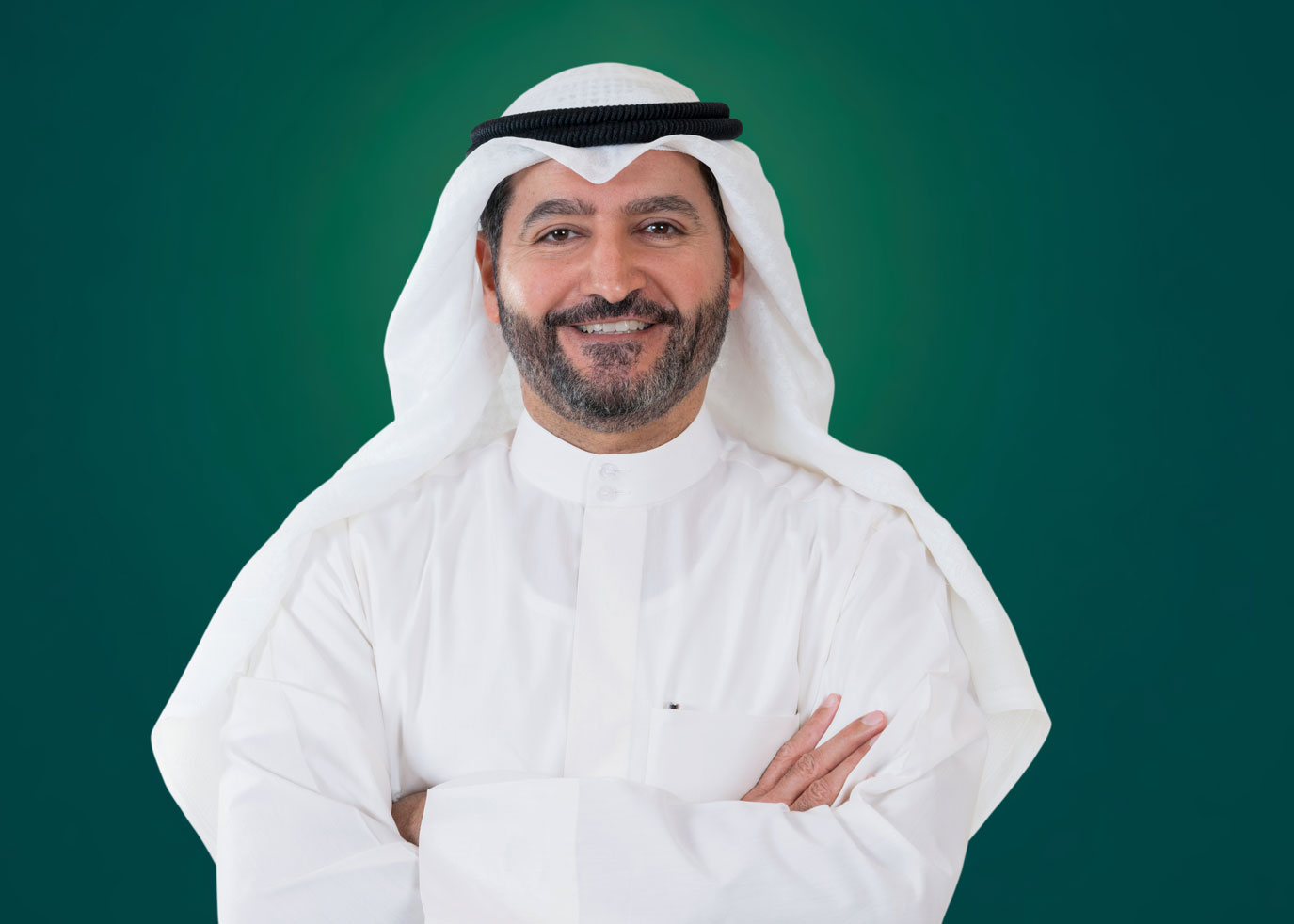
HAMAD ABDULMOHSEN AL-MARZOUQ The banking sector is fully prepared to support Kuwait’s future growth.
- The banking sector’s growth trajectory is bound by the structural real-world dynamics of the economy.
- Our overarching strategic priority is to act as a proactive engine for economic modernization while safeguarding the resilience and financial stability of the banking system.
- Banks have an important role in supporting the expansion of the non-oil economy, but sustainable finance must always be based on sound commercial fundamentals.
- Several non-oil sectors closely aligned with Kuwait Vision 2035 offer attractive investment.
- SMEs are essential drivers of innovation, employment, and economic diversification.
Kuwait Banking Association Chairman and KFH Chairman Hamad Abdulmohsen Al-Marzouq discusses how the country’s banks can convert strong balance sheets into productive financing for the next phase of economic transformation — while preserving credit discipline, strengthening bankability, deepening capital markets and building the technology and talent required for long-term competitiveness.
Kuwaiti banks enter the next phase of economic transformation with substantial financial capacity, supported by capital, liquidity and coverage ratios that remain comfortably above international baselines. The central challenge is therefore not simply the availability of financing, but the depth and quality of commercially viable opportunities through which that capacity can be deployed into productive private investment and non-oil growth.
In this interview with Al Masaref, Hamad Al-Marzouq, sets out the sector’s priorities as Kuwait advances its development agenda. He addresses project bankability, SME finance, sovereign debt and debt-market development, artificial intelligence, public trust, human capital and the collective role of the banking industry in supporting Kuwait Vision 2035.
STRONG FOUNDATIONS, STRUCTURAL CHALLENGES
Kuwait’s banks maintain strong capital, liquidity, asset-quality and profitability indicators. What structural features of the Kuwaiti economy could nevertheless limit the sector’s ability to support the next phase of growth and diversification?
Kuwait’s banking sector enters this period of global and regional economic transformation from a position of exceptional balance-sheet strength. Supported by the proactive and prudent regulatory oversight of the Central Bank of Kuwait, our banks maintain capital adequacy, liquidity, and coverage ratios that comfortably exceed international baselines. This financial strength provides us with a robust cushion and significant capacity to fund the nation’s economic goals.
However, the banking sector’s growth trajectory is ultimately bound by the structural real-world dynamics of the economy. While Kuwait banks possess the capacity to fund broad-based transformation, several structural factors historically condition productive non-oil credit expansion. Most prominent among these is the heavy dominance of the public sector, which acts as both the primary driver of economic activity and the chief employer of the domestic workforce. To shift toward self-sustaining private-sector growth, economic activity needs to be increasingly anchored by private enterprise and market-driven dynamics.
Furthermore, expanding credit into non-traditional, high-growth sectors relies on a continuous, predictable pipeline of commercially viable, revenue-generating projects, alongside modern legal, bankruptcy, and regulatory frameworks. The banking sector is fully prepared to support Kuwait’s future growth, provided continued reforms that unlock private investment opportunities and accelerate public-private partnerships.
What should be the principal priorities for Kuwaiti banks as they respond to changing domestic credit demand, evolving customer expectations and the transformation of Kuwait’s economy?
The mandate for Kuwaiti banks today extends well beyond traditional financial intermediation. Our overarching strategic priority is to act as a proactive engine for economic modernization while safeguarding the resilience and financial stability of the banking system. Today, success depends on combining financial strength with agility, operational excellence, and customer-centric innovation across every tier of our operations.
To achieve this, Kuwaiti banks are prioritizing four strategic pillars. First, we are accelerating digital transformation by investing heavily in artificial intelligence, cloud infrastructure, and advanced data analytics to elevate the customer experience, streamline back-office operations, and deliver secure, real-time banking solutions. Second, we are aligning our capital deployment directly with Kuwait Vision 2035, financing high-impact national infrastructure, green energy, logistics, and technology projects that drive structural diversification.
Equally important are credit discipline and human capital. We remain committed to world-class underwriting standards, robust cybersecurity, and resilient risk management as credit demand evolves across new economic sectors. At the same time, we are dedicating significant resources to building future-ready national talent, equipping the next generation of Kuwaiti banking professionals with specialized capabilities in financial technology, quantitative risk analysis, data science, and sustainable finance.
FINANCING PRIVATE-SECTOR AND NON-OIL GROWTH
How can Kuwaiti banks direct a greater share of credit towards productive private investment and non-oil activity while maintaining disciplined underwriting and appropriate risk-adjusted returns?
Banks have an important role in supporting the expansion of the non-oil economy, but sustainable financing must always be based on sound commercial fundamentals. Channeling abundant bank liquidity into asset-light, emerging sectors require financing models that place greater emphasis on cash-flow generation, business performance, and long-term growth potential.
Advanced data analytics can further help banks strengthen credit underwriting and risk assessment, enabling prudent financing to emerging sectors while maintaining sustainable returns.
Which sectors of Kuwait’s non-oil economy currently offer the strongest bankable opportunities, and what is required to develop a deeper pipeline of commercially viable projects?
Several non-oil sectors closely aligned with Kuwait Vision 2035 offer attractive investment. High-potential areas include smart infrastructure and logistics, renewable energy and clean-tech utilities driving national sustainability, specialized healthcare, private higher education, digital infrastructure, and localized advanced manufacturing designed to strengthen national food security.
Realizing their full potential, however, requires a stronger pipeline of investment-ready projects supported by transparent regulations, streamlined approvals, standardized procurement frameworks, and predictable execution timelines, that mitigate execution risks for financial institutions and investors alike.
As the pipeline of well-structured projects expands, banks will be better positioned to provide long-term financing that supports national development priorities while generating sustainable risk-adjusted returns.
DEVELOPMENT FINANCE AND SME GROWTH
How can Kuwaiti banks, government entities and project sponsors improve the bankability of Kuwait’s major development and public-private partnership projects?
Improving project viability requires early alignment among all stakeholders to establish clear commercial frameworks, appropriate risk allocation, and credible implementation plans. These foundations are critical to attracting long-term capital and supporting successful project execution.
Kuwait’s national development agenda relies heavily on the successful execution of public-private partnerships. By fostering strong strategic collaboration between the public sector and commercial banks, we can transform ambitious policy goals into high-quality, investment-ready assets that attract institutional capital and create lasting economic value.
What reforms and risk-sharing mechanisms are needed to improve Kuwaiti banks’ financing of small and medium-sized enterprises, particularly companies without substantial fixed assets or long credit histories?
SMEs are essential drivers of innovation, employment, and economic diversification. However, expanding SME financing requires an ecosystem that balances entrepreneurial growth with prudent risk management. Strengthening credit support mechanisms and advancing cash-flow-based financing can unlock greater financing opportunities for promising SMEs.
At the same time, improving access to finance requires SMEs to adopt stronger financial reporting and governance practices. Success will depend on a collaborative effort across policymakers, financial institutions, and business owners to build a more dynamic and sustainable SME sector.
DEEPENING KUWAIT’S FINANCIAL MARKETS
How could Kuwait’s sovereign debt programme and the development of a domestic benchmark yield curve affect bank liquidity, corporate financing and the development of the local debt and sukuk markets?
A well-developed sovereign debt programme and a domestic benchmark yield curve are important foundations for the continued development of Kuwait’s financial markets. A liquid sovereign debt market provides a reliable pricing reference for corporate bond and sukuk issuances, helping deepen local capital markets and diversify funding sources for businesses. For banks, it creates additional investment opportunities and enhances liquidity management, while supporting more efficient balance-sheet management.
More broadly, capital markets complement the banking sector rather than compete with it. A stronger debt market expands financing options for corporates and strengthens the overall financial ecosystem, enabling it to better support Kuwait’s long-term economic development objectives.
TECHNOLOGY, TRUST AND COMPETITIVENESS
How can Kuwaiti banks use artificial intelligence, data analytics and digital platforms to improve productivity, credit decisions and customer service while maintaining cybersecurity, data governance and public trust?
Artificial intelligence is becoming a key strategic capability across the banking sector. When implemented responsibly, it can enhance operational efficiency, strengthen risk management, improve fraud detection, and deliver more personalized customer experiences. Its successful adoption, however, must be supported by strong governance, robust cybersecurity, and rigorous data protection.
Trust has always been the foundation of banking, and as the industry becomes increasingly digital, preserving that trust through responsible innovation will remain as important as embracing new technologies.
What institutional, technological and human-capital capabilities must Kuwaiti banks develop to compete more effectively with larger regional banking groups?
Competing effectively with larger regional banking groups requires continuous investment in technology, talent, and innovation. Success will increasingly depend on the ability to adapt quickly to changing customer expectations, evolving technologies, and a dynamic regulatory environment.
At the same time, strengthening leadership capabilities, developing specialized skills, and maintaining high standards of governance will be essential to sustaining long-term competitiveness.
Kuwaiti banks have strong foundations, and by continuing to build on these strengths, they can remain competitive both regionally and internationally.
COLLECTIVE ACTION FOR KUWAIT VISION 2035
Which issues should the Kuwait Banking Association prioritize through collective action, particularly in relation to fraud prevention, cybersecurity, financial data, talent development, sustainable finance and support for national development?
As the financial landscape becomes increasingly complex and interconnected, collective action has become more important than ever. The Kuwait Banking Association provides a platform for member banks to address industry priorities that are best tackled through collaboration.
Key areas of focus include fraud prevention, cyber resilience, digital identity, talent development, sustainable finance, and the responsible adoption of artificial intelligence. Equally important is strengthening financial awareness through initiatives such as the “Let’s Be Aware” campaign, implemented in coordination with the Central Bank of Kuwait, which has become a leading national platform for promoting financial literacy, safe banking practices, and fraud prevention.
KBA also plays an important role in facilitating dialogue between Banks, the Central Bank of Kuwait, legislative authorities and government entities to support national development priorities and strengthen the financial ecosystem. Through these efforts, KBA aims to ensure that Kuwait’s banking sector remains resilient, competitive, and well positioned to contribute to the successful deli
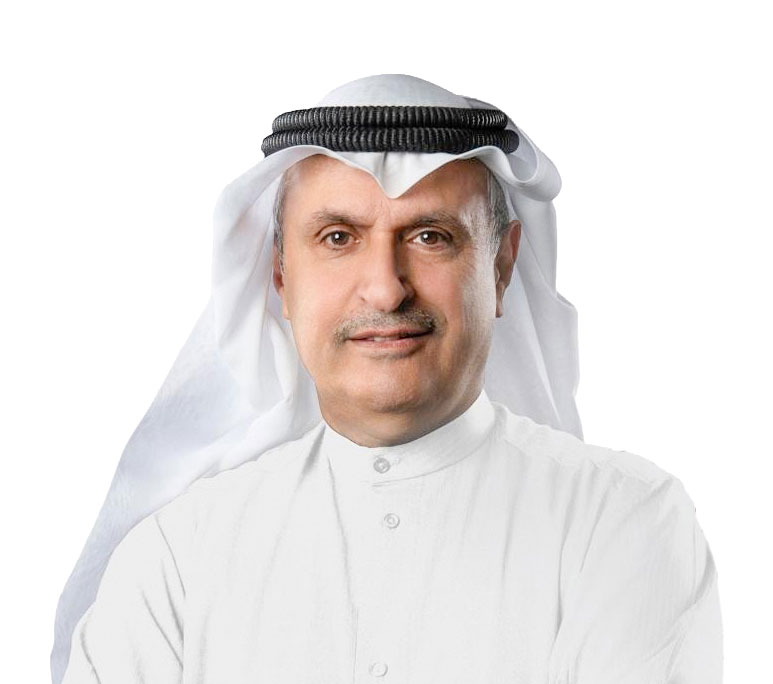
ISAM JASIM AL-SAGER The next frontier for Kuwaiti banks is to grow selectively through integrated technology and disciplined international expansion
- Geographic expansion remains important, but it should follow genuine client demand rather than precede it.
- International Presence Must Serve a Defined Commercial and Strategic Purpose
- Capital Should Be Deployed Where It Strengthens the Group’s Franchise, Delivers Sustainable Risk-Adjusted Returns and Enhances Diversification
- Resilience Must Be Established Before Periods of Stress Emerge. It Cannot Be Assembled Effectively Once a Crisis Is Already Under Way
- When Used Effectively, an International Banking Network Becomes Genuine Economic Infrastructure
KBA Vice Chairman and NBK Vice Chairman & Group CEO Isam Jasim Al-Sager on why the next phase of international banking growth must be selective, client-led and capital-disciplined — combining financial strength, integrated technology and specialized capabilities to connect Kuwait more effectively with regional and global markets.
Kuwait’s leading banks enter the next phase of international competition with a foundation built on capital strength, regulatory credibility, deep client relationships and increasingly sophisticated digital capabilities. For NBK Vice Chairman & Group CEO Isam Jasim Al-Sager, however, international growth is not a question of footprint for its own sake. It is a question of where a bank has a genuine strategic advantage, how effectively it integrates technology and controls across markets, and whether each deployment of capital strengthens resilience and sustainable returns.
In this interview with Al-Masaref, Al-Sager sets out a disciplined model for international growth: deepen relationships before adding distance; expand where client demand justifies it; build shared technology with local flexibility; diversify funding before stress arrives; and use international networks not merely as overseas presence, but as infrastructure that can finance trade, attract investment into Kuwait and support Kuwaiti companies abroad. The result is a clear argument for how Kuwaiti banks can compete at greater scale without attempting to replicate global universal banks: by combining domestic strength with specialized capabilities, cross-border integration and disciplined capital allocation.
COMPETING FROM A POSITION OF STRENGTH
How do Kuwait’s leading banks compare with major regional and international banking groups in terms of scale, profitability, geographic reach, technology and institutional capabilities?
Kuwait’s leading banks, and NBK in particular, compare favorably with major regional and international banking groups across several important measures of financial strength, profitability, risk discipline and performance. We do not seek scale for its own sake. We compete through capital resilience, disciplined risk management while maintaining our ability to deliver consistent returns to our shareholders across economic cycles. NBK has established a significant regional scale, with the group ranking among the top 10 Arab banks by assets and top 10 banking brands in the Middle East. More importantly, this scale is supported by a strong domestic franchise and deep institutional capabilities.
The figures support that position. NBK’s total assets reached approximately USD 150 billion at the end of June 2026. The Group also reported a capital adequacy ratio of 17.0%, a non-performing loan ratio of 1.22% and provision coverage of 256%. Together, these indicators position NBK among the region’s strongest banks in terms of capital resilience, asset quality and provisioning. This financial strength has been accompanied by consistent profitability and returns across cycles, enabling us to navigate global uncertainty from a position of genuine strength.
Geographic diversification has long been a strategic advantage for NBK. We were an early mover among regional peers in building an international presence, giving us a depth of cross-border experience that has developed over many years. Today, we operate across 13 countries and four continents, connecting regional clients with major international financial centers. Together with Boubyan Bank and NBK Wealth, this footprint provides meaningful earnings diversification and strengthens our ability to serve clients across markets.
In technology, Kuwait’s banking sector has advanced rapidly, and we moved early. Weyay was developed as a genuinely digital-first bank rather than as a digital layer added to a traditional operating model. That philosophy has since extended across the Group through the modernization of core infrastructure, investment in data and artificial intelligence, and the development of integrated digital platforms.
The comparison is not uniform across every capability. Large international banks continue to possess greater depth in global markets infrastructure, capital markets and highly specialized advisory services. It would be unrealistic to claim full parity in those areas. However, in capital strength, risk discipline, client relationships and digital execution, a well-managed GCC bank can compete effectively with institutions many times its size.
Our objective is not to become a global conglomerate. It is to combine the trust and agility of a leading regional institution with the governance, technology and talent standards expected of an international banking group. That combination defines our differentiation and supports our ability to create sustainable value.
Which strengths of Kuwait’s domestic banking sector provide the strongest foundation for further international growth, and which additional capabilities should be developed to compete successfully at a larger scale?
The foundation begins with strong fundamentals, and Kuwaiti banks are well positioned in that respect. At the end of the first quarter of 2026, the sector-wide capital adequacy ratio stood at 18.5%, with Tier 1 capital representing nearly 88% of the total capital base. The IMF has described Kuwait’s financial system as stable and prudently managed, while the Central Bank of Kuwait (CBK) has confirmed that capital and liquidity indicators remain comfortably above regulatory requirements and international averages.
This discipline does not constrain international expansion. On the contrary, it gives regulators, investors and counterparties confidence that Kuwaiti banks can operate responsibly at greater scale.
Regulatory credibility is another important advantage, and one that is sometimes underestimated. The CBK’s emphasis on stress testing, governance and operational resilience has cultivated a strong culture of discipline across the sector. When a Kuwaiti bank enters a new market, that regulatory track record provides foreign supervisors and counterparties with a credible basis for confidence from the outset.
Equally important is the depth of client relationships. Decades of serving sovereign entities, major corporates, family businesses and private clients have created institutional knowledge that cannot be replicated quickly. NBK’s model has always been built on enduring relationships and a deep understanding of how to support clients across economic cycles and geographies.
Competing successfully on a greater international scale nevertheless requires further development in several areas.
A central priority is an integrated operating architecture. Technology platforms, data standards, cybersecurity and compliance frameworks need to function consistently across jurisdictions, rather than allowing each market to operate through a separate model. We are already standardizing platforms across our international network, supported by central Group functions spanning data, digital channels and core banking.
Product depth is equally important. Kuwaiti banks need to continue expanding their capabilities in transaction banking, trade finance, structured and project finance, treasury, capital markets and wealth management. The objective is not to replicate every service offered by a global universal bank, but to originate, structure and deliver more of what clients require through our own platform.
Specialized talent is another critical requirement. International growth demands genuine expertise in cross-border regulation, financial-crime compliance, sanctions, structured finance and complex risk management. It also requires greater mobility of people and leadership, allowing expertise, institutional culture and Group standards to move effectively across markets.
Our international operations continued to contribute meaningfully to Group revenue and profitability during the first half of 2026. The foundation is therefore well established. The next phase is about adding greater depth, integration and specialization. Growth must remain selective, client-led and capital-disciplined. That is how a strong domestic bank develops into a genuinely international banking group rather than simply becoming a larger domestic institution.
GROWTH BEYOND THE DOMESTIC MARKET
Where do you see the strongest opportunities for Kuwaiti banks to achieve profitable growth beyond the domestic market, through geographic expansion, specialized services or deeper relationships with regional corporate clients?
All three routes are relevant, but they do not carry equal weight, and the sequence matters.
The most immediate opportunity lies in deepening relationships with clients we already know. It is the most capital-efficient route because the trust, connectivity and institutional knowledge are already established. The opportunity is to capture a greater share of those clients’ requirements across transaction banking, trade finance, treasury, cross-border payments, syndication, and structured and project finance. This is growth through depth rather than distance.
Geographic expansion remains important, but it should follow genuine client demand rather than precede it. Our existing presence across regional markets and major international financial centers already gives us a strong platform for supporting cross-border trade, investment and capital flows.
At NBK, some of the strongest opportunities are where we can leverage our position as a leading Kuwaiti bank together with our regional and international network to facilitate greater cross-border activity. This is a two-way opportunity. On one side, Kuwaiti and regional corporates are increasingly expanding across the GCC and into international markets, creating demand for financing, transaction banking, trade, treasury and other specialized services. On the other, we see an important opportunity to support international companies looking to enter Kuwait or participate in the significant investment and development opportunities emerging in the country.
Specialized capabilities reinforce that opportunity. NBK Wealth is a clear example. It is an established platform that ranks as the largest wealth manager in Kuwait and among the largest in the MENA region. Its capabilities have been recognized through several major industry awards, including Kuwait’s Best Private Bank, Best for Ultra-High-Net-Worth Clients and the Middle East’s Best for Fixed Income. The priority now is to deepen the platform, broaden its proposition and connect it more effectively across our international network.
Digital capability is another important growth enabler. Weyay continues to drive genuine digital adoption, while more than 100 enhancements were introduced to our mobile banking platform during 2025. Digital penetration among SME clients reached nearly 79%, representing an increase of 14% year on year. The same infrastructure enables us to serve specialized and international clients more efficiently and to scale our proposition without relying entirely on branch-led expansion.
Sustainable finance also represents a substantive growth opportunity. NBK’s sustainable assets increased by 23% year on year to approximately USD 6 billion by the end of 2025, while sustainable loans reached around USD 3 billion. The Bank was also named Best Sustainable Finance Bank in Kuwait for 2026. Corporate clients increasingly expect sustainability to be embedded within the broader banking relationship rather than offered as a separate product line, and that is how we have approached it.
What financial, regulatory and strategic criteria should guide a Kuwaiti bank’s decision to enter, expand in or withdraw from an international market?
The decision to enter or expand in an international market has to be guided by a combination of strategic relevance, sustainable returns and a favorable and clear understanding of the regulatory environment.
First, there needs to be a clear strategic rationale. We look at whether the market provides meaningful opportunities for our clients, whether it strengthens our ability to connect Kuwait with regional and international markets, and whether we can bring differentiated capabilities to that market. Geographic expansion should ultimately enhance the broader Group franchise rather than operate as a standalone objective.
Market size alone has never been sufficient. International presence is not an objective in itself. It must serve a defined commercial and strategic purpose.
Our approach is selective, client-led and capital-disciplined. We prioritize markets connected to our clients’ actual trade, investment and capital flows, particularly where our existing relationships and institutional capabilities provide a credible reason for us to establish a presence. Any investment must strengthen the Group’s diversification and resilience rather than simply extend its geographic footprint.
We will not compromise governance, compliance, cybersecurity or risk standards in pursuit of a commercial opportunity, regardless of how attractive it may appear. The operating model must support effective oversight, integration and sustainable value creation from the outset.
Expansion within an existing market must meet an even higher threshold than the original entry decision. Once a presence has been established, there can be a natural tendency to pursue additional scale. However, further capital should follow demonstrated client demand, improving economics and clear evidence that technology, talent and control functions can scale with the business.
The same discipline applies in reverse. We are prepared to reduce our exposure or withdraw from a market if returns no longer meet our thresholds, the risk profile moves beyond our appetite, or the operation ceases to support clients or the wider franchise. This is not an exceptional response. It is an integral part of disciplined portfolio management.
We enter markets where we possess a genuine advantage, expand where performance and demand justify further investment, and reconsider our position when the original strategic rationale no longer applies.
How should Kuwaiti banking groups allocate capital between their domestic franchises and international operations while maintaining appropriate risk-adjusted returns and avoiding excessive exposure to particular markets?
Capital allocation between domestic and international operations should not be governed by a fixed ratio. It must remain a dynamic and disciplined process, guided by risk-adjusted returns, strategic relevance and resilience rather than historical allocations or predetermined targets.
Kuwait remains the foundation of NBK’s franchise and its core market, where our deepest client relationships, strongest funding base and most established capabilities are concentrated. The domestic franchise must remain fully equipped to support high-quality credit demand and Kuwait’s broader development agenda.
Egypt is our second domestic market and an important contributor to the Group’s diversification and long-term growth. GCC markets, specifically Saudi Arabia, are also of key strategic focus, with capital deployed selectively to deepen our presence, support client activity and capture opportunities in these dynamic markets.
Beyond these priority markets, capital is allocated according to clear Group-wide criteria. These include sustainable risk-adjusted returns, diversification benefits, connectivity to client trade and investment flows, and the ability to scale within a robust control environment. Strong headline growth alone is not sufficient, particularly where returns do not adequately compensate for risk or where further investment would increase exposures already present with limited incremental value to the Group.
Concentration risk requires equal discipline. No market, sector or counterparty should become sufficiently significant for its underperformance to weaken the Group’s overall resilience. We manage this through country and sector limits, counterparty exposure controls and regular stress testing against geopolitical disruption, market volatility, currency movements and restrictions on capital or liquidity flows.
Capital allocation must also remain flexible. Businesses that demonstrate sustainable returns, strategic relevance and well-controlled scalability earn greater capital over time. Where performance weakens or risks move beyond appetite, capital is reduced or redirected.
The principle is straightforward. Capital should be deployed where it strengthens the Group’s franchise, delivers sustainable risk-adjusted returns and enhances diversification, while preserving disciplined concentration limits and resilience across markets.
OPERATING ACROSS MARKETS WITH DISCIPLINE
What are the main challenges Kuwaiti banks face in managing subsidiaries and operations across jurisdictions with different capital, liquidity and data requirements?
The principal challenge is maintaining effective Group-wide coordination across markets with distinct legal, supervisory and operational requirements. Capital, liquidity, resolution and data frameworks naturally reflect the characteristics of each jurisdiction, requiring banks to manage resources locally while preserving consolidated oversight, operational efficiency and strategic alignment across the Group.
Data management adds another layer of complexity. Requirements relating to residency, privacy and cross-border information sharing vary between markets. Banks therefore need a technology and governance architecture that provides timely, consolidated visibility at Group level while ensuring that customer information is stored and processed in accordance with the applicable local requirements. This becomes increasingly important as digital services and artificial intelligence are deployed across multiple markets.
There is also an organizational dimension. International operations require sufficient local autonomy to respond effectively to customers, market conditions and supervisory expectations, while remaining fully aligned with the Group’s risk appetite, compliance framework, financial-crime controls and technology standards. The objective is to preserve local responsiveness while maintaining Group-wide integration.
At NBK, our approach combines common Group-wide standards with strong local governance. We assess capital and liquidity requirements market by market and actively manage correspondent banking relationships, while maintaining effective consolidated oversight across the international network.
The objective is not complete uniformity, but disciplined alignment. A common institutional backbone, adapted thoughtfully to local requirements in each market, allows international operations to contribute to the Group’s diversification and growth while maintaining strong oversight, regulatory compliance and resilience.
How can internationally active Kuwaiti banks diversify their funding and manage liquidity, currency and country risk across markets during periods of financial or geopolitical stress?
Resilience must be established before periods of stress emerge. It cannot be assembled effectively once a crisis is already under way.
At NBK, we aim to fund assets in each market primarily through stable local deposits. This reduces dependence on parent-bank funding and limits the risks associated with moving liquidity across borders during periods of pressure. At Group level, we diversify funding by source, currency, investor base and maturity, while staggering refinancing requirements to avoid excessive concentrations of maturities.
Currency risk is managed by matching assets and liabilities in the same currency wherever practicable and hedging residual exposures within strict limits. We do not regard open currency positions as a source of return. Currency management is intended to protect the balance sheet and preserve earnings stability.
Country risk is not assessed only at the point of market entry. It is monitored continuously through defined limits, early-warning indicators and regular stress testing against geopolitical, macroeconomic and liquidity scenarios. Positions are adjusted proactively as conditions evolve rather than waiting for a crisis to dictate the response.
Regional tensions during 2026 tested this discipline in practice. In March, the CBK temporarily eased certain liquidity and capital requirements to provide the banking system with greater flexibility during a period of heightened uncertainty. NBK did not need to draw on those measures, as its liquidity and capital buffers remained comfortably above the applicable requirements. We regarded the additional flexibility as a protective buffer rather than as a basis for assuming greater risk.
Resilience of this kind is built over many years through diversified funding, locally sustainable liquidity, disciplined currency management and continuous country-risk oversight. Those are the foundations that allow an international banking group to remain operational, responsive and trusted when conditions deteriorate.
How can Kuwaiti banks build more integrated digital operating models across their international networks while accommodating differences in regulation, customer behavior and market infrastructure?
The most effective model is a shared technology core with local flexibility incorporated from the outset. Neither complete standardization nor a collection of independent local systems provides the right answer.
Our digital strategy operates on two parallel tracks. We are modernizing our core banking infrastructure while developing new digital platforms anchored in a digital-first philosophy. At Group level, this approach has supported the expansion of digital onboarding, enhanced mobile banking functionality and the introduction of new solutions designed to simplify customer journeys and broaden access to financial services.
Around that shared core platform, the customer experience must remain locally relevant. Payment habits, channel preferences, language requirements, product demand and trust signals differ meaningfully between Kuwait, our regional markets and our wider international operations. We are not seeking to impose an identical interface everywhere. Modular platforms allow each market to configure products, customer journeys and authentication methods without rebuilding the underlying infrastructure.
Regulatory requirements must also be incorporated from the design stage rather than addressed retrospectively. We distinguish clearly between capabilities that can be shared across the Group, including core processing logic, analytics and fraud-detection tools, and those that must remain local, such as certain categories of data, disclosures and regulatory controls.
This requires a clear operating model. Central Group functions establish common standards for core banking, data, cybersecurity and digital channels, while local teams retain the flexibility to adapt customer-facing services to their market and regulatory requirements.
The experience gained through Weyay’s digital-first model, together with the resilience and growing adoption of NBK’s digital channels across its international network, provides a strong foundation for extending this approach further across the Group.
TURNING INTERNATIONAL NETWORKS INTO ECONOMIC INFRASTRUCTURE
How can the international networks of Kuwaiti banks be used more effectively to finance trade, attract investment into Kuwait and support the regional expansion of Kuwaiti companies?
The value of an international network is not determined simply by its size. It depends on whether that network operates as one coordinated platform rather than as a collection of separate offices sharing a common identity.
In trade finance, NBK operates from a position of considerable strength. We maintain a market share exceeding 30% and serve at least 75% of foreign companies operating in Kuwait. Our capabilities have also been recognized through the Best Trade Finance Bank in Kuwait award for the fifth consecutive year.
The opportunity now is to extend that origination, structuring and execution capability across the entire network, allowing clients to access a coordinated relationship covering financing, guarantees, payments, liquidity and foreign-exchange risk rather than assembling those services separately in each market.
The network should also function as a gateway for investment into Kuwait, not solely as a channel for outbound activity. A significant part of our international presence was established specifically to capture investment and trade flows connected with Kuwait, and it continues to fulfill that purpose. Overseas teams can identify prospective investors, facilitate introductions and combine local market knowledge with project finance, syndication, treasury and transaction-banking capabilities.
For Kuwaiti companies expanding regionally, continuity is particularly important. A client entering Saudi Arabia, the UAE or another market should be able to benefit from the relationship and institutional knowledge already established in Kuwait, supported by local teams once operations commence in the new market.
When used effectively, an international banking network becomes genuine economic infrastructure. It finances trade, channels capital into Kuwait and gives Kuwaiti companies a stronger starting position as they expand into regional and international markets.
Looking ahead, should the international growth of Kuwaiti banks rely primarily on organic expansion, strategic partnerships, acquisitions or greater consolidation, and what capabilities will determine their success?
No single model is universally superior. Success depends on selecting the appropriate approach for each market and sequencing it with discipline.
Organic expansion is generally our preferred route where we already possess brand recognition, established regulatory relationships and a genuine right to compete. Saudi Arabia provides a clear example. We have developed our presence progressively through branches in Jeddah, Riyadh and the Eastern Province, maintaining a conservative and client-led approach rather than pursuing expansion for its own sake.
Acquisitions can be appropriate where organic entry would take too long or where an established franchise provides licenses, customers and local capabilities that would be inefficient to build independently. NBK’s acquisition in Egypt demonstrates how a carefully selected transaction, supported by patient investment and effective integration, can evolve into an enduring growth platform.
Strategic partnerships and institutional collaborations play a complementary role in our international strategy rather than serving as a primary route for organizational expansion. NBK’s preferred model remains organic growth or selective acquisitions where we can maintain appropriate strategic and operational control. Partnerships can nevertheless support business growth by deepening client relationships, extending access to new opportunities and broadening our capabilities across markets.
Domestic consolidation is a separate consideration. Our earlier acquisitions provided NBK with meaningful diversification and integration experience before the current phase of consolidation. Our priority today is to extract greater value from the platform we have already built rather than pursue transactions for their own sake.
Whichever route is selected, success ultimately depends on disciplined capital allocation, scalable technology, regulatory execution and the effective integration of people, systems and risk cultures as the business develops.
Lasting advantage will come from expanding with clarity of purpose and applying disciplined judgment about where to build organically, and where an acquisition can create genuine strategic value.
H.E. Sheikh Dr. Meshaal Jaber Al-Ahmad Al-Sabah Positioning Kuwait as a Resilient Market Where Global Investors Can Enter with Confidence and Grow Sustainably
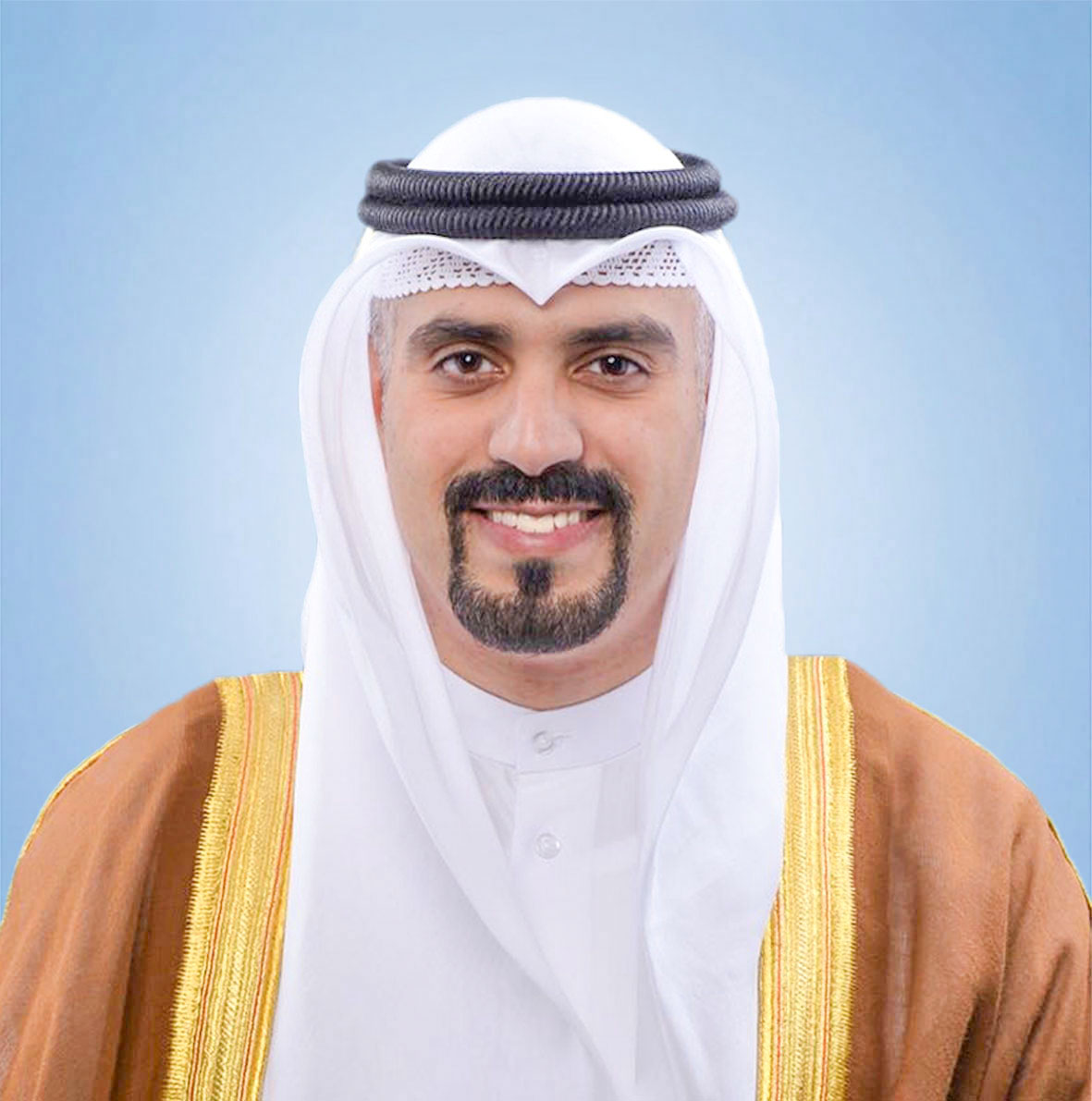
Success is measured not by capital inflows alone, but by lasting economic value, stronger competitiveness, and sustainable growth for future generations.
Our focus is on ensuring investors can establish, operate, and scale in Kuwait with confidence and predictability.
 KDIPA outlines how Kuwait is sharpening its investment proposition around quality, innovation and long-term economic value — while improving the investor journey, deepening local linkages and leveraging the strength of the country’s financial system.
Kuwait’s investment agenda is increasingly centered on the quality of capital entering the economy, not capital inflows alone. For KDIPA, the strongest foreign direct investment is investment that brings innovation, advanced technologies and expertise, creates opportunities for national talent, strengthens local supply chains and supports economic diversification.
As Kuwait advances its transformation agenda, the opportunity set spans technology, renewable energy, healthcare, financial services, logistics, tourism, infrastructure and industry. In this interview with
Al-Masaref, KDIPA discusses the priorities required to make the investor journey more seamless, connect global investors more closely with domestic capabilities and reinforce Kuwait’s position as a trusted, competitive and future-ready investment destination.
DEFINING HIGH-QUALITY FDI
How does KDIPA define high-quality foreign direct investment, and which indicators are used to assess its economic value? What are KDIPA’s Priorities?
KDIPA defines high-quality FDI by its contribution to Kuwait’s future: bringing innovation, advanced technologies, and expertise while creating opportunities for national talent, strengthening supply chains, and supporting diversification.
As Kuwait advances its transformation agenda, opportunities are strongest in technology, renewable energy, healthcare, financial services, logistics, tourism, infrastructure, and industry—sectors that build future capabilities and deepen Kuwait’s integration into regional and global value chains.
Ultimately, success is measured not by capital inflows alone, but by lasting economic value, stronger competitiveness, and sustainable growth for future generations.
FROM MARKET ENTRY TO INVESTOR GROWTH
What further measures could help investors move more efficiently from licensing to full operations and support the timely resolution of any practical challenges that may arise?
KDIPA’s role is to provide a seamless experience from market entry through expansion, supported by strong facilitation, effective aftercare, and close coordination across government. As digital integration and regulatory alignment continue to advance, our focus is on ensuring investors can establish, operate, and scale in Kuwait with confidence and predictability.
How can Kuwait deepen the links between foreign investors and local companies, suppliers, universities, research institutions and national talent?
KDIPA actively encourages stronger connections between global investors, local businesses, universities, research institutions, and national talent. Through partnerships, supplier-development initiatives, training programs, and innovation collaborations, we aim to ensure that foreign investment strengthens domestic capabilities while supporting investor growth.
FINANCIAL DEPTH AS AN INVESTMENT ADVANTAGE
How can Kuwaiti banks, investment institutions and capital markets support incoming investors through financing, treasury and supply-chain solutions?
Kuwait’s resilient banking sector is a core pillar of the country’s investment proposition. Backed by strong regulation, solid capital adequacy, ample liquidity, sound asset quality, and prudent risk management, the sector gives incoming investors the financial depth and stability needed to establish and expand operations. Kuwaiti banks, investment institutions, and capital markets are well equipped to support investors through project financing and support long-term growth.
A FUTURE-READY INVESTMENT DESTINATION
What measurable improvements in the investor experience and investment outcomes would you like Kuwait to achieve over the next two to three years?
The bigger objective is to continue to strengthen Kuwait’s position as a trusted, competitive, and future-ready investment destination. Over the coming years, progress should be reflected in faster and more predictable investor journeys, stronger coordination across government entities, deeper digital integration, and a higher level of aftercare that supports expansion and reinvestment in line with global best practice. At the same time, the quality of investment matters as much as the volume. KDIPA’s focus is on investments that advance innovation, transfer technology, create high-value opportunities for national talent, strengthen local supply chains, and support Kuwait’s broader economic diversification agenda. Ultimately, success means positioning Kuwait as a resilient market where global investors can enter with confidence, grow sustainably, and contribute meaningfully to the country’s long-term transformation.
H.E. MR. SONGCHAI CHAIPATIYUT Thailand Views Kuwait as a Promising and Important Investment Destination
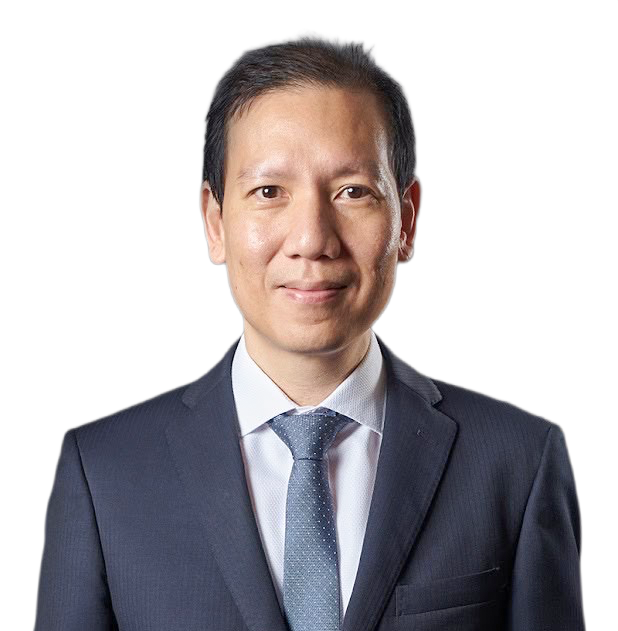
- Thailand views Kuwait as a promising and important investment destination.
- We see Kuwait Vision 2035 as an important roadmap, not just for Kuwait, but for our shared prosperity.
- By combining Thailand’s expertise with Kuwait’s investment capacity, we’re looking for
- a long-term partnership that creates sustainable growth.
- The next step is to translate this trust into tangible economic cooperation that mutually benefits our countries.
- The objective is to create a more balanced investment relationship in which Thai companies participate in Kuwait’s development.
- The objective should be to create a stronger ecosystem connecting government institutions, financial institutions, and the private sector.
- Over the next three to five years, I would like to see our economic relations enter a new chapter.
Thailand’s Ambassador to Kuwait outlines a more ambitious phase in bilateral relations — moving beyond trade toward two-way investment, structured partnerships and practical cooperation in food security, healthcare and wellness, tourism, technology and logistics, while positioning Thailand as a gateway for Kuwaiti investors to the wider ASEAN market.
After 63 years of diplomatic relations, Kuwait and Thailand are seeking to translate a relationship built on mutual trust and respect into deeper economic cooperation. Bilateral trade stood at approximately USD 947 million in 2025, but the next opportunity, according to H.E. Mr. Songchai Chaipatiyut, Ambassador of the Kingdom of Thailand to the State of Kuwait, lies in moving beyond a traditional buyer–seller relationship toward more balanced investment and structured partnerships.
In this exclusive interview with Al-Masaref, the Ambassador sets out the sectors with the strongest potential, explains how Kuwait Vision 2035 can provide a framework for shared prosperity, and discusses how stronger institutional links, financing, business matching and easier movement of people can convert diplomatic goodwill into concrete commercial projects and long-term value for both countries.
A PARTNERSHIP BUILT ON TRUST
How would you assess the current state of Kuwait-Thailand relations, and which recent developments have contributed most to strengthening the partnership?
Overall, I would say that Thailand and Kuwait enjoy a very strong and cordial relationship, built on 63 years of diplomatic relations and underpinned by mutual trust and respect. What is particularly encouraging is that our relationship has evolved well beyond traditional government-to-government ties. We are seeing increasingly vibrant people-to-people exchanges and growing business-to-business cooperation, particularly in promising areas such as food security, health and wellness, and tourism.
In recent years, we have also witnessed engagement at various levels.
For example, in 2024, our then Prime Minister had an audience with H.H. Sheikh Sabah Al-Khaled Al-Hamad Al-Mubarak Al-Sabah, the Crown Prince of the State of Kuwait, on the sidelines of the 3rd Asia Cooperation Dialogue (ACD) Summit
in Doha. In the same year, Thailand hosted the first Thailand-Kuwait Political Consultation in Bangkok.
Now, my priority is to keep this momentum moving. The Embassy is preparing for the second Thailand-Kuwait Political Consultation in September 2026, while also working to advance some of the pending bilateral agreements.
At the same time, we want to ensure that this strong partnership between Thailand and Kuwait is translated into tangible cooperation and felt more directly by our businesses, families and communities in both countries.
Which sectors offer the strongest potential for expanding bilateral trade and investment, and what currently limits the development of these opportunities?
Thailand and Kuwait already have a strong trade foundation, as our bilateral trade volume currently stands at approximately 947 million USD in 2025.
However, the main limitation is that our relationship has traditionally been stronger in trade than in two-way investment and structured partnerships. I therefore believe that the real opportunity lies in moving beyond this traditional buyer–seller relationship, toward a more strategic partnership. Key areas such as food security, health and wellness, and tourism offer strong potential, which also aligns with Kuwait’s Vision 2035.
We see Kuwait Vision 2035 as an important roadmap, not just for Kuwait, but for our shared prosperity. Thailand and Kuwait have a real opportunity to do more together. When we approach this partnership, Thailand focuses on three core principles: building confidence, boosting competitiveness, and fostering deeper collaboration.
We see three key areas where this can really come to life:
First, food security. Thailand is a major food exporter, but we want to be a “solutions partner” for Kuwait. We’re ready to share our expertise in smart farming, precision agriculture, and logistics to help strengthen your local supply chain.
Second is our medical and wellness sector. We’ve been a trusted partner for many Kuwaiti families seeking treatment for years, and we want to expand on that. We see great potential in sharing our expertise, from advanced medical technology to refine and excellent wellness infrastructure, to support Kuwait’s own healthcare ambitions.
And third, tourism. Thailand has long been a favoured destination for Kuwaiti travellers, and we see strong potential to further enhance this connection. Beyond leisure travel, we can collaborate on developing high-quality tourism infrastructure, service standards, and hospitality training. By sharing Thailand’s experience in building a globally competitive tourism sector, we can support Kuwait’s efforts to diversify its economy and strengthen its tourism ecosystem.
Ultimately, by combining Thailand’s expertise with Kuwait’s investment capacity and our shared visions, we aren’t just looking for a transaction, we’re looking for a long-term partnership that creates sustainable growth for both our people.
TWO-WAY INVESTMENT OPPORTUNITIES
How can Kuwaiti investors access opportunities in Thailand more effectively and use the country as a gateway to the wider Southeast Asian market?
I would encourage Kuwaiti investors to look at Thailand not only as an investment destination, but also as a gateway to the wider ASEAN market. Thailand has several advantages in this regard. We have a large domestic market, strong infrastructure, established supply chains, and very good connectivity with the rest of Southeast Asia and further. So, for a Kuwaiti company, investing in Thailand can provide access not only to Thai consumers, but also to the broader regional market.
To do this effectively, the first step is to engage with the relevant Thai agencies, particularly the Board of Investment (BOI) whose office in Riyadh (Saudi Arabia) also covers Kuwait, to understand the incentives and opportunities available. What is equally important is finding the right local partner. This is where I believe the Embassy can play an important role. We can connect Kuwaiti investors with relevant Thai institutions, business networks and potential partners, and help them navigate the market. We can facilitate the introductions to the BOI in Thailand or its Riyadh office.
What opportunities does Kuwait offer Thai companies seeking to establish or expand their presence in the Gulf region?
Thailand views Kuwait as a promising and important investment destination, given its high-income economy, strategic position and ambitious Kuwait Vision 2035. The Embassy is therefore encouraging Thai businesses to view Kuwait not only as an export market but also as a long-term investment destination.
For Thai companies, opportunities are particularly relevant in areas where Thailand has established expertise and where Kuwait is seeking diversification and greater resilience. These include food security, healthcare and wellness, tourism, logistics, and potentially clean energy and related technologies. In food security, for example, Thailand can offer capabilities spanning production, processing, logistics and distribution rather than simply supplying finished products.
The Embassy is also seeking engagement with Kuwait Direct Investment Promotion Authority (KDIPA) to facilitate and encourage Thai investment into Kuwait. The objective is to create a more balanced investment relationship in which Thai companies participate in Kuwait’s development rather than limiting their role to exports.
To support this, facilitating business travel remains a key priority. We are actively exploring ways to streamline visa and entry procedures for Thai entrepreneurs, executives, and technical experts or even tourists, ensuring that business missions and exploratory visits can be carried out with greater ease and efficiency.
FROM SECTOR OPPORTUNITIES TO PRACTICAL COOPERATION
Which practical initiatives could deliver the greatest progress in food security, healthcare, tourism, technology and logistics cooperation?
In food security, the most practical approach would be to move from simply exporting food to becoming a “solutions partner” for Kuwait. This could include cooperation in smart farming, precision agriculture, smart irrigation, food processing, storage, logistics and distribution. Joint investment in food-storage and distribution infrastructure could also contribute to more resilient supply chains.
In healthcare and wellness, cooperation could focus on hospital and healthcare partnerships, patient-referral and medical-transfer mechanisms, as well as advanced medical technology, and wellness infrastructure. In particular, establishing structured systems for the referral and transfer of Kuwaiti patients to hospitals and specialised medical institutions in Thailand could also make bilateral healthcare cooperation more practical and systematic. Thailand’s medical expertise, internationally recognised healthcare services, and the longstanding trust of Kuwaiti patients provide a strong foundation for expanding cooperation in this area.
In tourism, practical cooperation could focus both on facilitating two-way tourism flows and on strengthening the broader tourism ecosystem between Thailand and Kuwait. The Embassy is actively promoting efforts to facilitate Visa on Arrival (VoA) arrangements for Thai nationals travelling to Kuwait, which could help make travel between the two countries more convenient and support greater two-way tourism flows. At the same time, Thailand also sees potential in sharing our experience in developing a globally competitive tourism ecosystem, including integrated tourism services, and hospitality development.
As for technology, Thailand is well positioned to contribute to Kuwait’s economic diversification and long-term development priorities through cooperation in advanced medical technology, smart agriculture, and clean-energy technologies, including renewable energy, green hydrogen, energy storage and EV infrastructure.
How can the two countries translate strong governmental relations into more joint ventures and direct commercial partnerships?
For me, this is one of the most important questions. Thailand and Kuwait already enjoy strong government-to-government relations and a high level of mutual trust. The next step is to translate this trust into tangible economic cooperation that mutually benefits our countries.
I believe the key is to build stronger institutional bridges between government-level cooperation and the private sector. Political consultations and bilateral agreements provide the necessary framework, but they need to be complemented by investment facilitation, targeted business matching, and direct engagement between companies. This is where government can play an important enabling role—by creating the right conditions, building confidence, and connecting businesses with the right partners.
The Embassy has already adopted this approach through a number of initiatives. For example, in May 2026, the Embassy led a delegation of Kuwaiti business leaders to “THAIFEX-Anuga Asia 2026” in Thailand under the Thailand -Kuwait Trade Partnership Development Project, creating opportunities for direct engagement with leading Thai companies and identifying new opportunities for long-term trade and investment partnerships. In July 2026, the Embassy also brought government, business, and media representatives from Kuwait to “Grand Halal Bangkok 2026”, where they had the opportunity to see Thai halal products and innovations firsthand and engage directly with Thai entrepreneurs. These initiatives demonstrate how government-led engagement can help build the connections and confidence necessary to develop concrete commercial partnerships between the private sectors of our countries.
What improvements in air connectivity, logistics and trade facilitation would most effectively support commerce, tourism and investment?
The first priority is to make travel and business movement as convenient as possible. When people can travel easily, they are more likely to meet, do business and build relationships.
We have already taken steps on the Thai side. Kuwaiti citizens currently enjoy visa-free entry to Thailand for tourism and short-term business purposes for up to 30 days, while Thailand’s e-Visa system, introduced in January 2025, has also streamlined applications for other nationals who require visas to enter Thailand.
The Embassy has also highlighted the potential value of further visa facilitation, including consideration of Visa on Arrival (VoA) for Thai nationals travelling to Kuwait or, ultimately, reciprocal visa exemption. Such measures would make travel more convenient and could further stimulate both tourism and business connections between Thailand and Kuwait.
FINANCING AND CONNECTING THE PRIVATE SECTOR
What role can banks, investment institutions and business organisations play in financing bilateral projects and connecting companies in both markets?
Financial and investment institutions can play an important role in converting commercial interest into actual investment. They can help provide financing, facilitate transactions, assess investment opportunities, and connect companies with credible partners in both markets.
For Thailand and Kuwait, I see particular potential for greater cooperation between financial institutions, investment authorities, chambers of commerce, and business associations. Institutions such as the Kuwait Investment Authority (KIA), the Kuwait Direct Investment Promotion Authority (KDIPA), the Board of Investment of Thailand (BOI), the Kuwait Banking Association (KBA) and relevant banks could help identify promising projects, connect investors with potential partners, and provide guidance on the regulatory and financial aspects of doing business in Thailand and Kuwait.
Banks can also play a practical role by providing project financing, and other financial instruments that can help businesses move from initial discussions to actual transactions and investments. At the same time, the chambers of commerce in both countries can also serve as an important bridge between the private sectors in Thailand and Kuwait. They can help identify companies with complementary interests, organise business-matching activities, and provide market information and networks that individual companies may not have access to on their own.
Ultimately, I believe the objective should be to create a stronger ecosystem connecting government institutions, financial institutions, and the private sector.
If we can strengthen these connections, we can make it easier for Thai and Kuwaiti companies to find the right partners, access financing, manage risks, and turn promising business opportunities into concrete projects and long-term partnerships.
What competitive advantages and institutional support does Thailand offer Kuwaiti companies entering the Thai market?
Thailand’s competitive advantage is based not simply on price, but on quality, reliability and consistency. These are important pillars of the “Thai brand” and provide the foundation for long-term commercial relationships.
Thailand also offers deep expertise across several sectors relevant to Kuwait’s development priorities. In food security, for example, Thailand has capabilities across the full value chain, from production and processing to logistics and distribution. Similar strengths can be found in other business sectors such as healthcare and wellness, tourism, agribusiness, automotive, advanced manufacturing, and green technologies. This combination of industrial capabilities, skilled human resources and established supply chains enables Thai and Kuwaiti companies to develop partnerships that go beyond simple trade and create longer-term value.
Institutionally, Kuwaiti investors can benefit from Thailand’s investment-promotion framework, particularly through the Board of Investment (BOI), which provides investment incentives, facilitation services and support for eligible projects. Thailand also offers a well-established ecosystem of government agencies, chambers of commerce and business associations that can help foreign investors identify suitable partners, navigate regulatory requirements and establish operations in the country.
For Kuwaiti companies, therefore, Thailand offers not only access to a large and diversified production base, but also a relatively mature business ecosystem and institutional support that can facilitate market entry and long-term investment. In this connection, the Embassy also stands ready to help connect Kuwaiti investors with relevant Thai authorities, business organisations and potential partners,
and to provide initial guidance in exploring investment opportunities in Thailand.
A NEW CHAPTER IN BILATERAL RELATIONS
What economic, trade and investment outcomes would you like Kuwait and Thailand to achieve over the next three to five years?
Over the next three to five years, I would like to see our economic relations enter a new chapter. Thailand and Kuwait already have a solid bilateral trade foundation, but I would like to see more balanced and diversified investment flows between our two countries.
In particular, I would like to see greater Kuwaiti investment in Thailand, alongside more Thai companies’ presence in Kuwait, especially in sectors linked to Kuwait Vision 2035’s economic diversification and long-term development.
We should also encourage more joint ventures and structured partnerships between the private sectors of both countries, moving beyond a traditional buyer–seller relationship toward longer-term value creation.
More importantly, I would like to see Thailand seen by Kuwait not simply as a tourist destination and trading partner, but as a “true friend”, a reliable partner that Kuwait can count on in areas of long-term importance. Thailand has the potential to be a strategic partner for Kuwait in food security,
a trusted destination for excellent healthcare and wellness services, and a second home for Kuwaiti families and visitors.
Ultimately, I would like to see our relationship continue to build on mutual trust and respect, with Thailand and Kuwait working together as reliable partners to address our shared long-term priorities. I believe the next three to five years present an opportunity to deepen this partnership and lay the foundation for a more resilient and genuinely strategic relationship that delivers lasting ben
SHAIKHA AL-BAHAR From Participation to Genuine Influence
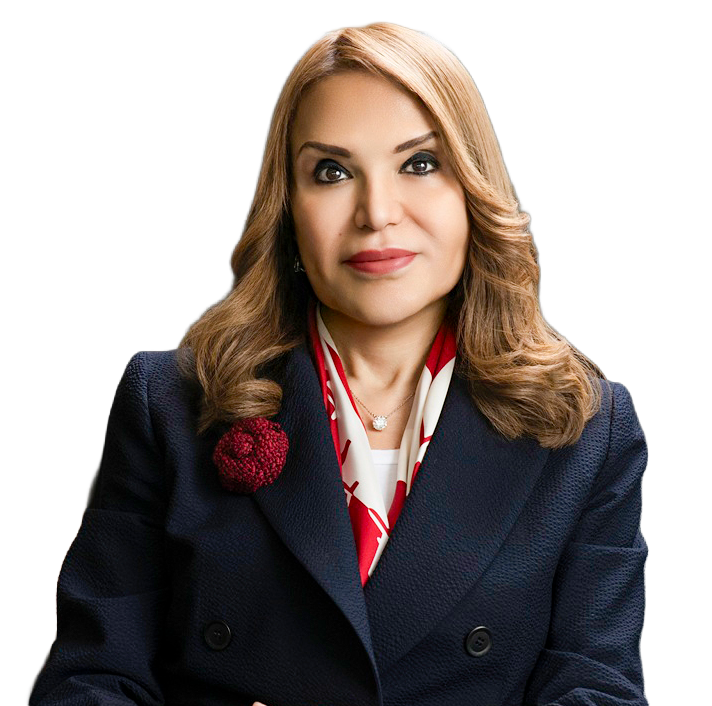
- Women’s participation has moved well past headcount and into genuine influence.
- Women now help shape strategy, governance, risk and transformation.
- The strongest progress shows up in the quality of responsibility women are taking on.
- More women are gaining exposure to strategic and commercial roles earlier, and their potential is being recognised deliberately.
- The goal was never participation for its own sake. It’s ensuring capable women are recognised, tested and prepared for the top.
Give women something important to own, early enough for the results to speak for themselves.
NBK Deputy Group CEO Shaikha Al-Bahar reflects on Kuwait’s banking transformation, the discipline required to innovate without weakening trust, and what institutions must do to turn a stronger female talent pipeline into genuine leadership influence.
Banking in Kuwait has undergone a profound transformation over the course of Shaikha Al-Bahar’s career — from a predominantly domestic, relationship-driven business to an increasingly digital, interconnected and data-enabled industry.
For Al-Bahar, Deputy Group CEO of National Bank of Kuwait (NBK), that transformation has changed not only how banks operate, but also what leadership demands. In this interview with Al-Masaref, she reflects on the experiences that shaped her leadership philosophy, the balance between innovation and prudence, the progress of women across Kuwait’s financial sector, and what institutions must do next to convert leadership potential into real influence.
BANKING, LEADERSHIP AND TRANSFORMATION
What have been the most significant changes in Kuwait’s banking sector during your career, and how have they reshaped the requirements of senior leadership?
When I began my career, banking in Kuwait was largely domestic, relationship-driven and manual. Transactions that now take seconds once required paperwork, stamps and repeated visits to a branch. Today, banking is digitally enabled, highly interconnected and shaped increasingly by data and rapidly evolving customer expectations.
Technology used to sit off to the side, supporting the business. Now it sits at the centre of the operating model, the customer experience and long-term competitiveness. At NBK, we recognised early that disruption was coming and made a deliberate decision to lead it, including through the launch of Weyay, Kuwait’s first fully digital bank.
The sector’s mandate has also widened. It now covers governance, financial inclusion, national talent development and support for Kuwait’s economic diversification, alongside financial performance. Sustainability has become part of that mandate too as we carry the responsibility of preserving our planet for future generations and invest in the wellbeing of our societies. Banks need to embed ESG considerations into financing and risk decisions, not treat them as a report published once a year and then set aside.
All of this has changed what leadership actually requires. Technical expertise still matters, but on its own it was never enough. Leaders today have to anticipate change, make sound decisions under uncertainty, and pursue innovation without compromising prudence. Modern leadership also means building institutions that can outlast any single individual through diverse teams, genuine succession, and a culture where people are ready for tomorrow’s demands, not just today’s.
Which professional experiences or major decisions have had the greatest influence on your leadership approach?
When I joined NBK in the late 1970s, there was no established path for women to reach senior leadership in banking. So I made a decision early on: I would not wait for responsibility to be offered. I sought out the most demanding assignments and let the work speak for itself.
Working on major sovereign, institutional and project-finance transactions shaped me more than almost anything else. One night has stayed with me for decades. I was working on one of Kuwait’s earliest BOT projects, and I stayed at the office until dawn to see the deal through, went home just long enough to freshen up, and was back at my desk within a couple of hours. I wasn’t thinking about recognition that night. I was thinking about getting it right.
Those years taught me the value of rigorous preparation, perseverance and personal accountability. They also taught me that pressure sharpens focus when you know how to use it, rather than eroding judgement. Influence is earned through performance, and I understood early that my work had to establish its own credibility.
That principle guided the bigger calls that followed, including how NBK approached digital disruption. We knew change was coming whether we invited it or not, so we chose to lead it. Leadership, I’ve come to believe, isn’t measured only by what you personally achieve. It’s measured by the doors you open for other people. That’s why developing women and building visible pathways into leadership have stayed central to how I define lasting success.
How can banking leaders manage technological and organisational transformation while preserving a strong risk culture and customer trust?
Technological transformation and strong risk discipline should never compete. Governance has to keep pace with innovation, not trail behind it. Every new digital capability, including instant transfers, e-KYC and digital lending, needs risk management, compliance, cybersecurity and data governance built in from the design stage. Bolting these on afterwards doesn’t work.
Transformation also has to be genuinely cross-functional. Technology decisions can’t sit only with technologists, any more than risk decisions should sit only with control functions. Business, digital, risk and compliance leaders need to be in the room from day one. Bringing them in at the end to approve something they’ve never seen defeats the purpose.
Building Weyay was a great real example of how to strike exactly this balance. A fully digital bank needed speed and experimentation, but that never came at the cost of the standards our customers expect from NBK. We built speed and oversight together, on purpose, rather than trading one for the other.
Customer trust is an experience question as much as a technical one. We’ve reflected that in the continuous development of the NBK Mobile Banking Application, adding features regularly to make everyday banking simpler, faster and more intuitive without compromising security. Customers expect simplicity, security and responsiveness at the same time, and they judge us on all three. Being transparent about how we use and protect data isn’t just a compliance requirement. It has become a genuine point of difference for us.
Preserving trust was never about slowing innovation down. It’s about staying disciplined enough to move quickly without mistaking speed for carelessness. The world’s best digitally positioned bank wouldn’t survive without an equally strong risk and compliance foundation to support it.
FROM PARTICIPATION TO LEADERSHIP
How has women’s participation in Kuwait’s banking and financial sector evolved, and where has progress been strongest?
Women’s participation has moved well past headcount and into genuine influence. Women now help shape strategy, governance, risk and transformation. They’re no longer concentrated mainly in roles with limited influence over institutional direction.
The strongest progress shows up in the quality of responsibility women are taking on. More women are gaining exposure to strategic and commercial roles earlier, and their potential is being recognised deliberately. Women’s growing presence on the Central Bank of Kuwait’s board also sends a clear signal that this shift now carries institutional weight, not just goodwill.
Progress across commercial banks isn’t uniform yet, but the direction is unmistakable. At NBK, we’ve pushed it forward through structured development, sponsorship and initiatives such as NBK RISE. The goal was never participation for its own sake. It’s ensuring capable women are recognised, tested and prepared for the top.
I’m encouraged by how far the sector has come. But momentum isn’t completion. The next stage is consistent representation on executive committees and boards, where the numbers still lag behind the talent that’s actually available.
Where do the greatest opportunities remain to accelerate women’s progression through the leadership pipeline?
The talent pipeline is stronger than it has ever been. The challenge now is conversion, turning readiness into actual appointments.
The biggest opportunity is giving women meaningful responsibility earlier and making sure strong performance leads somewhere concrete. Readiness comes from commercial ownership, accountability for complex outcomes and exposure to the decisions that define careers. It doesn’t come from leaving those opportunities to chance.
Women also need to be identified several years before a vacancy opens. That way, appointments become the result of deliberate preparation, not a last-minute response to a gap that should have been addressed much earlier.
NBK RISE combines structured learning with mentorship and real strategic exposure, and it is built on that thinking. But if I had to name the single most consequential step, it would be simpler than any programme. Give women something important to own, early enough for the results to speak for themselves.
How can succession planning, sponsorship and leadership-development programmes prepare more women for senior executive and board roles?
Each of these serves a different purpose. Progress stalls when institutions treat them as interchangeable, which happens more often than it should.
Succession planning has to look forward, not react. Institutions should identify high-potential women several leadership cycles before a vacancy arises, giving them time to prove themselves through real responsibility. Potential alone is a much harder thing to interview for.
Sponsorship is what converts that preparation into progression. A mentor gives guidance. A sponsor puts their own credibility behind you and opens access to business-line ownership, major transactions and board-level exposure. Without that advocacy, even a well-designed succession plan risks staying a plan rather than becoming a pathway to appointment.
Development programmes build the capability underpinning all of it. NBK RISE has graduated 45 women across its first two cohorts, combining executive education, coaching and real strategic projects, well beyond what a classroom alone could offer.
None of this works if it’s delegated entirely to HR. Senior leadership has to stay personally engaged in identifying talent and creating opportunity. Representation goals set the intent. Succession planning defines the pathway. Sponsorship creates the access and development builds the readiness.
How can institutions equip women and young professionals to compete for leadership roles in technology, data, risk and innovation?
This takes more than training. It takes early, direct exposure to the actual work. Readiness in these fields is built by doing.
Institutions should rotate high-potential women and young professionals through these functions early and give them ownership of live projects, whether a digital product, a system migration or a risk framework, with real consequences attached. That builds technical fluency and judgement far faster than any lecture series could.
Technology, data and risk fluency need to be treated as core leadership skills, not as a specialist detour from the main path. Future executives have to be able to connect technology with strategy and risk with opportunity themselves, rather than relying on someone else to explain it to them.
Cross-functional experience matters here too. People need to work across business and control functions, present to senior decision-makers, and understand how technical choices ripple into capital, operations and reputation. Mentorship helps them make sense of it. Sponsorship makes sure strong performance actually leads somewhere.
At NBK, this is reflected in NBK Academy, NBK Tech Academy and NBK RISE, alongside continued investment in our STEM pipeline. The institutions that lead the next decade will be those building this fluency at entry and mid-career level today, because trying to import it at the top later rarely works as well as people hope.
DIVERSITY AS A LEADERSHIP ADVANTAGE
How does greater diversity within senior leadership affect decision-making, risk oversight, innovation and long-term performance?
At this point, the question isn’t whether diverse leadership improves outcomes. It’s how well institutions actually put that diversity to work.
Diverse teams bring more perspectives into the room before a decision gets made. Homogeneous teams tend to align quickly and comfortably. Diverse teams are more likely to test assumptions and push back on the obvious answer, which can slow the early conversation but produces sturdier judgement by the end of it.
This matters most in risk oversight. Risk failures are usually failures of imagination rather than analysis. They occur when an entire leadership team shares the same blind spot and nobody in the room is positioned to see around it. Diversity of background is one of the strongest defences against exactly that kind of collective blind spot.
The same logic applies to innovation. Products succeed when they reflect a broad customer base, and a leadership team that actually reflects that breadth is better placed to understand how something will land, instead of guessing.
Diverse institutions don’t outperform simply because their leadership looks different. They outperform because difference sharpens decisions and catches risks sooner, consistently, over time. Diversity at the top isn’t a complement to strategy; it’s part of the strategy itself. But its value only shows up when different perspectives are actually empowered to shape outcomes, not just present in the room.
Which indicators should financial institutions use to measure genuine career progression for women?
The indicators that matter track movement into real influence, not just overall workforce representation. Representation numbers are useful, but they can hide where women are actually concentrated and whether they’re progressing at all.
Start with representation by seniority and responsibility, specifically the proportion of women with business-line ownership, executive committee membership and board seats. These are the roles where capital gets allocated and decisions actually get made.
Succession-pipeline depth and conversion matter just as much. Track how many women are identified as ready one, two or three cycles out, and how many of them actually convert into appointments. That conversion rate says more about whether the system works than almost any other number you could look at.
Promotion speed and access to career-defining assignments should also be compared with those of male peers at the same level. Genuine progress means comparable access to the stretch project, not a longer wait for the same opportunity everyone else has already received.
Retention at the transition from senior management to executive leadership is worth watching closely, because that’s often where institutions quietly lose their best people. Pay equity, performance ratings and attrition should be examined by level and function, not folded into one aggregate number that flatters the average.
Finally, institutions should look at who is being put forward for visible mandates and whether that advocacy results in greater responsibility. A mentor builds capability. Measuring whether access converts into real advancement says more about an institution’s actual commitment than any representation figure sitting on its own.
LEADERSHIP STARTS LONG BEFORE THE TITLE
What advice would you give to young Kuwaiti women seeking to build long-term careers and assume leadership responsibilities in financial services?
Seek responsibility before you feel entirely ready for it. Readiness isn’t a state you arrive at before you begin. It is built by taking on work that stretches your judgement beyond what is comfortable. Financial services reward people who step forward and deliver under pressure, not those waiting for permission.
Early on, choose substance over visibility. The roles that look impressive on paper aren’t always the ones that build real capability. I still think about the long nights I spent early in my career, proving myself one transaction at a time. What mattered wasn’t the hours themselves. It was the discipline, judgement and credibility that work built. I try to make sure the women coming up behind me receive that same kind of opportunity, with someone firmly in their corner while they take it on. I wasn’t chasing recognition then. I just wanted to get the outcome right. It’s usually that demanding, largely unseen work that quietly builds the credibility everything else rests on.
Find both mentors and sponsors, and know the difference. Confusing the two can cost you years. A mentor gives you honest feedback and a useful outside view. A sponsor puts their own reputation behind you, opening doors you couldn’t open yourself, and does it best once you’ve already given them something worth vouching for. Don’t wait to be discovered. Ask for the difficult assignment and the seat at the table yourself.
Treat setbacks as information, not verdicts. Careers at senior levels are rarely a straight line, whatever the polished biographies suggest. What separates the people who make it isn’t the absence of difficulty. It’s the discipline to keep learning and building anyway, while holding on to your own judgement even when it isn’t the popular one in the room.
And remember: as you rise, you’re not only building your own career. You’re widening the path for whoever comes after you. Leadership starts long before the title, in the responsibilities you accept and the standards you refuse to lower.
BADER AL-KHARAFI - Vice Chairman and Group CEO, Zain Kuwait Can Serve as Both a Proving Ground and a Launchpad for Regional Digital Innovation
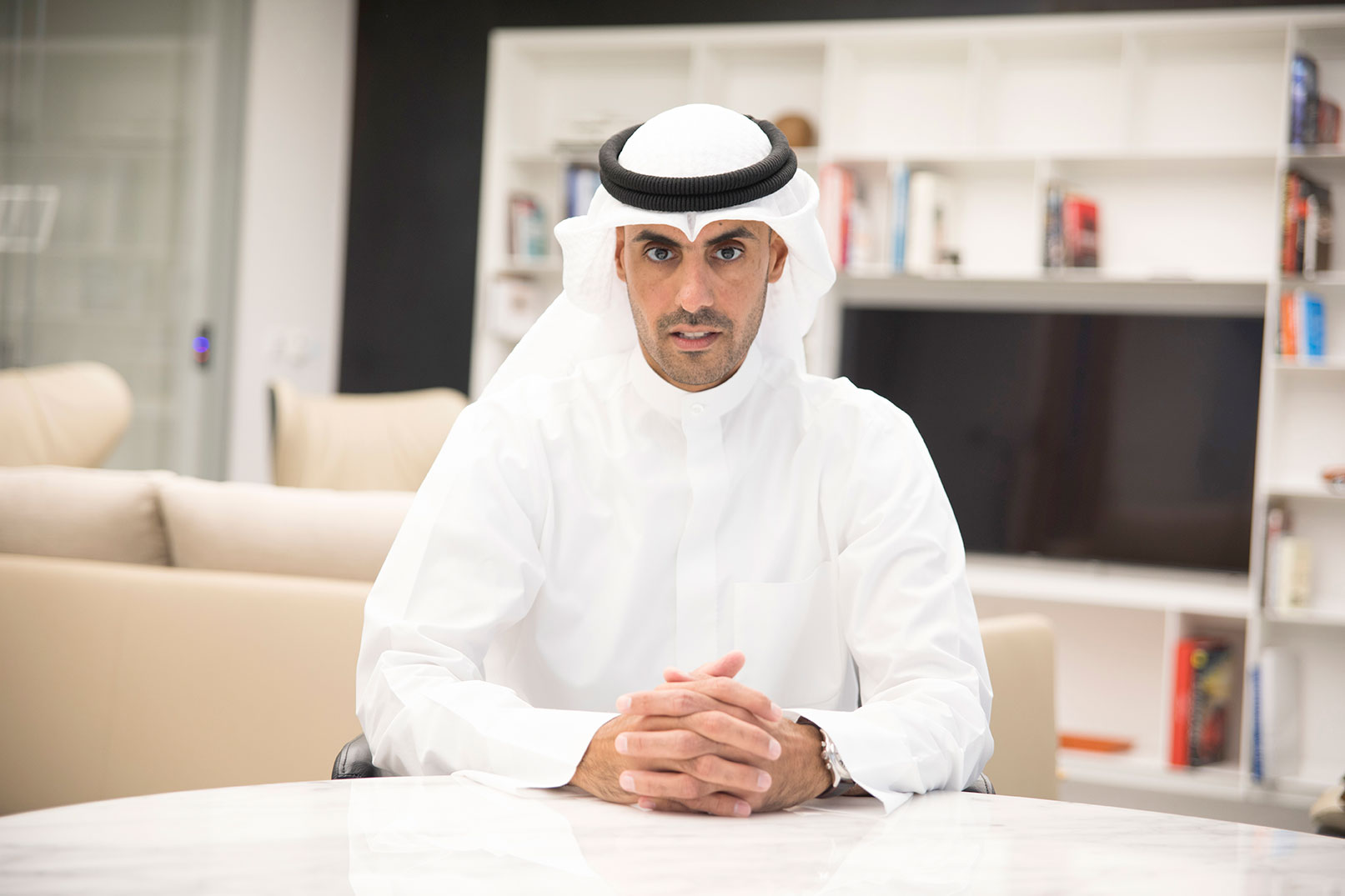
Zain Vice Chairman and Group CEO Bader Al-Kharafi discusses the Group’s evolution beyond connectivity into a regional digital growth platform, the capital discipline behind new growth businesses, the role of AI and fintech in value creation, and Kuwait’s potential as a base for digital capabilities that can scale across regional markets.
- Zain’s transformation into a leading TechCo is a success story.
- Every dollar invested in all aspects of the business is thoroughly scrutinized to ensure it makes commercial sense and supports the Zain cause.
- Growth, however, must remain measured and market-specific.
- AI at Zain is an economic program first and a technology program second.
- We are acutely aware that elevated risk can be accompanied by outsized opportunity.
- Kuwait can serve as both a proving ground and a launchpad for regional digital innovation.
 Zain is moving further beyond the traditional boundaries of telecommunications, building a broader regional platform spanning ICT, digital infrastructure, fintech, cloud, cybersecurity, entertainment and digital ventures. Across its eight-market footprint serving approximately 52 million customers, connectivity remains the foundation, while the Group is increasingly focused on integrating and scaling new business verticals that can strengthen the core and generate sustainable returns.
In this interview with Al Masaref, Bader Al-Kharafi explains how Zain’s 4WARD strategy is shaping capital allocation, portfolio integration and responsible AI adoption; how the Group balances regional scale with local agility; and why Kuwait can serve as a proving ground and launchpad for digital innovation. He also reflects on the leadership, governance and operating disciplines required to preserve entrepreneurial speed while building long-term value.
FROM CONNECTIVITY TO A REGIONAL DIGITAL GROWTH PLATFORM
As telecommunications companies evolve beyond connectivity, what would define the successful transformation of Zain into a regional digital growth platform, and which financial and operational indicators should be used to measure that progress?
Zain’s transformation into a leading TechCo is a success story that academia will write about as a case study in the years to come. Our current ‘4WARD-Progress with Purpose’ corporate strategy accelerates and builds on the significant momentum and accomplishments made under the previous corporate strategy, 4SIGHT, which was introduced in 2019, and under which Zain emerged as a sustainable multi-core digital player, successfully transforming its fixed and mobile services, and expanding into a number of new business verticals including ICT, digital mobile operations, fintech, entertainment, Digital Infrastructure, Subsea and Cross-Border Connectivity, and more.
Across our eight-market regional footprint that serves approximately 52 million customers, Zain today is a diversified, scalable and customer-centric digital platform in which connectivity remains the foundation, while a growing share of value is created through these new business verticals. The objective is not simply to add new businesses, but to provide meaningful connectivity that creates systemic change by building an integrated portfolio that strengthens the core telecom service, creates cross-market synergies and generates sustainable returns for all stakeholders across the region.
Progress should therefore be measured through a balanced set of indicators: Socio-economic impact on the communities we serve, revenue growth and the increasing contribution of new business verticals; EBITDA performance and margin resilience; disciplined CAPEX and OPEX management; customer growth, digital adoption and engagement; improvements in customer experience and NPS; and the ability to scale successful products and platforms across multiple markets.
Zain’s ‘4WARD’ strategy already provides a clear framework for this journey by focusing on accelerating the core, expanding regional growth platforms, embedding AI, improving capital efficiency and creating long-term shareholder and societal value.
How does Zain allocate capital among its core network requirements and newer growth platforms such as data centers, cloud services, cybersecurity, fintech and digital ventures, and what return and strategic criteria must each investment meet?
Every dollar invested in all aspects of the business is thoroughly scrutinized to ensure it makes commercial sense and supports the Zain cause. Allocation of additional capital for core networks is undertaken by balancing the continued strength and resilience of current networks with selective investment in growth platforms that can expand the Group’s role in the digital economy. Core infrastructure remains fundamental because it supports service quality, customer experience and almost every digital solution built on top of the network. At the same time, areas such as data centers, cloud, cybersecurity, fintech and digital ventures are assessed for their ability to create new and scalable sources of growth across our various entities and markets. Each investment must demonstrate clear strategic fit, address a defined customer or market need, complement Zain’s existing capabilities and offer the potential to scale across its regional footprint. It must also meet disciplined financial and risk criteria, including a credible path to sustainable returns, capital efficiency, appropriate governance, regulatory feasibility and resilience under changing market conditions. This approach allows Zain to pursue innovation and diversification without compromising the stability of its core business or its commitment to long-term shareholder value.
As Zain’s digital businesses expand, how can the Group build an integrated portfolio of scalable and profitable services that complements and strengthens its core telecommunications business?
Since 2019, we have been building an integrated portfolio and our 4WARD strategy is accelerating the cohesiveness of our digital businesses, subsidiaries, platforms and strategic investments, rather than allowing them to operate as isolated businesses. This ecosystem spans all our operations, enterprise technology through ZainTECH and its specialist businesses; digital infrastructure through Zain Omantel International and TASC Towers; fintech through Bede, Zain Cash, Tamam and FOO; digital services through platforms such as Dizlee, Oodi and Yaqoot; as well as Zain Ventures, Zain Insure, and Zain Esports. The opportunity is to connect these capabilities through shared technology, data, APIs, customer identity, distribution, billing and go-to-market models, enabling services developed in one market or business to be adapted and scaled across the wider footprint. Each entity therefore has a clear role within the portfolio, whether strengthening the core, deepening customer relationships, opening new revenue pools or providing access to strategic capabilities and innovation. Disciplined portfolio management will remain essential, with investment focused on businesses that demonstrate strong demand, repeatable economics, regional scalability and a credible path to profitability, ensuring that expansion beyond connectivity reinforces the core telecommunications business and creates sustainable value across the Group.
What is the strategic rationale for Zain’s expansion in fintech digital services, and how can these activities complement the Group’s connectivity, customer data and distribution capabilities without creating disproportionate regulatory or financial risk?
As a customer‑centric business, our proposition is straightforward: what customers want and need, we ideate, build and deliver to an exceptional standard. Today, approximately 6.4 million customers transact through our fintech services, whether by holding a card, accessing a micro‑loan, or sending and receiving funds. In 2025, Zain’s fintech platforms processed more than 117 million transactions, with total transaction value exceeding USD 11 billion, underscoring the strength of our strategic rationale for entering this fast‑growing, life‑enhancing space.
Zain’s expansion into fintech is a natural extension of its role as a regional TechCo, allowing the Group to leverage its scale, trusted customer relationships, digital channels and extensive distribution footprint to widen access to payments, remittances, wallets, credit, microfinance and merchant services. The strategic value lies not only in creating new revenue streams, but also in deepening customer engagement, supporting financial inclusion and SME digitization, and embedding Zain more meaningfully into the everyday lives of consumers and businesses. These capabilities complement the core connectivity business through seamless mobile experiences, established billing and identity capabilities, responsibly governed customer insights and broader access to merchants, agents and service channels. Growth, however, must remain measured and market-specific, with compliance embedded from the outset through early engagement with regulators, continuous monitoring of regulatory developments, clear accountability and formal assessment of compliance gaps. Strong controls around data privacy, cybersecurity, digital onboarding, e-KYC, consumer protection and credit risk are essential, alongside partnerships with established banks, payment networks and other regulated ecosystem participants. A phased approach, aligned with the maturity of each market’s licensing framework and supported where appropriate by regulatory sandboxes, allows Zain to scale successful models without allowing regulatory or financial exposure to outpace the maturity of the business.
By mid-2026, Zain’s fintech footprint expanded to eight markets, making it the region’s largest fintech entity by presence.
AI, SCALE AND RESPONSIBLE INNOVATION
Where do you see artificial intelligence generating the greatest measurable value across the Group, in network optimization, customer experience, enterprise services, fraud management or operating efficiency, and what governance is required to manage model, data and ethical risks?
AI at Zain is an economic program first and a technology program second. Each of these mentioned areas of the business creates real value, but the more important point is how they connect to and impact each other, noting we measure AI by realized value and impact on society, not by the number of pilots launched. We realize that greatest value will come from treating AI as a Group-wide economic and operational program aligned to the key accelerators of our corporate 4WARD strategy which is built on four key accelerators: Customer Delight; Digital Zain; Purpose and Action; and Collaborative Growth; and our AI transformation exists to serve all four. Every AI initiative in our portfolio is prioritized by its contribution to those accelerators, with a defined economic, social impact or operational outcome attached.
Under Customer Delight, it can improve personalization, responsiveness, churn management and next-best-action capabilities. Under the Digital Zain accelerator, AI can deliver measurable gains through fault prediction, root-cause analysis, proactive maintenance and site-level energy optimization. Digital Zain can capture further value through workflow automation, fraud and anomaly detection, and more efficient shared services across functions such as finance, legal, procurement, compliance and audit. Each use case should be linked to a defined baseline and measured against clear value levers, including cost reduction, revenue growth and risk mitigation, with emphasis placed on realized benefits rather than the number of pilots launched. Through our ICT arm, ZainTECH and other partners we collaborate with, AI can strengthen Zain’s position as a Partner of Choice by expanding enterprise and government offerings across AI, cloud, analytics and cybersecurity.
On governance, we treat responsible AI as a condition of value, not a constraint on it. We are anchoring this in a Group Responsible AI Policy that sets binding principles across all our markets: ownership, model validation, human oversight, data privacy, bias assessment and continuous monitoring. All overseen through dedicated Group governance bodies and calibrated to the regulatory requirements of each market we operate in, converting this ambition into consistent execution across our operations that has sustainable and purposeful impact. This is essential because an AI system that cannot be trusted cannot scale, and one that cannot scale cannot create sustainable value.
Zain operates across markets with different economic conditions, currencies, regulations and customer needs. How can the Group capture regional economies of scale while retaining sufficient flexibility to compete effectively in each local market?
Since our first expansion in 2003, Zain has operated across multiple markets simultaneously, once reaching a peak presence of 23 countries across the Middle East and Africa. This breadth of exposure has endowed us with an unrivalled track record in adaptation and performance excellence. Regional scale creates the greatest value when Zain standardizes the capabilities that benefit from common investment while keeping market-facing decisions close to customers. A united operating model allows the Group to centralize shared technology platforms, cybersecurity and data standards, procurement, centers of excellence, product development and selected investment decisions, reducing duplication and accelerating the rollout of proven solutions across multiple markets. At the same time, local operations should retain sufficient flexibility to tailor execution to their regulatory, operational and market realities. This combination of Group-wide governance and local agility is already reflected in Zain’s approach of pairing regional capabilities and global partnerships with execution tailored to local market and regulatory realities. It enables Zain to capture economies of scale without imposing a uniform model that weakens local relevance, while maintaining consistent standards for risk, compliance, capital discipline and customer experience across the Group.
RESILIENCE ACROSS MARKETS
How do geopolitical uncertainty, currency volatility, energy costs and regulatory change influence investment decisions and portfolio management across the Group’s regional operations?
Zain has developed a distinctive expertise in navigating geopolitical and currency complexities, drawing on extensive experience in Sudan, South Sudan and Iraq over the past decade, and more recently in Kuwait and Bahrain amid the current crisis. Most recently, we secured a 25-year license in Syria, a high‑potential and promising market that has faced significant challenges in recent years.
We are acutely aware that elevated risk can be accompanied by outsized opportunity, and investment decisions across Zain’s footprint are evaluated on a risk-adjusted basis, with capital deployment reflecting the operating realities of each market rather than applying a uniform model. Geopolitical instability can affect business continuity, access to technology and the pace of execution, while currency depreciation and higher funding costs can weaken reported returns, asset values and cash generation. These factors increase the importance of staged investment, diversified funding sources, cost discipline, appropriate hedging and strong continuity planning. Energy costs similarly influence network design and infrastructure strategy, strengthening the case for shared infrastructure, remote monitoring, efficient power systems, hybrid solutions and renewable energy where viable. Regulatory change can alter costs, delay new services or reshape the viability of an investment, so regulatory feasibility, licensing clarity, compliance requirements and ongoing engagement with authorities must be considered from the outset. Portfolio management should therefore remain dynamic, with investments continually reassessed against changing market conditions, strategic relevance, resilience and their ability to generate sustainable long-term value.
KUWAIT AS A DIGITAL LAUNCHPAD
What role can Kuwait play as a base for developing digital capabilities, attracting technology talent and building solutions that Kuwaiti companies can scale and export across regional markets?
Our home market is a success story on every front. As the leading operator across all major KPIs, offering advanced 5G services and blessed with a rich and emerging pool of digitally savvy talent, Kuwait can serve as both a proving ground and a launchpad for regional digital innovation by combining advanced infrastructure, local private-sector expertise, academic institutions, global technology partnerships and sustained investment in talent.
The priority is to create an ecosystem in which Kuwaiti companies and entrepreneurs can develop solutions around real market needs, test their commercial viability, access technical expertise and investment, and then expand through regional partnerships and operating footprints. Zain Great Idea, the Group’s award-winning tech startup accelerator, provides a strong example of this model: launched in Kuwait, the accelerator has evolved into a regional platform across six markets, connecting founders with mentorship, advanced technology capabilities, venture investment, pilot opportunities and practical routes to market. Building a sustainable pipeline also requires closer collaboration between education and industry, from early training in coding, AI and cybersecurity to university programs that expose students to real business challenges and help turn prototypes into viable products or ventures. With the right combination of talent, capital, market access and technology partnerships, Kuwait can develop capabilities locally while enabling its companies and innovators to scale solutions across the Middle East and beyond.
CAPITAL AND PORTFOLIO DISCIPLINE
What criteria guide Zain’s decisions to build a new capability internally, enter a strategic partnership, acquire an existing business or exit an investment that no longer meets the Group’s objectives?
Over our 40‑year track record of success, Zain has consistently and deliberately weighed the strategic options of building, partnering, acquiring or exiting. From the sale of Zain Africa operations in 2010, to the merger of Zain and Omantel’s wholesale carrier businesses, the establishment of ZainTECH and the acquisition of several entities to complement its growth ambitions, and most recently the strategic partnership with Ooredoo to create the region’s largest TowerCo infrastructure entity, each represents a shareholder value‑accretive decision.
Generally, decisions are guided by strategic fit, speed to market, access to capabilities, scalability and the quality of long-term returns. Internal development is most appropriate when a capability is central to competitive differentiation, can leverage the Group’s existing assets and talent, and has the potential to scale across multiple markets. Strategic partnerships are better suited to situations where they provide faster access to specialized expertise, technology, distribution or new markets without requiring full ownership, reflecting our 4WARD strategy’s emphasis on deeper alliances to accelerate innovation and market access. Acquisitions become relevant where they can shorten the path to scale, add proven capabilities or customer relationships, and integrate effectively with Zain’s operations, technology subsidiaries and digital ventures. Equally, portfolio discipline requires investments to be reassessed when strategic relevance weakens, expected synergies do not materialize, scalability is limited, risk becomes disproportionate, or capital can generate greater value elsewhere. The objective is not to own every capability, but to select the model that best strengthens the wider ecosystem, improves capital efficiency and creates sustainable value for customers, shareholders and communities.
LEADERSHIP, CULTURE AND LONG-TERM VALUE
What organizational capabilities, leadership behaviors and incentive structures are required to preserve entrepreneurial speed while maintaining capital discipline, accountability and operational control across a large regional group?
We firmly recognize that leadership capabilities and entrepreneurial culture are key to Zain’s future sustainability. The required balance begins with an operating model that combines clear Group-wide guardrails with empowered teams, explicit decision rights and proportionate governance. New initiatives need room to move quickly, supported by cross-functional teams, access to shared technology and expertise, and stage-gate reviews that test customer demand, strategic fit, risk, scalability and capital requirements without creating unnecessary bureaucracy. Leadership must provide clear direction, encourage informed experimentation, address challenges early and remain willing to redirect resources when evidence no longer supports an initiative. This is reinforced by a culture that promotes collaboration, customer centricity and innovative problem-solving through internal programs such as UNITY, which embeds purpose into Zain’s culture, and ZAINIAC, our innovation platform for developing and advancing employee ideas. Accountability should be maintained through transparent ownership, common performance dashboards and incentives that recognize execution, collaboration, customer outcomes, capital efficiency and the practical application of new capabilities, rather than rewarding growth alone. Zain’s Inclusion, Diversity and Equity University IDEU, developed in partnership with IE University, further supports this model by educating 2,000 Zain employees, building digital fluency, adaptability and transformation leadership across functions and markets. Its mobility, peer-support, recognition and performance-tracking mechanisms help translate learning into measurable business contribution.
Excluding financial-related metrics, what would you consider Zain’s major successes and milestones over the last 12 months?
As a responsible, inclusive and purpose-driven regional TechCo, our progress across people, planet and governance has stood out. External validation from distinguished organizations such as MSCI, CDP, Forbes and Global Child Forum has reinforced Zain Group’s standing across the markets and communities it serves.
Our MSCI ESG rating was upgraded from BBB to A in September 2025, with a perfect 10/10 environmental score. Zain also achieved CDP Climate Change 2025’s top A score, placing it among the top 12% of global telcos and making it the region’s only telecom operator at this leadership level.
In parallel, Zain ranked first in the regional telecom sector, first in Kuwait and among the top three employers in the Middle East on Forbes’ World’s Best Employers 2025 list.
Zain was also ranked top company in the region across all sectors in Global Child Forum’s 2025 Benchmark, scoring 8.5/10 and 10/10 in Governance & Collaboration.
Furthermore, Kuwait set a Guinness World Records title with the farthest intercontinental remote robotic surgery over 12,000 km to Brazil, affirming Kuwait’s leadership in medicine with advanced connectivity infrastructure, all in service of human health. With its advanced infrastructure, Zain is contributing to the nation’s vision to propel the growth of digital medicine across the region.
Overall, the Group’s transformation to a TechCo has contributed immensely to Zain’s brand value to currently stand at more than US$4 billion, according to the Brand Finance 2026 rankings, a 100% increase from its 2020 valuation. The company’s appealing marketing activities, customer centricity and commitment to its values and the community, along with its purpose-driven focus on sustainability, inclusion, diversity, and equity powered by innovation, are key drivers for the Zain brand’s value success.
Abdulaziz Yacoub Al-Babtain - CEO, Ooredoo Kuwait Kuwait has important strengths: a digitally engaged population, sophisticated consumers, a strong financial sector, strategic regional connections and the capacity to mobilise investment.
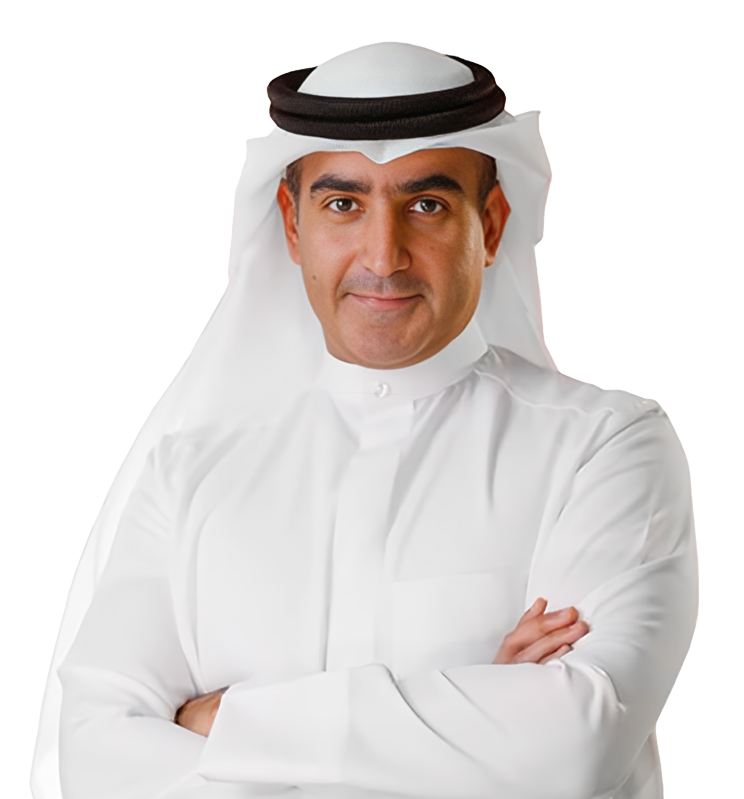
Ooredoo Kuwait CEO Abdulaziz Yacoub Al-Babtain discusses how the company’s RISE strategy is reshaping its role from connectivity provider to technology partner — and how digital infrastructure, AI, cybersecurity, talent and strategic partnerships can help Kuwait build a more competitive, productive and globally connected digital economy.
Ooredoo Kuwait is moving from being primarily a provider of connectivity to becoming a customer-first technology partner that combines networks, cloud, cybersecurity, data and AI into solutions that solve real problems. In practical terms, the company is focusing on three shifts: from products to outcomes, from isolated channels to seamless customer journeys, and from traditional telecom growth to a more diversified digital business model, while continuing to invest in the infrastructure Kuwait needs.
In this interview with Al Masaref, Abdulaziz Yacoub Al-Babtain, CEO of Ooredoo Kuwait, discusses how advanced 5G networks, cloud computing, data centres, IoT and AI can work together to improve productivity, accelerate services and enable new business models; Ooredoo’s role as a technology partner to banks and financial institutions; and the growing importance of cybersecurity, digital infrastructure, talent and investment. He also explains Ooredoo’s role as an enabler and an integrator, bringing the right technologies and partners together to convert digital ambition into measurable economic outcomes.
REDEFINING THE CUSTOMER AND TECHNOLOGY MODEL
Ooredoo Kuwait’s RISE strategy aims to transform the company into a customer-first technology company while strengthening its position in digital infrastructure. What does this transformation mean in practical terms for Ooredoo’s business model and strategic priorities over the coming years?
RISE is more than a strategy for adapting to change; it is our commitment to help shape the next chapter of Kuwait’s digital economy. The telecom industry has reached a defining moment. Connectivity remains fundamental, but leadership can no longer be measured by network performance alone. It must be measured by the value we create for customers, enterprises and the country. For Ooredoo Kuwait, that means moving from being primarily a provider of connectivity to becoming a customer-first technology partner that combines networks, cloud, cybersecurity, data and AI into solutions that solve real problems.
In practical terms, we are focusing on three shifts: from products to outcomes, from isolated channels to seamless customer journeys, and from traditional telecom growth to a more diversified digital business model. We will continue investing in the infrastructure Kuwait needs, while becoming more disciplined about where we can differentiate, build partnerships and generate sustainable returns. My responsibility as CEO is to make RISE tangible not only in our plans, but in the experience of a customer, the productivity of a business and the capability of our people. The ambition is clear: we want Ooredoo to be a company that does not simply respond to the future of our industry, but helps define it.
Ooredoo Kuwait has been accelerating the shift toward a more integrated digital customer experience through expanded self-service capabilities, eSIM adoption and new digital platforms for both consumers and businesses. How is this changing the way customers engage with Ooredoo, and what will define the next phase of the customer experience?
Customers do not judge their experience by our internal systems; they judge it by how effortlessly they can get things done. Whether someone joins Ooredoo through eSIM, manages a service digitally or seeks support, they should feel that we understand their needs and respect their time. Self-service is important, but digital transformation is not about transferring work to the customer. It is about removing friction, giving customers control and making help available when it matters.
The next phase is a shift from digital transactions to intelligent, proactive engagement. We want to use data responsibly to anticipate needs, offer more relevant choices and resolve issues before they become frustrations. That also means maintaining a human touch: complex or sensitive situations should never become more difficult because of automation. Our goal is a consistent experience across the app, contact centre, stores and enterprise channels. If we do this well, the strongest outcome will not be higher digital adoption alone; it will be trust, loyalty and a relationship with Ooredoo that grows stronger over time.
POWERING KUWAIT’S DIGITAL ECONOMY
As Ooredoo continues to invest in 5G Advanced, cloud computing, data centres and IoT, how do you see these technologies contributing to Kuwait’s broader digital transformation and enhancing the competitiveness and productivity of the private sector?
I see these technologies as elements of one economic platform, not separate investment categories. Advanced 5G networks provide speed and low latency; cloud and data centres create the capacity to process information securely; IoT connects assets and operations; and AI can turn the resulting data into decisions. Their real value emerges when they work together to improve productivity, accelerate services and enable new business models.
For Kuwait, the opportunity is especially compelling in sectors such as energy, logistics, financial services, healthcare and government. A connected operation can monitor equipment, reduce downtime and use resources more efficiently. A cloud-enabled enterprise can innovate faster without building every capability itself. But infrastructure alone does not produce transformation. It requires practical use cases, industry partnerships, digital skills and an environment that supports investment. Ooredoo intends to play the role of an enabler and an integrator bringing the right technologies and partners together to convert digital ambition into measurable economic outcomes.
The banking and financial sector is among the most dependent on secure connectivity, cloud computing, data centers and cybersecurity, while the convergence of telecom, financial services and digital payments continues to accelerate. How do you see Ooredoo’s role evolving as a technology partner to banks and financial institutions in Kuwait, and what opportunities do you see for new partnership models that can enhance digital financial services and customer experiences?
The financial sector is among the clearest examples of why telecom operators must evolve into trusted technology partners. Banks need much more than bandwidth. They require resilience, secure digital infrastructure, dependable service, sophisticated cybersecurity and the agility to introduce new customer experiences. Our opportunity is to support that full technology foundation while respecting the rigorous requirements of the financial industry.
I see significant potential for partnership models built around secure connectivity, cloud and data-centre services, cyber resilience, digital identity-related capabilities where appropriate, and integrated customer propositions. We are also interested in partnerships that make digital services more accessible and relevant, particularly for younger customers and digitally native businesses. The principle is collaboration, not competing for the sake of it: financial institutions bring deep financial expertise and customer relationships, while Ooredoo brings technology platforms, distribution capabilities and digital reach. Together, we can create propositions that are simpler, safer and more valuable for customers. The partnerships that succeed will be the ones designed around a shared business outcome rather than a collection of disconnected products.
Small and medium-sized enterprises are a key pillar of private-sector growth and economic diversification. How can Ooredoo’s technology and digital solutions help SMEs improve productivity, reduce the cost of digital transformation, and access new markets and business opportunities?
SMEs should not need the budget or technical resources of a large corporation to benefit from digital transformation. In fact, technology should help level the playing field. Our role is to simplify the journey: provide reliable connectivity and security as a foundation, then make cloud applications, collaboration tools, managed services and practical AI solutions available in manageable, scalable offerings.
For a small business, the question is not whether it has adopted the latest technology. It is whether it can serve more customers, control costs, protect its operations and grow beyond its existing market. That is why I believe in solutions that can be deployed quickly, priced transparently and supported end to end. We also see value in working with technology partners and local innovators to make sophisticated capabilities usable for smaller businesses. Kuwait’s diversification will be driven not only by major projects but by thousands of ambitious businesses becoming more productive and competitive. Enabling that growth is both a commercial opportunity and a national responsibility.
AI, CYBER RESILIENCE AND TRUST
Artificial intelligence is becoming an increasingly important part of Ooredoo Kuwait’s transformation agenda and its portfolio of business solutions. Where is AI already creating tangible value today, and where do you expect its greatest impact to emerge, both within Ooredoo and in the solutions offered to enterprise customers?
AI is moving from an experimental technology to a fundamental capability across business. At Ooredoo, we see opportunities to apply it to customer care, network and service operations, commercial decision-making and employee productivity. Used properly, AI can help teams detect issues earlier, understand customers better, reduce repetitive work and make faster, more informed decisions. The objective is not automation for its own sake; it is better outcomes, with people remaining accountable for important decisions.
For enterprise customers, the opportunity is even broader. Businesses want to move beyond demonstrations to use cases that deliver measurable value for example, improving knowledge management, streamlining documents and workflows, supporting service teams or analysing operational information. Our strategic role is to bring together connectivity, computing infrastructure, cybersecurity, industry understanding and a strong ecosystem of technology partners. I believe the winners in AI will not be the companies that talk about it most loudly. They will be those that make it useful, secure, accessible and economically viable at scale. That is the standard we are setting for ourselves.
As businesses and public institutions become increasingly digitally connected, cybersecurity, data protection and operational resilience are becoming more critical. How is Ooredoo strengthening its capabilities in these areas, and how can it help Kuwaiti institutions address increasingly sophisticated digital risks?
As Kuwait digitises more essential services, security and resilience become economic priorities, not simply IT considerations. Every new connection creates opportunity, but it also expands the responsibility to protect data, services and public confidence. This is why we approach cyber resilience as an integral part of how infrastructure and digital solutions are designed and operated, not as an optional feature added later.
Our direction is to strengthen the combination of secure connectivity, resilient infrastructure, managed security capabilities and partnerships with specialist technology providers. For customers, this means looking beyond a single security product to the full operating environment: prevention, monitoring, response, recovery and business continuity. Just as importantly, organisations need clear governance and skilled people to manage increasingly sophisticated threats. Trust is difficult to earn and easy to lose. As a national digital enabler, Ooredoo must lead by treating security, data governance and protection, and operational resilience as foundations of growth.
Advanced networks, data centers and new digital technologies require substantial and continuous capital investment. How do you balance investing ahead of future demand with the need to generate sustainable returns, and what could further strengthen Kuwait’s environment for private investment in digital infrastructure?
Infrastructure leadership requires conviction, but it also requires investment discipline. If we wait until demand is fully visible, we risk constraining innovation; if we invest without a clear path to utilisation and value creation, we risk weakening the economics of the sector. The right balance comes from a long-term view of demand, phased deployment, careful capital allocation and partnerships that accelerate adoption.
We evaluate investments not only on technological advancement but also on the customer and national value they can unlock. That includes the ability to support new enterprise workloads, improve network efficiency, grow digital services and generate sustainable returns. Kuwait can further encourage private investment through regulatory predictability, efficient access to infrastructure and sites, clear frameworks for emerging technologies, and opportunities for meaningful public-private collaboration. A strong digital economy is not built by investment alone; it is built when infrastructure, policy, skills and market demand advance together. Our role is to invest responsibly while helping create the ecosystem that makes those investments productive.
INVESTMENT, TALENT AND LONG-TERM CAPABILITY
Ooredoo’s strategy also places emphasis on developing talent and future skills. Which capabilities will be most important as Kuwait’s economy becomes increasingly technology-driven, and how is Ooredoo contributing to the development of national talent and digital skills?
The most valuable skill in a rapidly changing technology economy is the ability to keep learning. Of course, Kuwait needs specialists in AI, cloud, cybersecurity, data engineering and advanced networks. But it also needs people who can translate technology into business value, leaders who understand customers, manage change, work across disciplines and make responsible decisions. Technology expertise without commercial and human understanding is not enough.
For Ooredoo, developing talent is part of our growth strategy, not a separate corporate initiative. We want to expand learning opportunities, develop future leaders, expose employees to new technologies and work with education and ecosystem partners to support national capabilities. That also means creating an environment where new ideas can be tested and where people feel empowered to challenge established ways of working. I have always believed that transformation is ultimately a leadership and people agenda. Networks can be upgraded through investment; a culture of curiosity, accountability and innovation must be built every day.
KUWAIT’S DIGITAL COMPETITIVE EDGE
- Looking at Kuwait’s digital economy as a whole, what do you see as its strongest competitive advantages, and what more is needed to translate those strengths into greater international technology investment, private-sector growth and economic diversification?
Kuwait has important strengths: a digitally engaged population, sophisticated consumers, a strong financial sector, strategic regional connections and the capacity to mobilise investment. These give us a credible platform from which to develop a more competitive digital economy. The opportunity now is to turn those advantages into an environment where technology businesses can build, scale and export their capabilities.
That will require greater alignment across policy, infrastructure, education and industry. International investors look for clarity, talent, a reliable operating environment and credible routes to market. Local businesses need access to advanced technology, funding, skills and customers. Government and the private sector have complementary roles in creating those conditions. My conviction is that Kuwait should aim higher than being a consumer of technology; it can become a creator, adopter and regional platform for digital value. Under RISE, Ooredoo Kuwait intends to contribute to that ambition as an active industry leader, investing in the right foundations, building partnerships that matter and demonstrating that technology-led growth can deliver real outcomes for the country.
- We want Ooredoo to be a company that does not simply respond to the future of our industry, but helps define it.
- The next phase is a shift from digital transactions to intelligent, proactive engagement.
- Ooredoo intends to play the role of an enabler and an integrator bringing the right technologies and partners together to convert digital ambition into measurable economic outcomes.
- The partnerships that succeed will be the ones designed around a shared business outcome rather than a collection of disconnected products.
- Kuwait’s diversification will be driven not only by major projects but by thousands of ambitious businesses becoming more productive and competitive.
- The winners in AI will be those that make it useful, secure, accessible and economically viable at scale.
- As a national digital enabler, Ooredoo must lead by treating security, data governance and protection, and operational resilience as foundations of growth.
- A strong digital economy is not built by investment alone; it is built when infrastructure, policy, skills and market demand advance together.
- The most valuable skill in a rapidly changing technology economy is the ability to keep learning.
EDWARD WANG - CEO Huawei Kuwait Kuwait Has All the Ingredients Necessary to Become One of the Leading Intelligent Banking Markets in the GCC

- AI-driven banking will reshape financial services in the next five years.
- Agentic AI is emerging as a critical driver shaping the next generation of intelligent banking.
- The «Bank of the Future» cannot run on yesterday›s hardware.
- The best intelligent infrastructure experience is one customers never notice because it is always available.
- Digital transformation is never a one-off project. It is a journey of continuous evolution.
- Infrastructure first: Build intelligent, AI-ready infrastructure before building AI products.
- We are dedicated to being a long-term strategic partner in Kuwait›s journey towards becoming a leading intelligent financial hub in the GCC
 Huawei Kuwait CEO Edward Wang discusses why Kuwait is well positioned for the next phase of intelligent banking, as Agentic AI, sovereign data infrastructure,
AI-ready computing, resilience and long-term technology partnerships reshape the financial sector.
Kuwait’s banking sector is entering a new phase of digital and intelligent transformation. Huawei sees the market’s regulatory strength, capitalisation, liquidity, digital adoption and cybersecurity capabilities as a foundation for accelerating the move towards enterprise-scale AI and more intelligent financial infrastructure.
In this interview with AlMasaref, Edward Wang, CEO of Huawei Kuwait, sets out the technology trends he believes will define banking over the next five years, from Agentic AI and sovereign cloud infrastructure to operational resilience, data governance and new models of collaboration between banks and technology companies. He also explains where Huawei sees opportunities to support Kuwait’s ambitions under Vision 2035 and its evolution into a leading intelligent financial hub in the GCC.
COMPANY PROFILE
Company Profile: Huawei Technologies Kuwait was registered under the Kuwait Direct Investment Promotion Authority (KDIPA) as a local entity in the year of 2015.
Since then, Huawei Kuwait has focused its efforts on several domains such as 5G, Financial Intelligence, Government Digitalization, and Smart Cities, collaborating closely with local partners to drive the realization of the Kuwait Vision 2035.
OPENING STATEMENT
On behalf of Huawei Kuwait, we are honored to participate in this dialogue with the Kuwait Banking Association. Deeply rooted in the financial industry for over 16 years, Huawei stands apart from traditional ICT vendors. We combine China›s banking digital and intelligent transformation experience with our deep history of collaboration with global banking customers. Through the establishment of the Financial Services Industry (FSI) Business Unit, we bring together ecosystem partners to jointly develop financial-grade, end-to-end solutions ranging from resilient infrastructure, data platforms, private cloud, AI computing power, to upper-layer applications. By the end of June 2026, Huawei had served over 7,100 financial customers in more than 80 countries and regions, including 54 of the world›s top 100 banks. We believe Kuwait›s banking sector stands at a uniquely promising inflection point—one where intelligent infrastructure, sovereign data capability, and AI-driven services can redefine the competitive landscape both regionally and internationally.
The following responses reflect our global expertise, regional footprint across the Gulf Cooperation Council (GCC), and deep commitment to building long-term partnerships with Kuwaiti financial institutions.
FROM DIGITAL BANKING TO AGENTIC BANKING
The banking industry is entering a new era shaped by artificial intelligence, cloud computing, and digital ecosystems. From Huawei›s perspective, what are the most significant technology trends that will redefine banking over the next five years?
As observed globally, banks are currently at a stage where digitization and intelligence are advancing in parallel. AI-driven banking will reshape financial services in the next five years.
Agentic AI is emerging as a critical driver shaping the next generation of intelligent banking. AI is evolving from an assistive tool into an advanced productive force capable of autonomous task orchestration and execution. On one hand, it is accelerating the deep digitalization of finance, enabling a leap from the digital economy to the real-time economy. On the other hand, it further drives deep intelligence, ushering in the new Agentic Banking model where «every user has a super steward and every employee has a super avatar.»
- Redefining user experience from Graphical User Interface (GUI) to Language User Interface (LUI): Enabling intent- and memory-driven hyper-personalization.
- Transforming human-machine collaboration: Building adaptive, dynamic business processes through agent collaboration.
- Reinventing business decision-making: Shifting from «rules + data» to «ontology + knowledge» to enable forward-looking risk control and operations.
Banks across the GCC are accelerating their digital transformation agendas. How do you assess the current maturity of the Kuwaiti banking sector compared to regional and international benchmarks?
Kuwait boasts one of the most stable, liquid, and heavily capitalized banking sectors in the region. Kuwait›s strong regulatory environment under the Central Bank of Kuwait, combined with high smartphone penetration and a young, digitally-native population, creates ideal conditions for an accelerated digital leap. As a result, the market is characterized by a highly deliberate, policy-led transformation rather than reckless disruption.
Kuwait is actively closing the gap with global benchmarks while emerging as a regional leader in certain areas such as regulatory frameworks, mobile and digital banking, and cybersecurity.
The next stage of maturity is likely to focus on:
- AI & data adoption at enterprise scale
- Business continuity (resilience) enhancement.
- Cloud-native modernization.
- Open ecosystem collaboration.
In our view, Kuwait has all the ingredients necessary to become one of the leading intelligent banking markets in the GCC.
AI, RESILIENCE AND SOVEREIGN INFRASTRUCTURE
Artificial intelligence has become a strategic priority for financial institutions worldwide. What practical AI applications are already delivering measurable value for banks today, and where do you see the next wave of adoption emerging?
Focusing on high-value scenarios is critical to successful AI implementation. Therefore, we are prioritizing four major domains:
- Intelligent interaction
- Efficient operations
- Intelligent risk control
- Revenue growth
We have launched nine AI agent solutions with our partners. Notably, AI-driven applications such as anti-money laundering (AML), anti-fraud, intelligent risk control, intelligent operations, AI workflow, and customer marketing have been successfully deployed in top banks globally and across the GCC region, bringing significant improvements in efficiency and value.
As banks increasingly rely on digital infrastructure, resilience and cybersecurity have become board-level concerns. How is Huawei supporting financial institutions in strengthening operational resilience while maintaining innovation and agility?
Building digital infrastructure with «4 Zeros» of comprehensive resilience and security in the AI era has always been a key part of Huawei›s value proposition for the financial industry.
From traditional data centers (DCs) to cloud DCs, and further to AIDCs, resilience remains an indispensable foundation for financial institutions. Anchored by its «4 Zeros» resilience value proposition and the product framework of the R-A-A-S solution, Huawei has comprehensively upgraded its architecture, solutions, and infrastructure. By delivering cutting-edge capabilities that span disaster recovery (DR) consulting, intelligent traffic scheduling, and heterogeneous DR, Huawei upgrades active-active DR capabilities to a premium level. Facing the AI computing era, Huawei is further constructing a converged general-purpose and AI computing resilience architecture. Through its AIDC integrated inference and full-lifecycle intelligent DC O&M solutions, Huawei empowers global financial institutions to fast-track AI innovation while building future-proof, resilient infrastructure.
Remarks: 4 Zeros is Zero-Trust, Zero-Wait, Zero-Downtime, Zero-Touch.
Data sovereignty, privacy, and regulatory compliance remain critical considerations for the banking sector. How can banks balance innovation with the growing requirements surrounding data governance and security?
In Kuwait, compliance and data governance are fundamental priorities for financial institutions. As banks accelerate intelligent transformation, they need to balance innovation with regulatory requirements, data security, and operational resilience.
Therefore, in the era of intelligent transformation, fast innovation that meets data and security requirements cannot rely on traditional architecture and technology.
Huawei›s architecture offers a purpose-built response to this through Sovereign Cloud Infrastructure:
Local Cloud Stacks: We enable banks to deploy cloud-native capabilities (like containerization and microservices) entirely within their own on-premise data centers or localized, compliant cloud nodes.
Data Governance Architecture: Data platforms have evolved from lakehouse architecture to data-AI convergence, while the data consumption experience has shifted from manual analysis to Agentic automated analysis. To facilitate this data upgrade for customers, Huawei has constructed the R-A-C-E data capability framework, encompassing Real-time processing, All-domain data, Converged platform, and Experience-driven.
Security Architecture: Huawei solutions feature end-to-end encryption. Even as data moves across open banking APIs, it remains strictly ring-fenced under a Zero Trust framework.
The concept of intelligent infrastructure is becoming central to future banking models. How do technologies such as AI-ready data centers, cloud platforms, and advanced connectivity contribute to building the bank of the future?
The «Bank of the Future» cannot run on yesterday›s hardware. It requires a cohesive, high-performance physical and digital nervous system:
Huawei›s vision encompasses multiple layers:
AI-Ready Data Centers: Huawei SuperPoD offerings provide hyper-dense, liquid-cooled AI computing clusters that allow Kuwaiti banks to run localized Arabic financial models efficiently and sustainably.
Intelligent Sovereign Cloud Platform: Moving to a cloud-native, distributed core replaces rigid silos with a flexible pool of computing power and achieves %99.999 high availability.
Data Intelligence Foundation: Huawei›s data intelligence platform unifies data governance, real-time analytics, AI model management, and regulatory reporting into a single, integrated environment — eliminating data silos that plague most banks.
Advanced Connectivity: Xinghe Intelligent Financial Network ensures ultra-low latency between bank branches, headquarters, local data centers, and ecosystem partners, guaranteeing a seamless, zero-wait user experience for end consumers.
Our philosophy is simple:
The best intelligent infrastructure experience is one customers never notice because it is always available.
GLOBAL LESSONS AND STRATEGIC PARTNERSHIPS
Huawei works with financial institutions across multiple markets. What are some of the most successful international banking transformation initiatives you have observed, and what lessons could be relevant for banks in Kuwait?
As a strategic partner for financial institutions in the global market, we are delighted to share two case studies to serve as a reference for banks in Kuwait:
Case 1: Intelligent transformation journey of a leading Chinese commercial bank
This Bank embarked on its digital transformation journey as the financial industry entered the era of digitalization and intelligent transformation. Through long-term strategic cooperation with Huawei, the Bank continuously advanced its transformation across multiple areas, including resilient infrastructure, data platforms, core system modernization, and intelligent applications.
Throughout this journey, the Bank focused on building a solid technology foundation to support continuous business innovation. By strengthening real-time data capabilities, modernizing its IT architecture, and exploring AI-enabled scenarios, the Bank has enhanced customer experience, operational efficiency, and overall service capabilities.
Key Takeaways:
The transformation journey of leading banks demonstrates that digital and intelligent transformation requires clear strategic direction, continuous technology evolution, and long-term collaboration with ecosystem partners. Financial institutions need to proactively build future-ready capabilities rather than respond only to immediate business demands.
Case 2: Rapid AI adoption by a leading bank in the GCC
As a leading financial institution in the GCC region, the Bank has embraced an open and collaborative approach in the era of intelligent transformation, actively learning from global industry practices and exploring new technology opportunities.
Through strategic cooperation with Huawei, the Bank has introduced scenario-based AI solutions to enhance operational efficiency and improve user experience. By applying intelligent technologies to key business processes, the Bank has accelerated workflow optimization, strengthened operational capabilities, and supported its ongoing journey toward intelligent transformation.
Key Takeaways:
Financial institutions in the GCC region can benefit from closer collaboration with global technology ecosystems and industry partners. By combining local market insights with global best practices, banks can accelerate innovation, enhance competitiveness, and build sustainable capabilities for the future of finance.
Collaboration between banks and technology providers is evolving beyond traditional vendor relationships. How do you envision strategic partnerships between financial institutions and technology companies in the coming years?
The era of transactional «buyer-vendor» relationships is evolving. Rather than purchasing isolated hardware and managing integration independently, leading banks are increasingly seeking integrated, outcome-driven partnerships.
Digital transformation is never a one-off project. It is a journey of continuous evolution. Therefore, financial institutions must shift from fragmented purchasing to choosing strategic partners who can accompany you throughout the journey and provide global best practices, an open ecosystem, and long-term commitment.
We are actively driving this shift through our upgraded RONGHAI global partner ecosystem. Transcending traditional, fragmented vendor relationships, this ecosystem unites over 180 elite financial solution partners—including industry leaders like Temenos and Sunline—to establish a cohesive, collaborative foundation for the financial sector.
Anchored by this robust ecosystem and our high-performance ICT infrastructure, we have introduced the innovative «4-Win» collaboration model to redefine technology partnerships in modern finance. Under this framework, we co-develop solutions with top-tier Independent Software Vendors (ISVs), encompassing both agile local players in regional markets and global vendors with strong cross-border capabilities. Empowered by our global sales and service platform, these ISVs unlock vast worldwide market opportunities while injecting fresh business scenarios into the ecosystem. Concurrently, System Integrators (SIs) capitalize on their deep regional expertise to deliver localized deployment for ISVs, sparking new avenues for digital transformation. In return, the integration of cutting-edge ISV products significantly expands the service portfolios of our SI partners.
Ultimately, this highly synergistic ecosystem accelerates innovation and guarantees a true four-way win: delivering agile new solutions to financial institutions, unlocking new markets for ISV partners, providing enriched offerings for SI partners, and driving new capabilities for technology platforms.
KUWAIT’S NEXT PHASE OF INTELLIGENT BANKING
Looking ahead, what opportunities do you see for deeper cooperation between the Kuwaiti banking sector and global technology leaders in areas such as digital banking, AI, fintech innovation, and smart financial ecosystems?
We see three priority areas where Huawei can contribute meaningfully to Kuwait›s banking sector ambitions aligned with Kuwait Vision 2035:
AI Era›s sovereign infrastructure: Build sovereign, regulated infrastructure dedicated to financial institutions.
Kuwaiti FinTech ecosystem development: Connect Kuwaiti banks with our global network of FinTech partners for accelerated co-development.
Launching an AI talent development program: Over the next three years, Huawei aims to cultivate more than 10,000 interdisciplinary «Finance + AI» experts for the global financial industry.
If you were advising banking leaders today, what would be the three most important priorities they should focus on to successfully navigate the next phase of digital and intelligent transformation?
Drawing on Huawei›s experience supporting global financial institutions at different stages of transformation, we would advise banking leaders in Kuwait to focus on the following three imperatives:
Infrastructure first: Build intelligent, AI-ready infrastructure before building AI products.
Talent leadership: Lead on talent, not just technology.
Lifecycle partnership: Choose a strategic partner who can accompany you throughout the full lifecycle of transformation.
CLOSING REMARKS
Huawei›s commitment to Kuwait›s banking sector extends beyond technology provision. We are dedicated to being a long-term strategic partner in Kuwait›s journey towards becoming a leading intelligent financial hub in the GCC.
We invite the Kuwait Banking Association and its member institutions to engage with us in co-designing Kuwait›s financial future—one built on sovereign data infrastructure, inclusive AI, and world-class cybersecurity.
We look forward to a productive and enduring partnership.
ESAM ALKHESHNAM - CEO, The Shared Electronic Banking Services Company (KNET) Kuwait’s Digital Payment Infrastructure: A Strong Foundation for Innovation and Economic Growth
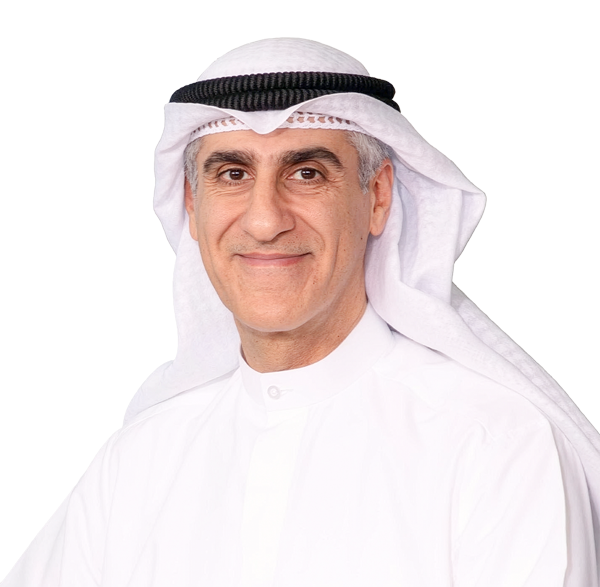
- Payments today are no longer simply a means of moving money—they are a critical component of national digital infrastructure.
- We are focused on ensuring that Kuwait’s payment infrastructure remains resilient, scalable and secure.
- Fraud prevention is most effective when it is treated as a shared responsibility across the entire payments ecosystem.
- Effective AI must be supported by strong governance, robust data protection, regulatory compliance and continuous model refinement.
- Closer technical integration between national payment infrastructures represents one of the most important opportunities for the region.
Our objective is to create an ecosystem where innovation can scale securely and consistently across the industry.
 KNET CEO Esam Alkheshnam discusses how Kuwait’s shift from cash to digital payments is reshaping infrastructure priorities, why resilience and interoperability must remain central to innovation, and how artificial intelligence, shared infrastructure and regional connectivity can support the next phase of the country’s digital economy.
Kuwait’s payments landscape is changing rapidly as mobile, contactless and digital wallet payments become embedded in everyday commerce and consumers increasingly expect transactions to be instant, secure and seamless. For KNET, that shift has raised the demands placed on national payment infrastructure — from processing capacity and latency to cybersecurity, availability and resilience.
In this interview with Al-Masaref, KNET CEO Esam Alkheshnam explains how the company’s role is evolving beyond transaction processing towards enabling a more integrated digital financial ecosystem. He discusses resilience, interoperability, fraud prevention, merchant acceptance, shared industry infrastructure and the opportunity to strengthen cross-border payment connectivity across the GCC.
THE SHIFT TO DIGITAL PAYMENTS
How has the continued shift from cash to digital payments changed transaction volumes, payment patterns and infrastructure requirements in Kuwait, and how has KNET adapted its operating priorities accordingly?
The transition from cash to digital payments has fundamentally reshaped Kuwait’s payments landscape. We have seen significant growth in transaction volumes, accompanied by changing customer expectations. Consumers increasingly expect payments to be completed instantly, securely and seamlessly, regardless of the time or channel. At the same time, mobile, contactless and digital wallet payments have become an integral part of everyday commerce, with even low-value transactions increasingly moving away from cash.
For KNET, this transformation has required continuous investment in infrastructure capable of supporting higher transaction volumes, lower processing latency, enhanced cybersecurity and uninterrupted availability. Our role today extends well beyond processing transactions. We are focused on ensuring that Kuwait’s payment infrastructure remains resilient, scalable and secure while providing a strong foundation for continued innovation and economic growth.
As a central operator within Kuwait’s payments infrastructure, how do you see KNET’s role evolving beyond transaction processing towards supporting a more integrated, efficient and data-driven financial ecosystem?
KNET’s role is naturally evolving from that of a transaction processor to a strategic enabler of Kuwait’s digital financial ecosystem. Our responsibility is increasingly centred on providing trusted shared infrastructure that enables interoperability, supports innovation and simplifies collaboration across banks, fintech companies and payment service providers.
Equally important is our ability to leverage operational insights to strengthen fraud prevention, improve system efficiency and support better decision-making across the ecosystem. As this evolution continues, our objective is to create an environment where innovation can flourish while maintaining the highest standards of security, privacy and regulatory compliance. Payments today are no longer simply a means of moving money—they are a critical component of national digital infrastructure.
RESILIENCE, INTEROPERABILITY AND TRUST
Which operational and service-quality indicators are most important in assessing the resilience of Kuwait’s payments infrastructure, particularly in relation to system availability, processing capacity, transaction speed, redundancy and recovery from disruptions?
Resilience must be measured across both operational performance and the ability to withstand unexpected events. Core indicators include system availability, transaction success rates, processing speed, peak capacity utilisation, cybersecurity effectiveness and recovery times following disruptions.
Recent geopolitical developments have also reinforced the importance of preparing for elevated operational risk. This makes geographically resilient infrastructure, effective redundancy mechanisms, robust business continuity planning and comprehensive disaster recovery capabilities more important than ever. Regular stress testing and close coordination across the financial sector help ensure preparedness under a wide range of scenarios.
Ultimately, resilience is demonstrated by the ability to deliver secure, reliable and uninterrupted payment services regardless of external circumstances, maintaining confidence among consumers, businesses and financial institutions.
How is KNET approaching the development of instant, mobile, contactless and QR-code payments while ensuring interoperability and avoiding fragmentation across banks, merchants and payment platforms?
Our approach is centred on building common standards and shared infrastructure rather than isolated solutions. Every new payment capability should operate consistently across participating banks, merchants and payment providers to deliver a seamless experience for consumers and businesses.
Interoperability is essential because it accelerates innovation while reducing complexity, implementation costs and operational inefficiencies. By working closely with regulators, banks and industry partners, we can continue expanding payment capabilities without creating fragmented ecosystems that limit adoption or customer convenience.
INNOVATION, FRAUD PREVENTION AND MERCHANT ACCESS
How can network-level data analytics and artificial intelligence be used to detect fraud earlier and improve risk monitoring, while maintaining appropriate data governance, customer privacy and controls over false alerts?
Artificial intelligence and network-level analytics have the potential to transform fraud prevention by identifying unusual transaction patterns significantly earlier than traditional rule-based approaches. Analysing activity across the broader payment ecosystem enables risks to be detected that may not be visible at the level of an individual institution.
However, technology alone is not enough. Effective AI must be supported by strong governance, robust data protection, regulatory compliance and continuous model refinement. Maintaining customer trust requires achieving the right balance between proactive fraud detection and minimising unnecessary customer disruption caused by false positives.
What more can be done to improve the economics of payment acceptance for merchants, particularly small and medium-sized businesses, while preserving the security, reliability and financial sustainability of the payments infrastructure?
Expanding affordable digital acceptance solutions remains a key priority, particularly for small and medium-sized businesses. Technologies such as SoftPOS, QR-code payments and simplified onboarding processes can significantly reduce barriers to accepting digital payments, allowing more merchants to participate in the digital economy.
At the same time, maintaining a secure, resilient and highly available payment infrastructure requires sustained investment. The objective is to strike the right balance between affordability, security and long-term sustainability, ensuring that merchants benefit from lower costs while consumers continue to enjoy reliable and trusted payment services.
How can banks, KNET, payment service providers and fintech companies cooperate more effectively in sharing fraud intelligence, strengthening transaction authentication and improving the handling of disputed payments?
Fraud prevention is most effective when it is treated as a shared responsibility across the entire payments ecosystem. Timely information sharing, common security standards and coordinated response mechanisms enable emerging threats to be identified and addressed far more quickly than any single organisation could achieve independently.
Greater collaboration can also strengthen authentication practices, improve the customer experience during dispute resolution and reduce operational costs throughout the ecosystem. As payment networks become increasingly interconnected, collaboration will remain one of the strongest defences against evolving financial crime.
REGIONAL CONNECTIVITY AND THE NEXT DIGITAL FRONTIER
What practical steps can KNET take, in coordination with banks and regional payment networks, to make cross-border retail payments within the GCC faster, less costly and more interoperable?
Closer technical integration between national payment infrastructures represents one of the most important opportunities for the region. Standardised messaging, harmonised operating procedures and interoperable instant payment capabilities can significantly improve both efficiency and customer experience.
Continued collaboration among payment operators, central banks and regulators across the GCC will help reduce processing times, improve transparency and lower transaction costs while maintaining strong security standards. Strengthening regional connectivity will also support greater economic integration and facilitate cross-border commerce throughout the GCC.
As API-based financial services continue to evolve, what role could KNET play in providing shared infrastructure and enabling greater collaboration among banks, fintech companies and payment service providers?
KNET is well positioned to serve as a trusted provider of shared digital infrastructure by supporting standardised APIs, secure connectivity and common technical frameworks that enable innovation while maintaining the integrity of the payments ecosystem.
Providing shared services lowers barriers to innovation, accelerates collaboration between established financial institutions and emerging fintech companies, and enables new customer-focused services to reach the market more efficiently. Our objective is to create an ecosystem where innovation can scale securely and consistently across the industry.
Which measurable outcomes would demonstrate meaningful progress in Kuwait’s payments ecosystem over the next three to five years, in areas such as system availability, transaction speed, merchant acceptance, fraud losses, instant-payment adoption and regional connectivity?
Meaningful progress should be reflected through consistently high system availability, faster transaction processing, broader merchant acceptance, increased adoption of instant and digital payments, reduced fraud losses and stronger customer confidence in digital financial services.
Equally important will be greater interoperability across financial institutions, deeper regional payment connectivity within the GCC and continued growth in digital payment usage across both consumers and businesses. Collectively, these outcomes would demonstrate a payments ecosystem that is more resilient, innovative, inclusive and well positioned to support Kuwait’s long-term digital economy ambitions.
FAISAL BOODAI - Co-Founder and Group Chairman of Trolley Trolley’s Journey Shows That a Kuwaiti Idea Can Grow into a Regional Platform
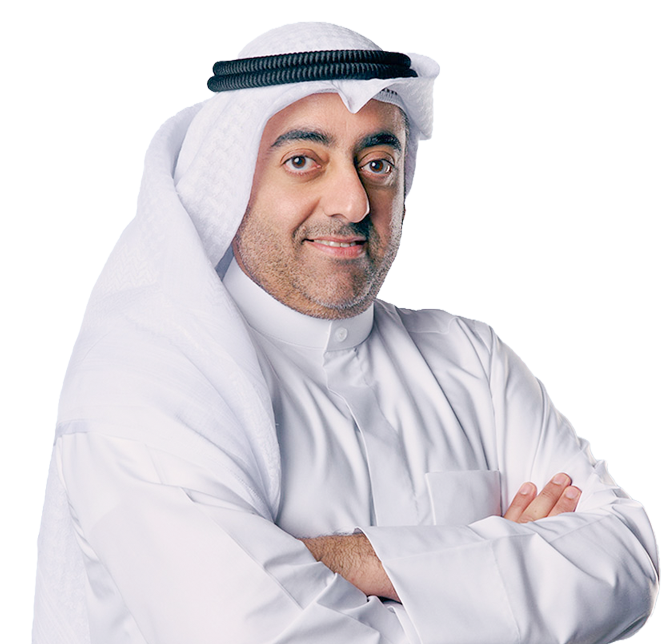
- Trolley’s journey shows that a Kuwaiti idea can grow into a regional platform.
- The real transformation was therefore from operating a chain of stores to managing an integrated convenience-retail platform.
- We do not view expansion as a store-count exercise. Store count is an outcome of our strategy.
- Expansion must translate into better earnings quality, stronger cash flow and sustainable returns.
- One of the most important lessons has been that a successful retail model can be transferable, provided it is never copied mechanically.
- Properly applied, governance creates clearer accountability, improves decision-making and gives the company a stronger foundation to grow.
Growth should strengthen the business without compromising its financial resilience.
 Trolley Co-Founder and Group Chairman Faisal Boodai on how a Kuwaiti convenience-retail concept evolved into a scalable platform, the discipline behind expansion in Kuwait and Saudi Arabia, and why governance, cash generation and operating systems matter as founder-led businesses move toward regional scale.
Since its establishment in Kuwait in 2010, Trolley has evolved from a convenience-store concept into an integrated retail platform spanning multiple formats, digital channels and a growing regional presence. Its development has been shaped by a repeatable operating model, centralized distribution, location partnerships and an expanding ability to use customer and operating data.
In this interview with Al-Masaref, Co-Founder and Group Chairman Faisal Boodai explains the decisions that made the model scalable, how Trolley balances store expansion with productivity and returns, what it has learned from Saudi Arabia, and how governance and capital discipline are shaping the company’s next stage. He also reflects on the lessons Trolley’s journey offers Kuwaiti entrepreneurs seeking to build companies capable of regional expansion and public-market scrutiny.
FROM KUWAITI CONCEPT TO SCALABLE PLATFORM
Looking back at Trolley’s development since its establishment, which strategic decisions were most important in transforming the original concept into a scalable convenience retail platform?
The decision that mattered most was building a model that could be repeated across different locations and customer occasions, rather than simply opening more stores.
When we established Trolley in Kuwait in 2010, we were addressing a clear gap in the market. Customers needed faster and more reliable access to everyday products in locations that formed part of their daily routines. Our early expansion through universities, fuel stations, residential communities and other high-traffic locations helped us understand that convenience retail is fundamentally a location, assortment and execution business.
As the network grew, we invested in the operating infrastructure needed to support it. Our centralized distribution model gave us greater control over inventory, product availability and business continuity, while our relationships with major location and fuel-station partners provided access to recurring customer traffic.
We subsequently expanded the platform through Baqala Bodega, our value-oriented neighborhood format, as well as our digital channels, loyalty program and customer-data capabilities. These developments allowed us to serve different customer segments without moving away from the core capability we had built.
The real transformation was therefore from operating a chain of stores to managing an integrated convenience-retail platform. That distinction is what made the model scalable in Kuwait and increasingly transferable to Saudi Arabia.
As the store network continues to expand, how do you balance opening new locations with improving like-for-like sales, store productivity, margins and returns from the existing network?
We do not view expansion as a store-count exercise. Store count is an outcome of our strategy. What matters is whether new locations mature successfully, existing stores continue to improve, and the network as a whole generates stronger returns.
Our H1 2026 performance demonstrates progress on both fronts. We added 25 net new stores while like-for-like sales grew by 9.8%. EBITDA increased by 36.7% and net profit grew by 54.0%, both ahead of revenue growth. Net cash flow from operating activities reached KD 10.1 million, an increase of 20.3% year on year.
For new stores, we maintain a selective approach based on location quality, the level of demand and measurable performance indicators. We monitor how quickly each location establishes a customer base and progresses towards its sales, profitability and cash-generation targets.
Across the existing network, our priorities include store productivity, assortment optimization, targeted refurbishments and stronger digital integration. We also consider the relationship between locations so that new stores expand our customer reach rather than simply redistribute demand within the existing network.
The priorities differ by market. In Kuwait, we are focused on strengthening the performance and cash-generating capacity of our established business. In Saudi Arabia, we are increasing store productivity and improving profitability as the network builds greater scale and maturity. Ultimately, expansion must translate into better earnings quality, stronger cash flow and sustainable returns.
What financial and operational criteria determine whether a new location or market is attractive, and how long should a typical store take to reach maturity and deliver its targeted return?
A successful convenience store begins with the quality of the area it serves. Operationally, we assess expected footfall, accessibility, visibility, surrounding residential or workplace density, customer profile, trading patterns, competitive intensity and the ability of our supply chain to service the location efficiently.
We also consider the role a proposed store would play within the wider network. A location must add meaningful customer access and address a recognizable demand occasion, whether it is serving a residential community, university population, fuel-station customer or another high-traffic areas.
Financially, we assess projected revenue, gross-margin potential, occupancy costs, required capital expenditure, store-level operating costs and the path to profitability and cash generation. We test these assumptions under different performance scenarios rather than relying on a single revenue forecast. This allows us to compare opportunities according to expected returns, not location appeal alone.
We do not apply one group-wide maturity or payback period to every store. A fuel-station store, residential location and new-market branch may follow different ramp-up profiles. Each proposed store is therefore assessed against a format-, location- and market-specific business case, with performance and return milestones established before the investment is approved.
We consider the store mature when it has established a stable customer base, predictable sales patterns and a sustainable contribution after direct operating costs. In Kuwait, our established brand awareness, network density and supply-chain coverage support the maturity process. In Saudi Arabia, the network is still building scale and market familiarity, so the profile may differ. In both markets, our objective is to shorten the path to maturity through disciplined site selection, localized assortment and consistent execution.
How do Trolley’s different retail formats serve distinct customer segments, and what role will each format play in the next phase of growth?
Trolley and Baqala Bodega play different but complementary roles within the platform.
Trolley is our flagship premium convenience format. It operates across fuel stations, residential communities, universities and other high-traffic locations, serving customers who want fast and reliable access to a broad selection of everyday products.
Baqala Bodega is our value-oriented neighborhood format. It is designed around accessibility, value and the needs of residential areas it serves while offering greater operational flexibility and a more focused capital profile. During the second quarter of 2026, its retail revenue increased by 119.6% year on year, supported by like-for-like growth of 53.6%.
The strategic value of operating two formats is that we do not have to force one model into every location. We can evaluate the demand, customer profile and economics of each area and deploy the format best suited to it.
Trolley will continue to support our core business in Kuwait and our growing presence in Saudi Arabia. Baqala Bodega provides an additional platform for disciplined expansion within neighborhood communities and a historically fragmented part of the retail market.
Our digital capabilities complement both formats. By connecting stores with the Trolley app, loyalty program, targeted offers and customer-behavior analytics, we can better understand our customers and create a more relevant and integrated experience across physical and digital channels.
REGIONAL EXPANSION WITH LOCAL DISCIPLINE
What lessons has the company learned from its expansion in Saudi Arabia, and which factors will determine whether the business model can be replicated successfully across additional regional markets?
Saudi Arabia is an important pillar of Trolley’s growth strategy. During H1 2026, retail revenue in the Kingdom grew by 56.9% year on year, while our Saudi network recorded a net increase of 17 stores.
One of the most important lessons has been that a successful retail model can be transferable, provided it is never copied mechanically. The operating principles may remain consistent, but assortment, site type, customer behavior and the pace at which stores mature must be understood locally.
Our experience has also reinforced the importance of strong location partnerships. Our expansion across residential communities and fuel-station networks gives us access to established customer flows while enabling us to build the brand across different consumption occasions. Recent openings at Sidra Compound by ROSHN and Sahl Station in Riyadh illustrate how we are serving both residential communities and customers on the move.
Our agreement with Tas’helat Marketing supports our expansion across its fuel-station network in the Kingdom, while our memorandum of understanding with Aldrees further demonstrates the strategic importance of the forecourt channel to our Saudi growth model.
When evaluating any additional regional market, we would examine recurring convenience demand, market size, the availability of suitable location partnerships, competitive intensity, regulation, supply-chain viability and the economics of reaching efficient scale. A large consumer market is not sufficient on its own. We must be confident that Trolley can create a differentiated proposition and develop the operating density needed to serve customers consistently.
Our immediate priority remains the continued development of Kuwait and Saudi Arabia. We will assess other regional opportunities selectively, and we will not enter a market simply to add another country to the map. Any decision must support long-term returns and strengthen the wider Trolley platform.
How are centralised procurement, distribution, inventory management and data analytics helping the company improve product availability, control waste and protect margins as the network expands?
Centralization gives us greater visibility and control across a growing network. By coordinating procurement, inventory and distribution through our central warehouse, we can improve replenishment discipline, maintain more consistent product availability and respond more efficiently to differences in demand between locations.
Demand patterns can vary considerably across our network. A residential store, university location and fuel-station branch may serve different customer needs even when they operate under the same brand. Store-level sales data helps us refine the product mix and direct inventory towards the locations where it is most likely to sell.
This becomes increasingly important as the network expands. Growth without inventory discipline can increase waste, weaken availability and absorb working capital. Our objective is to use scale to strengthen forecasting, purchasing efficiency and stock productivity while maintaining the service levels customers expect.
Our centralized operating model, which we adopted approximately three years ago, also supported business continuity during temporary regional disruptions earlier this year, with no material impact on our supply chain.
Customer data provides another important layer of insight. Information from the app, loyalty program and store transactions helps us understand purchase frequency, basket composition and customer preferences. This supports more relevant offers, better-informed assortment decisions and deeper customer engagement.
Over time, the combination of operational and customer data should allow us to improve availability, reduce avoidable waste and increase the value generated by each store and customer relationship.
GOVERNANCE, CAPITAL AND VALUE CREATION
Following Trolley’s listing on Boursa Kuwait, how have governance, disclosure, investor engagement and capital-allocation practices evolved to support the company’s next stage of growth?
The transition began before we became a public company. Preparing for a public listing required us to formalize the structures, controls and reporting disciplines expected of a Premier Market company. Following the listing, those responsibilities became part of our ongoing operating rhythm.
Trolley now operates through a defined governance framework under which the Board oversees strategy, financial reporting, risk management and internal controls. The Board is supported by its committees, each operating under an approved mandate. Independent board representation and dedicated internal audit, risk-management and regulatory-compliance functions further strengthen oversight and accountability.
Disclosure and investor engagement have also become more structured. Our earnings releases and analyst conferences require management to explain the relationship between operational decisions, financial performance and long-term value creation.
The same discipline applies to capital allocation. Our listing was completed through a secondary offering of existing shares and did not raise new capital for the company. Becoming publicly listed nevertheless increased the scrutiny applied to how we deploy our internally generated resources. Every material investment must be considered in operational and financial terms, as well as in the context of our responsibilities to shareholders.
Properly applied, governance creates clearer accountability, improves decision-making and gives the company a stronger foundation from which to grow.
How do you intend to balance store expansion with the development of higher-margin and lower-capital-intensity revenue streams, including digital channels, rental income, private-label products, franchising and distribution?
Our stores remain the foundation of the platform, and the value of the network extends beyond sales generated at the checkout. The next phase is about using our physical footprint, sourcing capabilities, customer relationships and operating data more productively.
Digital channels deepen the relationship between customers and the store network. They allow us to serve customers beyond an individual store visit and create more personalized engagement through the app and loyalty program. During H1 2026, online sales reached KD 2.1 million, while the network generated 21 million transactions.
Rental and shop-in-shop arrangements allow us to create additional value from selected locations. Shop-in-shop revenue increased by 114.6% year on year during the second quarter. Processing income linked to sublease arrangements also contributes to the revenue mix, although its timing and value may vary between reporting periods.
Private-label products represent another potential opportunity. They could allow us to use our purchasing insight and knowledge of customer demand to develop a more differentiated assortment and strengthen control over product economics.
Franchising and distribution could also provide ways to extend the Trolley platform with lower direct capital requirements than a fully company-operated store rollout. These opportunities must be developed carefully to protect the quality and consistency associated with the brand.
These areas will not all progress at the same pace. We will advance each one according to customer relevance, operational readiness and expected return. Our objective is a stronger ecosystem in which each additional capability reinforces the core retail network.
What principles guide decisions on reinvestment, dividends and maintaining financial flexibility as the company seeks to deliver both growth and sustainable shareholder returns?
Our capital-allocation principle is straightforward. Growth should strengthen the business without compromising its financial resilience.
We prioritize investments that reinforce the core network, improve store productivity or build capabilities that can create value across multiple locations. Store openings are assessed according to their expected sales, profitability, capital requirements and path to cash generation. Refurbishments must have a clear operational or customer rationale, while platform investments are evaluated according to their ability to improve efficiency, customer engagement or future scalability.
Dividends are considered within the same framework. The Board assesses profitability, operating cash generation, forecast investment requirements, liquidity and the company’s wider financial position when determining shareholder distributions.
The cash dividend of 17 fils per share approved by the Board following H1 2026, representing total distributions of KD 4.7 million, demonstrates that growth investment and shareholder returns can be pursued together when the company generates strong cash flow and maintains financial discipline.
At the same time, we do not believe in committing to a level of distribution that could restrict the company’s ability to invest or respond to changing market conditions. Our objective is to deliver sustainable shareholder returns while preserving the flexibility required to pursue attractive long-term opportunities.
FROM FOUNDER-LED BUSINESS TO REGIONAL PLATFORM
What lessons from Trolley’s journey are most relevant to Kuwaiti entrepreneurs seeking to transform founder-led businesses into professionally governed companies capable of regional expansion and public-market scrutiny?
The first lesson is that the founder’s role must evolve before the business is forced to evolve.
In the early stages, founders are involved in almost every decision because speed, instinct and personal commitment matter. As the company grows, the founder creates greater value by building the right team, establishing accountability and ensuring that sound decisions can be made consistently without depending on one individual.
For Trolley, scale required us to move from managing individual stores to building systems. Centralized distribution, defined performance indicators, stronger financial reporting and a clearer governance structure were the infrastructure that allowed us to expand while protecting consistency.
The second lesson is that professionalization should not eliminate entrepreneurship. Governance provides discipline, while a growing company must preserve its willingness to test ideas, respond to customers and act decisively. The balance is to maintain speed within a clearer framework of responsibility and accountability.
Regional expansion also requires humility. Success in Kuwait gives a company valuable experience, but it does not automatically provide the right answer for another market. In Saudi Arabia, we have had to continue learning, adapt to local customer behavior and build relationships that reflect the structure of the market.
My advice to Kuwaiti entrepreneurs is to build the company they want to become before they urgently need to become it. Strengthen the management team, reporting, controls and governance early. A listing should not be the moment a business begins acting like a public company. It should be the market’s recognition that the business is already capable of doing so.
Trolley’s journey shows that a Kuwaiti idea can grow into a regional platform. Ambition becomes scalable only when it is supported by disciplined execution, strong people and effective systems.
Kuwait Institute of Banking Studies: Oil Price Volatility Remains a Key Source of Instability for Kuwait’s Economy

Oil-price volatility affects far more than Kuwait’s fiscal and external balances, influencing investment, banking liquidity, credit conditions and consumer confidence. A Kuwait Institute of Banking Studies study highlights the importance of a medium-term fiscal framework, broader non-oil revenues and faster economic diversification in strengthening Kuwait’s resilience to oil-market uncertainty.
For decades, oil has been the engine of Kuwait’s economic success. It has financed development, supported generous public services, and built one of the world’s largest sovereign wealth funds. Yet this success has turned Kuwait into an oil-dependent economy, with the oil sector accounting for half of real GDP, the overwhelming majority of exports, and most government revenues. As a result, developments in global oil markets do not merely affect fiscal and external balances, they influence investment decisions, banking liquidity, and consumer confidence. This issue lies at the heart of a recent study published by the Kuwait Institute of Banking Studies (KIBS), which examines how oil price volatility transmits into the economy through different channels, arguing that volatility may be just as important as price levels in shaping public and private sector decisions.
Why does oil price volatility matter?
Oil price volatility creates uncertainty for oil-exporting countries, constraining budget planning, undermining revenue predictability, and affects financial planning by creating a stop-go cycle that prolongs the implementation of diversification agendas while reducing private sector investment and consumption. Kuwait’s dependence on oil proceeds makes it particularly exposed to fluctuations in oil prices and OPEC+ production decisions. The heavy reliance on oil revenues and pro‑cyclical fiscal policy mean that oil price volatility quickly translates into shifts in liquidity, credit conditions, and risk perceptions, making it a concern not just for policymakers, but for banks and investors as well.
The global oil market has become increasingly unpredictable over the past decade. The rapid growth of US shale production fundamentally altered global supply dynamics and contributed to the sharp decline in oil prices between 2014 and 2016. This was followed by the creation of the OPEC+ alliance, which created a more coordinated framework for managing production while making production decisions more responsive to global economic and geopolitical developments. The COVID-19 pandemic then delivered one of the largest shocks in oil market history with global demand collapsing, oil prices briefly turning negative, and oil-exporting economies facing severe fiscal pressures. Just as markets began to recover geopolitical tensions, including the Russia-Ukraine conflict and regional conflicts in the Middle East, created additional uncertainty and price fluctuations reinforcing that volatility in oil prices is becoming an increasingly frequent feature of the global economy.
How volatility reaches the Kuwaiti economy
The study identifies several channels through which oil price volatility affects Kuwait. The most immediate is the fiscal channel since oil revenues account for the overwhelming majority of government income. During periods of declining oil prices, revenues contract sharply while spending often adjusts more slowly, resulting in large budget deficits. Capital spending is frequently the first area to be reduced, delaying infrastructure projects and limiting support for non-oil activity while current expenditures such as wages and subsidies prove relatively difficult to adjust.
A second channel is the financial sector. Government deposits represent an important source of liquidity for the banking system. When oil revenues are strong, liquidity conditions improve and credit growth is supported. During downturns, however, lower government deposits can tighten liquidity conditions and raise funding pressures, increasing banks’ caution in extending credit and affecting investment and economic activity. While Kuwait’s banks remain well-capitalized and resilient, heightened volatility can still affect liquidity conditions and lending behavior, influencing economic activity beyond the energy sector.
The trade sector is also highly exposed. Oil exports account for roughly 90% of Kuwait’s total exports, making the country’s external position highly sensitive to developments in global energy markets. Volatility in oil prices can trigger sharp swings in export earnings and trade balances, creating additional uncertainty for businesses and investors. Asset prices and market sentiment constitute another channel through which volatility is transmitted. Equity valuations, investment flows, and corporate expectations are all influenced by prospects for government spending and future economic growth, both of which are closely linked to oil revenues.
One of the most important findings of the research is that oil price volatility affects sectors far removed from oil production itself. Manufacturing, construction, financial services, and real estate collectively account for a substantial share of Kuwait’s non-oil economy. Yet their performance remains closely linked to oil-driven economic cycles. When uncertainty increases, firms tend to postpone investment, households reduce discretionary spending, and economic activity slows. The empirical analysis confirms this relationship. The results show that a rise in oil price volatility has a statistically significant negative impact on non-oil GDP growth, with the strongest effects appearing during the first few quarters following a volatility shock. Non-oil exports are particularly affected, reflecting weaker investment and lower competitiveness during periods of uncertainty.
Building greater resilience
The findings point to an important policy conclusion that reducing vulnerability to oil price volatility requires strengthening economic resilience rather than attempting to predict future oil prices. A medium-term fiscal framework that links spending to long-run oil price trends rather than short-term fluctuations could help smooth economic cycles and protect public investments during downturns. Expanding non-oil revenue sources would further reduce reliance on oil income and improve fiscal sustainability. Recent steps—including the domestic minimum top‑up tax and higher public service fees—are a start, but non‑oil revenues remain small relative to spending. Broadening the tax base through VAT, excise taxes, and a larger non‑oil private sector would reduce vulnerability over time.
Equally important is accelerating the implementation of Kuwait Vision 2035 by encouraging private investment, improving the business environment, attracting foreign capital, and strengthening domestic productive sectors. Deepening local capital markets and enhancing risk-management tools could also help cushion the economy against future shocks with a selective hedging strategy, similar to Mexico’s oil hedge, could provide insurance against extreme price downturns but only as part of a broader risk‑management toolkit, not a substitute for reform.
Kuwait possesses significant financial resources and institutional strengths that can support this transition. However, the key lesson from recent years is that the greatest challenge facing the economy is not necessarily low oil prices, but uncertainty itself. Building resilience against that uncertainty will ultimately determine how successfully Kuwait transforms its oil wealth into sustainable and diversified long-term growth.
Fitch Affirms Kuwait at ‘AA-’; Outlook Stable

Fitch Ratings has affirmed Kuwait’s Long-Term Issuer Default Ratings (IDRs) at ‘AA-‘ with a Stable Outlook. A full list of rating actions is at the end of this rating action commentary.
Kuwait’s ‘AA-‘ rating is supported by its exceptionally strong fiscal and external balance sheets, with sovereign net foreign assets relative to GDP the highest among all Fitch-rated sovereigns. However, the rating is constrained by weaker governance than peers, heavy dependence on oil and a costly welfare system and large public sector, which could be a source of long-term fiscal pressure, despite spending rationalisation efforts.
Key Rating Drivers
Iran Conflict Continues:
The collapse of a ceasefire in mid-July 2026, following an interim deal signed in mid-June, means the US-Iran conflict will remain a source of risk for Kuwait’s creditworthiness. Kuwait has continued to be affected by attacks from Iran, which have damaged strategic infrastructure and disrupted transit conditions. Even if a renewed ceasefire is agreed, there is a high risk that the geopolitical situation will remain unstable and a further escalation remains possible, but we believe that the implications for sovereign risk will remain manageable given the sovereign’s large buffers.
Oil Transit Key Vulnerability:
The conflict will continue to affect Kuwait’s ability to export oil, given its dependence on the Strait of Hormuz. We expect some degree of normalisation in the near term, but uncertainty is high and severe disruptions remain possible. Production declined by 70% to 0.78m b/d barrel in March-May 2026 with a recovery to 1.65m b/d in June and about 2m b/d in July. We expect Kuwait’s crude oil production to average 2m b/d in the fiscal year ending March 2027 (FY26), before recovering in FY27. Some oil facilities have been damaged, but we believe Kuwait has the capacity to restore production quickly once transit conditions normalise.
We forecast Kuwait’s average oil price at USD81.4/b for FY26, up 21% from FY25, and to fall in FY27. We expect Kuwait’s fiscal break-even oil price (excluding investment income) will remain high at over USD100/b in FY26 (USD83/b in FY24).
GDP Contracts:
We expect the Iran war to weigh on economic activity mainly driven by the decline in oil production. Non-oil GDP will also weaken but remain in positive territory, supported by public infrastructure spending, public sector employment and the central bank’s support for the banking sector. We expect inflation to rise marginally in 2026 before easing in 2027.
Reported Budget Deficit to Widen:
Under the government’s reporting convention, which excludes our estimate of Kuwait Investment Authority (KIA) investment interest income, we expect the deficit to widen by 4pp to about 19% of GDP in FY26 as the war weighs on revenue and the government maintains its infrastructure drive, although capex execution will be weaker than budgeted amid heightened security risks. Current spending is sticky, mainly salaries and subsidies, which were 81% of spending and 40% of GDP in FY25. We expect subsidy reform to slow as support for consumers rises, despite the budget assumption that subsidies will fall 0.6pp to 8.2% of projected FY26 GDP.
We assume majority of the FY26 deficit will be financed through borrowing, with the remainder covered by the General Reserve Fund (GRF, the government’s treasury account) drawdowns. Including our estimate of KIA’s investment income, which is not officially disclosed, we project an overall fiscal surplus of 1.7% of GDP in FY26, up from 0.3% in FY25.
Non-Oil Revenue Below Peers:
Kuwait lags GCC peers in diversifying government revenue away from oil, reflecting slow progress broadening the revenue base. Excluding investment income, non-oil revenue averaged 9.1% of non-oil GDP in FY22-FY25, below the GCC median of 10.3%. The budget targets non-oil revenue to rise 1.2pp to 7.2% of projected FY26 GDP (11.6% of non-oil projected FY26 GDP), supported by fee increases, digitalisation efforts and the recently introduced 15% domestic minimum top-up tax (DMTT) on multinationals, estimated to generate 0.5-0.6% of GDP a year. We expect this to fall short as DMTT collections will only begin in 1Q27, and the war will weigh on non-oil activity.
Exceptionally Strong External Assets:
Kuwait’s external balance sheet remains robust and we forecast its sovereign net foreign assets will rise to 668% of GDP in 2026, from an estimated 652% in 2025, more than 10x the ‘AA’ median. The bulk of assets are held in the Future Generations Fund managed by the KIA, which also manages the GRF assets.
Rising Debt, But Below Peers:
Fitch expects the resumption of debt issuance, combined with projected fiscal deficits to increase government debt/GDP from 2.9% in FY24 to 38% by end-FY28. Nonetheless, we expect debt to remain below the projected 2028 ‘AA’ median of 51.5% of GDP.
ESG – Governance:
Kuwait has a medium WBGI ranking at 55, reflecting low scores for voice and accountability, and middling scores across other governance indicators.
RATING SENSITIVITIES Factors that Could, Individually or Collectively, Lead to Negative Rating Action/ Downgrade
Structural Features:
A political shock or a sharp escalation of regional geopolitical tensions that threatens Kuwait’s economic and financial stability, for example, if it caused prolonged disruptions to Kuwait’s hydrocarbon sector, or a prolonged disruption to its export route.
Public and External Finance:
Significant deterioration in fiscal and external positions, for example, due to a sustained period of low oil prices or an inability to address structural drains on public finances.
Factors that Could, Individually or Collectively, Lead to Positive Rating Action/Upgrade
Structural Features/Public Finances:
Strong evidence that Kuwait’s institutions and political system can tackle long-term fiscal challenges, and reduction of geopolitical risks.
Project Peregrine: A New Capital Partnership for Kuwait's Oil Sector
Project Peregrine (Shaheen) ranks among the most significant investment developments in Kuwait’s oil sector in 2026 — not simply for its headline value, but for the financing model it introduces. The transaction provides a new mechanism for attracting international institutional capital into strategic energy infrastructure while preserving national ownership and operational control.
In July 2026, Kuwait Petroleum Corporation (KPC) announced that Kuwait Oil Company (KOC) had signed a lease-and-leaseback agreement covering domestic and export crude-oil pipelines with a consortium of funds managed by Blackstone, Brookfield and KKR — three leading global investment firms. The agreement carries an announced value of $16bn, with KOC expected to receive approximately $7.85bn in upfront cash proceeds upon closing to support KPC’s capital expenditure programme.
The distinction is important: the $16bn represents the announced value of the transaction, while the $7.85bn represents the upfront cash proceeds KOC expects to receive. These are different financial measures and should not be used interchangeably.
Deal Structure: Foreign Capital Without a Loss of National Control
Peregrine covers 13 pipelines spanning approximately 320 kilometres and involves a newly established Kuwaiti-incorporated joint venture. KOC will hold a 51 per cent stake, while the international consortium will collectively own the remaining 49 per cent, divided equally among the Blackstone, Brookfield and KKR funds.
Under the lease-and-leaseback arrangement, the joint venture will lease usage rights to the pipeline network from KOC and grant KOC exclusive rights to use, operate and maintain the network for 20.5 years, in return for a tariff linked to pipeline throughput.
The transaction preserves KOC’s ownership and operational control of the physical infrastructure while granting international investors defined economic rights for the duration of the agreement. Peregrine is therefore best understood as a capital-management and financing arrangement rather than a sale of strategic energy infrastructure.
The international investors were selected following a competitive process. The transaction is governed by Kuwaiti law and, as announced, is subject to customary closing conditions and regulatory approvals, placing the partnership within a defined domestic legal and regulatory framework.
Why the $7.85bn Matters
The immediate financial significance of Peregrine lies in the expected upfront cash proceeds, particularly given the scale of investment required under KPC’s Strategy 2040.
KPC targets sustainable crude-oil production capacity of 4mn barrels a day by 2035, including production from the Divided Zone, with that level to be maintained through 2040. It also aims to increase non-associated gas production to 2bn standard cubic feet a day by 2040.
Achieving these objectives will require substantial and sustained investment in exploration, production, field development, facilities and supporting infrastructure. The expected proceeds would provide additional financial capacity to support this long-term investment programme.
The announcement links the proceeds to KPC’s capital expenditure plans, including its production-capacity objectives, but does not allocate them to specific fields or projects. Their significance should therefore be assessed within KPC’s broader investment framework.
Balancing Near-Term Liquidity Against Long-Dated Commitments
Peregrine offers an additional source of financing capacity, while its 20.5-year structure also makes long-term economic value an important consideration in KPC’s capital planning.
With the tariff linked to pipeline throughput, future network utilisation will be a relevant factor in the transaction’s economics. Production and export volumes, together with broader energy-market conditions, will therefore remain important considerations throughout the agreement.
The arrangement combines substantial upfront liquidity with defined long-term economic commitments. Its financial significance is consequently best considered over the full investment horizon, rather than solely in terms of the proceeds received at closing.
Global Capital, a Long-Term Commitment
The participation of Blackstone, Brookfield and KKR adds an important institutional dimension to Peregrine, reflecting the ability of Kuwait’s energy infrastructure to attract major international investors pursuing long-duration opportunities.
KPC has described Peregrine as the largest foreign direct investment in Kuwait’s history — a significant commitment at a time of elevated regional geopolitical uncertainty.
According to KPC, Peregrine marks the first deployment of long-term capital by leading global institutional investors into Kuwait’s midstream infrastructure. Beyond its announced value, the transaction therefore establishes an important precedent for international institutional participation in the country’s energy sector.
Its significance lies not in eliminating investment risk, but in the nature of the capital involved. Infrastructure investors typically assess assets over extended periods, placing Peregrine within the global market for long-term infrastructure investment rather than short-term portfolio flows.
Centerview Partners, HSBC and J.P. Morgan acted as financial advisors to KPC on the transaction, reflecting the scale and complexity of the arrangements involved.
Investor Confidence Amid Regional Uncertainty
The timing of Peregrine adds particular significance to the transaction. Against the backdrop of ongoing regional conflict and heightened geopolitical uncertainty, the decision by leading global investment firms to enter into a partnership extending more than two decades reflects confidence in Kuwait’s energy infrastructure, KPC’s institutional capabilities and its long-term strategic direction. The transaction also demonstrates Kuwait’s ability to attract substantial international institutional capital under challenging external conditions, reinforcing its position as a destination for long-term strategic investment.
Part of a Wider Gulf Evolution
Peregrine forms part of a broader evolution in how Gulf energy infrastructure is financed.
In 2019, BlackRock and KKR invested approximately $4bn for a combined 40 per cent interest in a vehicle linked to ADNOC’s oil-pipeline assets. Subsequent participation by additional investors increased total external ownership to 49 per cent, bringing the combined investment to approximately $4.9bn, while ADNOC retained its majority stake.
In 2020, ADNOC raised approximately $10.1bn through a similar arrangement involving its gas-pipeline network.
Saudi Aramco completed comparable transactions in 2021 and 2022, raising $12.4bn through its crude-oil pipeline network and $15.5bn through its gas-pipeline network, respectively. In both transactions, Aramco retained a 51 per cent stake in the respective pipeline subsidiaries, alongside full ownership and operational control of the underlying infrastructure.
Collectively, these transactions illustrate how national oil companies are increasingly complementing traditional funding sources with institutional capital linked to energy infrastructure and associated economic rights. Although the structures differ, each reflects an approach to mobilising investment in line with corporate priorities and ownership requirements.
Peregrine follows this regional pattern while retaining distinctly Kuwaiti characteristics, notably KOC’s majority interest in the partnership vehicle and the continued authority of the State of Kuwait over the production and refining decisions that shape its oil policy.
A Financial-Market Dimension
Beyond the oil sector, Peregrine has implications for Kuwait’s wider financial ecosystem.
Transactions of this scale require sophisticated financial structuring, valuation, advisory services and coordination across legal, financial and corporate disciplines. While Peregrine alone should not be expected to transform Kuwait’s capital markets, it adds to the country’s institutional experience in executing complex, long-duration investment partnerships with leading global investors.
Infrastructure Capital Recycling: Linking Existing Assets to Future Investment
From a broader economic perspective, Peregrine can be viewed through the concept of infrastructure capital recycling. This represents an analytical interpretation of the transaction rather than its official designation. The concept involves mobilising capital from established infrastructure assets to support future investment, allowing existing assets to contribute to development beyond their immediate operational function.
Viewed in this context, Peregrine illustrates how economic rights associated with an established pipeline network can be used to attract long-term institutional capital. The expected proceeds would support KPC’s broader capital expenditure programme, an approach that is consistent with the emphasis on portfolio optimisation and operational excellence in Strategy 2040.
More broadly, this analytical perspective highlights how existing energy infrastructure can serve both operational and financial objectives. Peregrine’s long-term significance will ultimately depend on how effectively the capital mobilised contributes to KPC’s strategic investment priorities.
From the Oil Boom to Fiscal Reforms: A History of Kuwait's Sovereign Rating

Sovereign credit ratings issued by credit rating agencies are assessments by independent, private firms that analyse the creditworthiness of countries and institutions. These assessments indicate a country’s ability to meet its financial obligations. These agencies evaluate a country’s economic and financial performance, including its political and economic stability, income sources, asset quality, monetary and fiscal policies, debt levels, and geopolitical factors. In fact, sovereign credit ratings play a crucial role in determining a country’s borrowing costs, bond pricing, and interest rates by indicating its level of credit risk. Moreover, a country’s sovereign rating acts as a ceiling, thus limiting the maximum credit ratings achievable by local banks, investment firms, and other financial institutions operating within that country.
The history of the sovereign rating industry dates back to the early 20th century, with the founding of the three main global rating agencies: Standard & Poor’s (S&P), Fitch, and Moody’s. S&P was established in 1860 and initially focused on securities analysis. In 1941, it merged with Standard Statistics to form Standard & Poor’s, which evaluated the creditworthiness of American firms and later expanded to include governments and financial institutions. S&P’s long-term ratings range from D to AAA. Meanwhile, Fitch was founded in 1913 by John Knowles Fitch to provide financial statistics; it merged with IBCA in 1997 and later, in 2000, with Duff & Phelps; it now operates as Fitch Ratings Ltd. Its credit ratings range from D to AAA. Moody’s was founded in 1900 by John Moody and his team, primarily to provide statistical data on stocks and bonds. It began analysing railway investments in 1909 and rated government bonds from 1914 until 1970.
Today, Moody’s offers ratings for corporate debt, bank deposits, and sovereign bonds, and is the second largest of the “Big Three”. Its long-term ratings range from C to Aaa, with + or – modifiers for certain ratings and numerical modifiers from 1 to 3; A1 is the top level within the category. Moreover, 1 denotes the upper end of the rating category, 2 the middle, and 3 the lower end. These agencies often include positive, stable, or negative outlooks based on expected rating changes and recent developments.
The Historical Development of Kuwait’s Rating
Kuwait’s sovereign credit rating dates back to 1995, when IBCA (now Fitch) issued its first sovereign rating for the country at the request of the Central Bank of Kuwait. The idea to rate Kuwait originated with former Central Bank Governor Sheikh Salem Abdulaziz Al-Sabah, during whose tenure the bank underwent significant improvements and modernisation aligned with best practices in monetary policy. Chart (1) shows the historical development of Kuwait’s sovereign rating by IBCA. Initially, Kuwait received an (A) rating with no outlook, which remained until 1999. In 2000, the rating remained (A) but with a positive outlook and, in 2001, was upgraded to (A+) with a positive outlook. Between 2002 and 2007, Kuwait was rated (AA-) with a stable outlook. In 2008, however, IBCA upgraded this rating to (AA) with a stable outlook; this rating, the highest for Kuwait, continued until 2020. Later, in 2021, it retained the (AA) rating, but the outlook was downgraded to negative. From 2022 onward, it fell to (AA-), with a stable outlook through 2026.
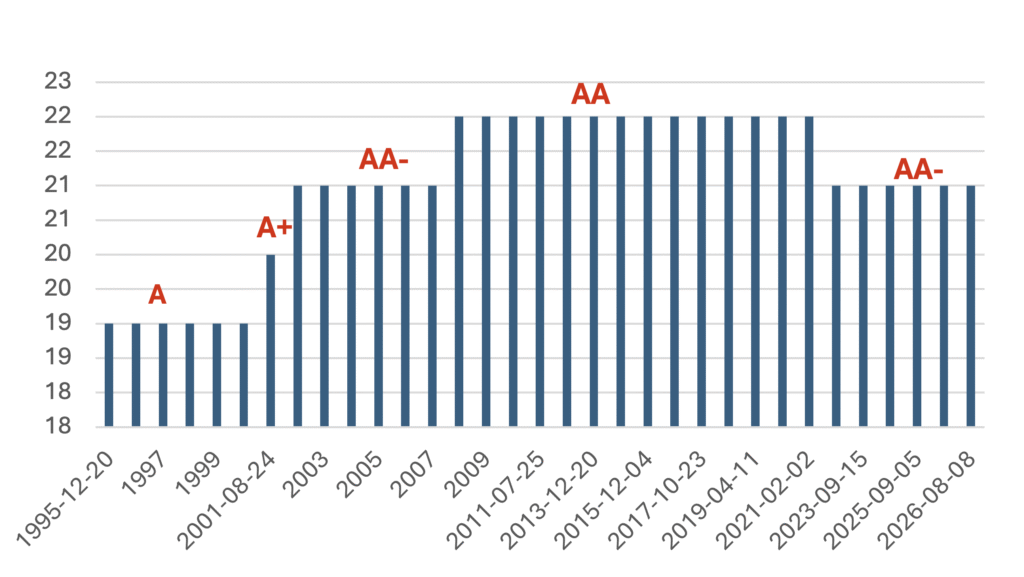
Source: prepared by the author, data collected from Fitch reports.
Since 1996, Moody’s has rated Kuwait’s sovereign debt, initially assigning a Baa1 rating with a stable outlook until 1998. Between 1999 and 2001, it revised the outlook to positive while maintaining the sovereign rating at Baa1. From 2002 to 2005, the rating improved to A2 with a stable outlook and, in 2006, was further raised to Aa3 with a stable outlook. From 2007 to 2019, the sovereign rating reached its highest level, Aa2, with a stable outlook, except in 2009 and 2016, when the outlook turned negative. From 2020 to 2026, the rating was downgraded to A1, with a stable outlook (Chart 2).
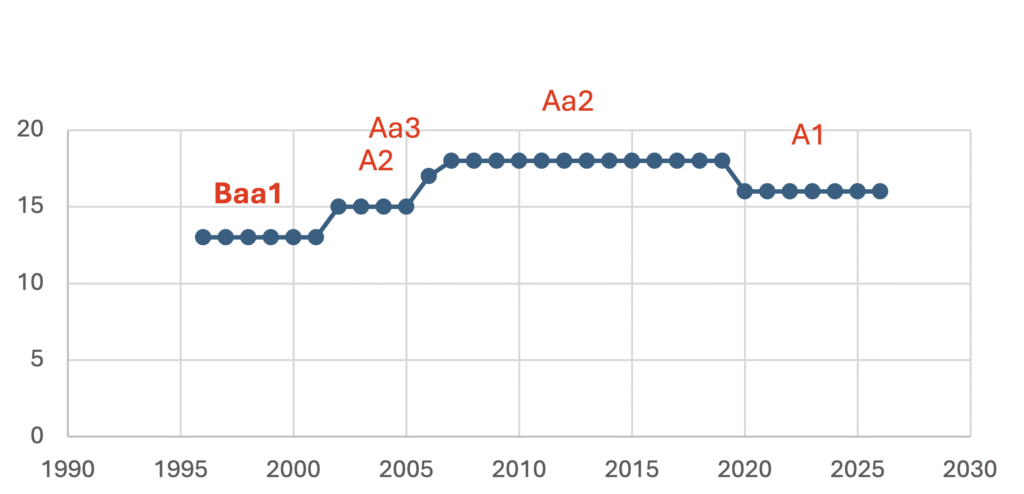
Source: prepared by the author, data collected from Moody’s reports.
Standard & Poor’s began rating the State of Kuwait in 1997, awarding it an (A+) rating with a stable outlook, which it maintained until 2006. In 2007, this rating was upgraded to (AA-) with a positive outlook, which continued until 2010. In July 2011, however, Kuwait received its highest rating from Standard & Poor’s, AA with a stable outlook. This rating remained unchanged until March 2020, when it was downgraded to AA- with a stable outlook. The outlook then turned negative in July 2020 and, in July 2021, the country’s rating was downgraded again to A+ with a negative outlook. The agency changed the outlook to positive in July 2022 and, in November of that year, raised the rating to AA- with a stable outlook. In March 2026, the agency affirmed the credit rating at AA- with a stable outlook (Chart 3).
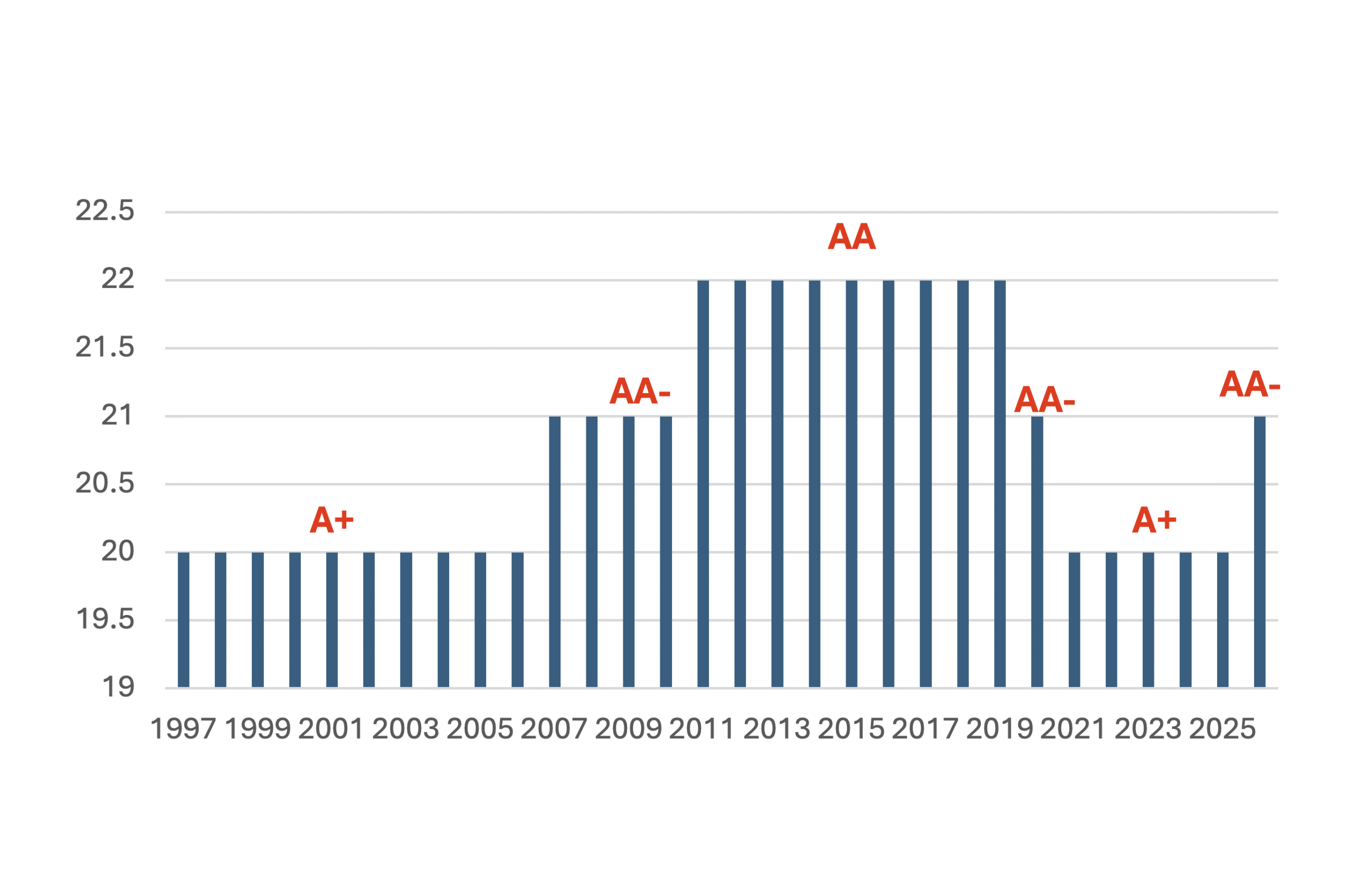 Source: prepared by the author, data collected from S&P reports.
Analysis and Conclusion
When tracing the trajectory of Kuwait’s sovereign credit rating across the three rating agencies (Fitch, Moody’s, and Standard & Poor’s) from 1995 to 2026, we observe that it passed through six stages, as shown in Table 1 and Chart 4.
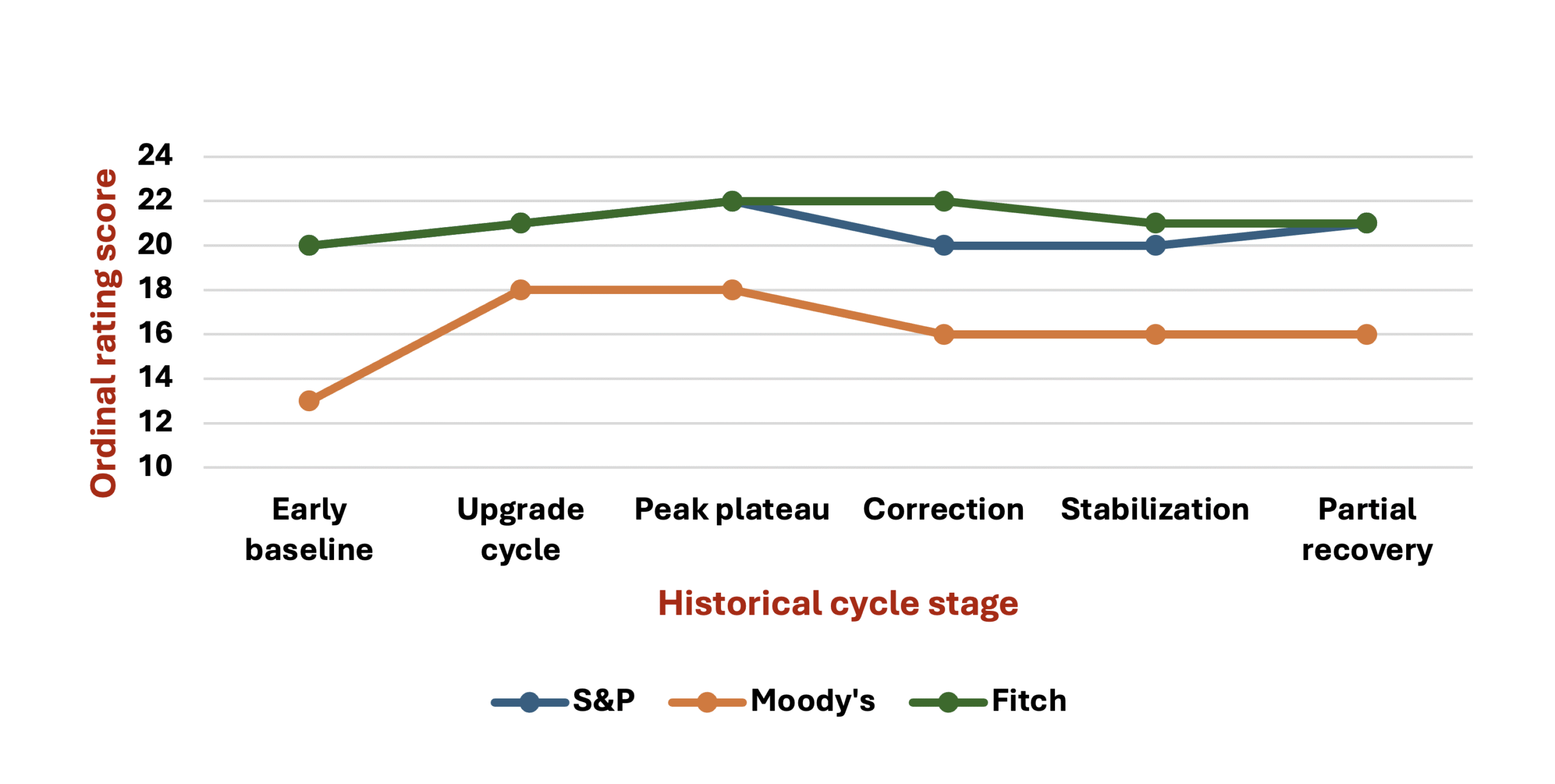
The first stage, the initial period, spanned from 1995 to 2001, during which Kuwait received an A+ rating from Fitch and Standard & Poor’s and a Ba2 rating from Moody’s. Positive indicators suggesting a potential upgrade were also present. The three rating agencies further raised Kuwait’s sovereign rating during 2002-2007, continuing the upward trend until Kuwait reached its highest rating during 2008-2019 (Chart 4), considered a golden era. All these ratings were characterised by stability, except in 2009 and 2016, when Moody’s outlook was negative.
During the period marked by the repercussions of the COVID-19 pandemic on the global economy, which led to the closure of airports, banks, and government institutions for varying periods, these agencies downgraded Kuwait’s sovereign rating. The downgrade continued from 2020 to 2021 and persisted throughout 2022-2025. In July 2021, however, these agencies expressed concern when the National Assembly at that time blocked the government’s proposed law, which would have allowed it to borrow from local and international markets to finance the budget. Following the expiration of Law No. 50/1987 in 2017, the first law allowing the government to borrow from local and international markets with a total ceiling of 10 billion Kuwaiti dinars, problems arose in passing proposed legislation for a new debt law.
These proposals were rejected by the National Assembly, significantly affecting Kuwait’s credit ratings from the three major rating agencies. This situation persisted until 2025, when the government enacted Law No. 60/2025 on Finance and Liquidity, authorising government borrowing. Moreover, this factor, along with Kuwait’s reliance on a single source of income, namely oil, and geopolitical developments in the Middle East, led to reservations among the rating agencies. Despite these factors, the State of Kuwait maintained strong, stable credit ratings from 1995 through 2026, thanks to a stable political system, a high average per capita income, substantial foreign assets, and a strong, stable banking sector. It is expected that the sovereign ratings of the State of Kuwait will rise in the coming years, as the country currently witnesses economic and legislative reforms, the elimination of corruption, the rationalisation of spending and unjustified subsidies for certain government services, and the activation of the private and joint sectors.
The New Era of Sovereign Borrowing in the Gulf

At the beginning of 2026, a conference was held in Kuwait, organized by UNDP. The aim of the conference was to raise awareness among relevant stakeholders about sovereign bonds and other issues related to financing development projects.
UNDP is making efforts to help the Kuwaiti government in its efforts to design policies to develop educational and health projects by using debt instruments.
Kuwait enacted a new law to allow the government to borrow up to KD 30 billion, or around $97.5 billion, with maturities of up to 50 years. The law was enacted to enable the government to meet its expenditure obligations.
More recently, the government amended the Future Generations Fund law to allow borrowing from the Fund according to budget needs in the coming years, but not to exceed the five-year average of its returns, meaning annual borrowing of $40–50 billion.
Sovereign loans:
Sovereign loans have been a fact of economic life since the early 1950s. The accumulation of debt endangered many countries and pushed some to the edge of bankruptcy.
Debt crises occur because of poor fiscal policies and excessive government spending.
Spending on arms, involvement in wars, and other local or regional disputes may create additional borrowing needs. Other forms of spending may be related to constructing administrative buildings or unnecessary projects that do not yield economic or social benefits or enhance genuine development.
Needed spending:
Some governments borrow to finance health or educational projects. Such borrowing can be useful and contribute to human development, which may raise the standard of living or improve the quality of life.
Infrastructure projects may justify borrowing in certain countries where it is difficult to raise sufficient funds internally.
Some projects may enable the relevant authorities to repay the debt when due, including tourism projects, manufacturing facilities, and agricultural projects.
Debt Levels
Many major countries are facing high levels of sovereign debt. Japan is one of the most striking examples.
As of mid-2026, the debt hit a record level of $8.5 trillion, representing around 233% of GDP.
The Japanese government intervened in the market after the collapse of the stock exchange in 1991. Since then, Japan has endured sluggish economic growth.
One of the reasons for this state of affairs is the low or negative population growth in the country, which has reduced domestic consumption.
The cost of money, or interest rate, was negative for a long period. However, since June of this year, the central bank has set 1.0% as the official discount rate.
Gulf States and Debt:
Saudi Arabia is a major player in debt markets. Sovereign debt and borrowing across the Gulf states have reached $1.25 trillion in 2026.
Saudi Arabia aims to borrow $57.9 billion this year and plans to allocate $44 billion to finance the budget deficit.
The government’s total debt is still manageable, at no more than 33% of GDP.
Qatar may be in greater need of borrowing after the shock of the war, the attack on gas facilities, and the disruption of gas and oil exports.
Qatar also intends to draw on its sovereign wealth fund. Total debt as of mid-year is $45 billion, equivalent to 45% of GDP.
The authorities plan to lower the debt to 33% of GDP. This will depend on how the region copes with the current geopolitical situation and deals with its impact after the end of hostilities.
As mentioned earlier, Kuwait has issued bonds and notes and recently decided to draw from the Future Generations Fund.
As of July 2026, Kuwait’s sovereign debt reached $12 billion.
The new debt law allows borrowing of up to $97 billion over a 50-year period. However, the debt-to-GDP ratio remains low at around 14.6%.
The Gulf states enjoy strong credit ratings, and some ratings may be upgraded later this year as the geopolitical environment becomes more stable.
Other Gulf states are also active in debt markets to meet spending obligations.
Challenges:
The most important matter regarding debt is how to manage borrowing and use the borrowed funds.
The expectation is to use the money for development and the financing of vital projects that can contribute to economic and social progress.
One issue that should be considered is that the funds should not be used to meet current obligations such as salaries, wages, or subsidies.
The government must be aware that loans must be repaid according to specified schedules, and the allocation of funds for debt repayment should be a priority when preparing annual budgets.
It is imperative to maintain stability to be able to export oil and gas while also improving the performance of sovereign funds to generate strong returns, which can help in servicing debt in the coming years.
Credit Ratings
The Gulf states have enjoyed strong credit ratings in the past few years. In December 2025, S&P rated the UAE AA+, Saudi Arabia A+, Kuwait AA-, Qatar AA, Oman AA-, and Bahrain B.
Such ratings mean that the Gulf states are viewed positively by rating agencies due to their economic performance and financial strength.
How, then, are they rated following the war?
Fitch’s ratings remain relatively positive. The following shows how each country is currently rated:
Qatar AA
UAE AA-
Saudi Arabia Aa3
Kuwait AA-
Oman AA-
Bahrain BB
It is possible that these ratings may change according to political and economic developments and how each country is affected in the coming months.
Stable oil and gas flows and prices can help in maintaining or improving credit ratings.
Also, if global financial markets support an appreciation in the value of Gulf states’ investment assets, sovereign funds may benefit from higher valuations and investment income, meaning that the Gulf states will maintain strong liquidity levels.
Side Benefits:
This also creates a new opportunity for Gulf banks to benefit from governments becoming active borrowers in debt markets.
Gulf banks may extend credit to governments or buy issued bonds to diversify and expand their credit portfolios.
It is reasonable to assume that sovereign borrowing in the Gulf states will remain a fact of economic life for a long time.
Kuwait’s Banks: The Road to New Kuwait 2035

As Kuwait advances New Kuwait Vision 2035, its banking sector is positioned to play an increasingly important role in financing economic diversification. With projects worth more than USD 358 billion expected to be implemented over the next 15–20 years, the scale of the development agenda could open substantial new opportunities for Kuwait’s banks.

How can Kuwait’s banking sector play a greater role in delivering New Kuwait Vision 2035? A comprehensive study prepared by Marmore MENA Intelligence, the research subsidiary of Kuwait Financial Centre (Markaz), at the request of the Kuwait Foundation for the Advancement of Sciences (KFAS), in collaboration with the Kuwait Banking Association, sets out to answer that question. Dated 2025, the study assesses the progress of the Kuwait National Development Plan, the sectors expected to drive economic diversification, and the financing requirements associated with its implementation. It explores how banks can expand their contribution through project finance and public-private partnerships, SME support, sustainable finance and digital transformation, while also identifying key policy, regulatory, implementation and funding gaps. Drawing on regional and international benchmarks, the study concludes with a set of recommendations aimed at strengthening the banking sector’s role in supporting Kuwait’s diversification agenda and advancing the objectives of Vision 2035.
Kuwait Vision 2035, launched in 2017, seeks to transform the country into a knowledge-driven economy and a leading regional financial and commercial hub. The plan places greater emphasis on private-sector participation while prioritising non-oil sectors including education, healthcare, infrastructure, SMEs and renewable energy, with public-private partnerships forming part of the framework for delivering selected services and development projects.
WHY BANKS MATTER TO THE FUNDING MIX
Kuwait’s fiscal breakeven oil price, estimated by the IMF at USD 80.2 per barrel in 2025, USD 76.7 in 2026 and USD 81.6 in 2030, is substantially higher than current oil prices, leading the study to project fiscal deficits in these years. It therefore concludes that increased participation from the banking sector, private sector and foreign investors will be required to fill the funding gap for the mega projects planned under New Kuwait Vision.
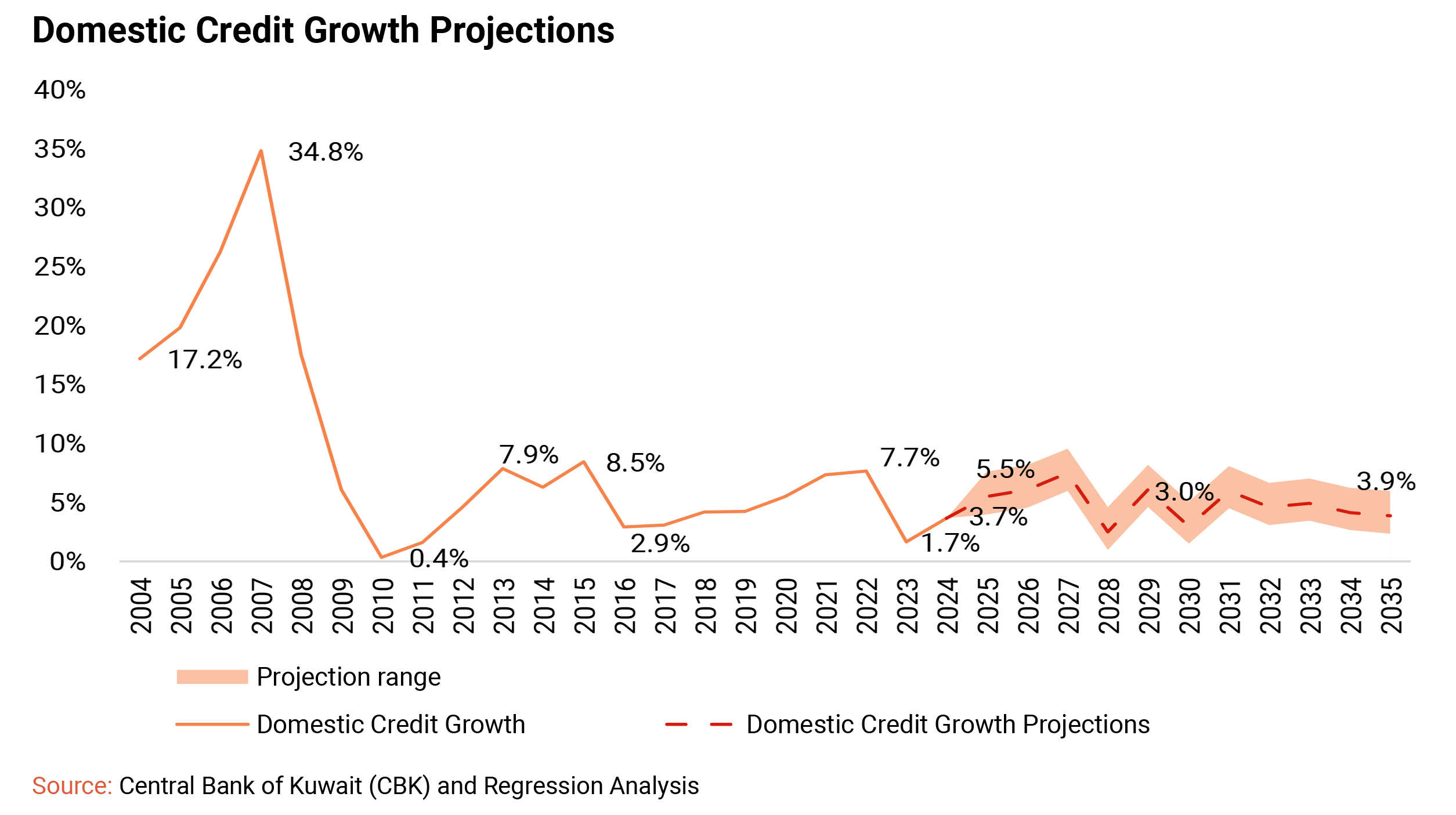
The study’s baseline forecast puts near-term domestic credit growth at 5–7%, stabilising at 3–5% in the long term by 2035. It also identifies significant near-term upside, with credit growth potentially reaching 7–10% if the mortgage law is passed and financing requirements for KNDP projects increase. Its base-case projection for 2025–2035 is a credit-growth CAGR of 4.9%.
WHERE KUWAITI BANKS STAND TODAY
The trend in green and social bond issuance is gaining momentum in Kuwait. The Central Bank of Kuwait is promoting sustainable finance by requiring banks to develop green financial products and become familiar with international climate-risk management principles, while around USD 1 billion of sustainability bonds or green sukuk were issued in Kuwait in 2024. NBK issued a USD 500 million green bond in mid-2024 and targets a sustainable asset portfolio exceeding USD 10 billion by 2030; Warba Bank issued a USD 500 million sustainable sukuk in July 2024; and KIB issued a USD 300 million sustainable sukuk in October 2025. The study notes that the size and frequency of such issuance remain lower than in the UAE and Saudi Arabia.
On digitalisation, Kuwaiti banks offer basic digital versions of traditional services and are gradually adding innovative app-based solutions, while advanced initiatives such as open banking, digital banks and fintech partnerships remain at an earlier stage with limited adoption. Recent fintech partnerships by Kuwaiti Banks include Boubyan Bank with Temenos, KFH with Gieom, Gulf Bank with Ottu, Burgan Bank with TCS BaNCS, and KIB with PayTabs Kuwait. The study sees further scope for collaboration with regional and global fintech players.
Lending to Traditional and Priority Sectors
Kuwait’s lending to traditional sectors such as trade, real estate, construction and agriculture remains relatively lower than in other GCC countries. Emerging sectors including ICT, transportation, tourism and scientific activities also present significant growth potential under Vision 2035. Lending to education, healthcare and renewable energy remains limited, although it is gradually gaining traction among a few banks. The study also notes that some priority sectors are perceived by banks as higher risk, supporting the case for government-backed credit guarantees and other incentives to encourage lending.
SEVEN BANKING OPPORTUNITIES IDENTIFIED IN THE STUDY
The study identifies a broad set of opportunities for banks to expand their contribution to Vision 2035, particularly through project and sector-specific finance, SME support, sustainable finance and digitalisation.
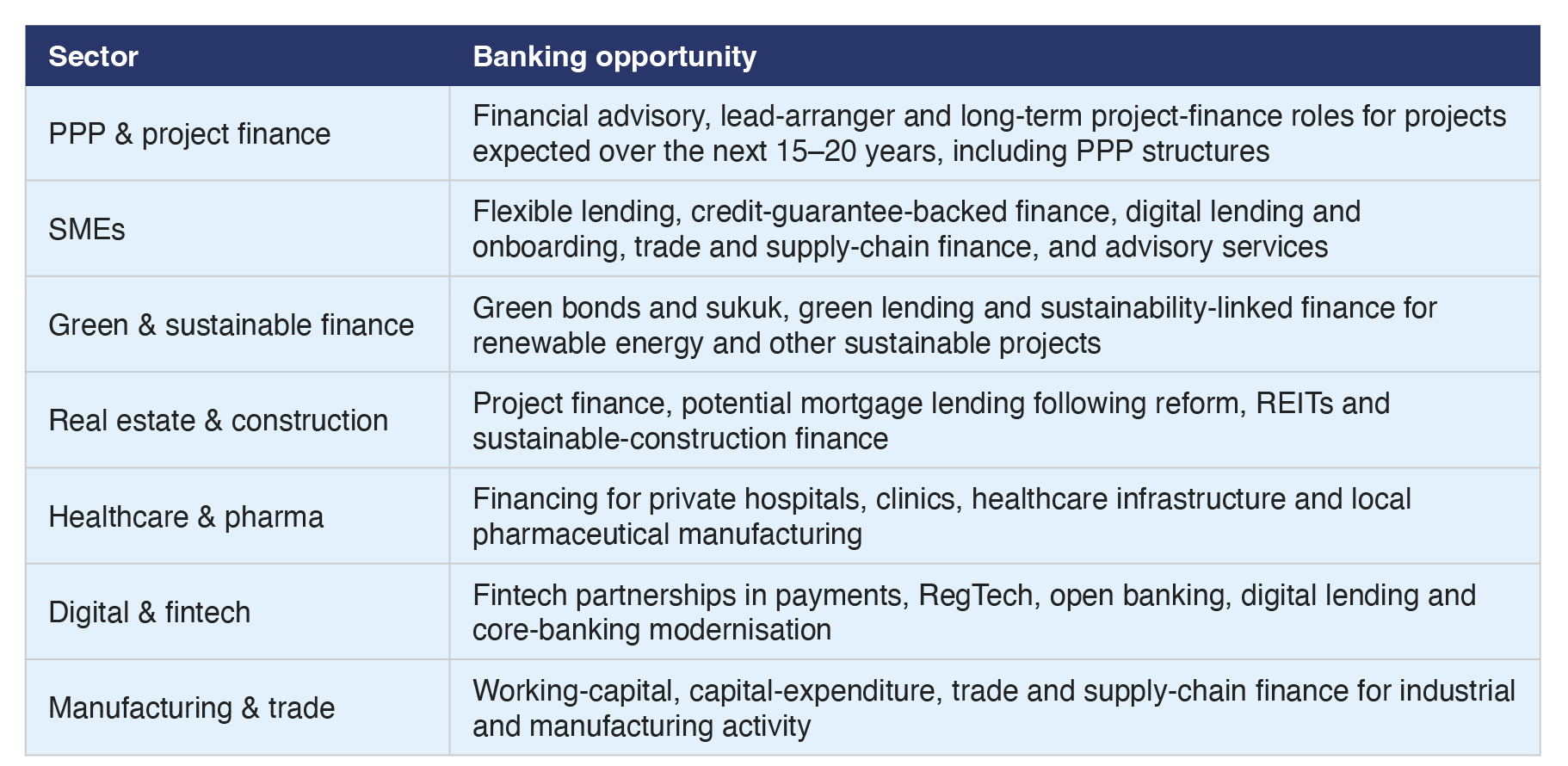
The study identifies PPPs and project finance as a major banking opportunity. Kuwait’s PPP framework has gained momentum since the 2014 PPP Law, and projects worth over USD 358 billion are expected to be implemented in Kuwait over the next 15–20 years. Private-sector-led development of these projects under PPP structures is expected to create a sizeable need for bank funding. According to the study, Kuwaiti banks are well positioned to act as financial advisers and lead arrangers, although bank lending to PPPs remains at an early stage and overall PPP uptake is lower than in Saudi Arabia and the UAE.
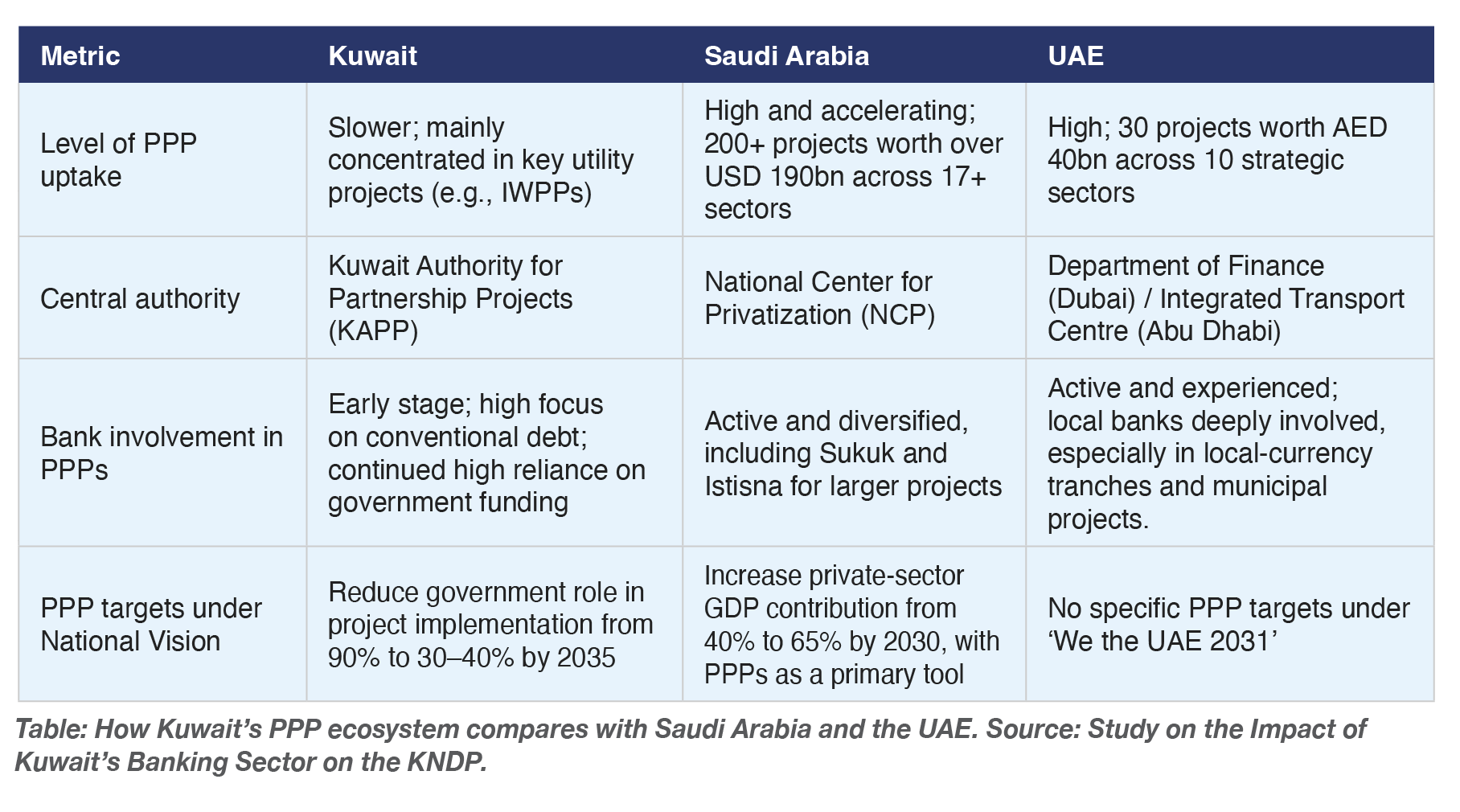
THE GAPS IDENTIFIED BY THE STUDY
The study organises the KNDP gap analysis around four dimensions — policy, regulatory, implementation and funding. It finds that these gaps have slowed progress toward Vision 2035. At the end of Q3 FY 2024/2025, 70% of projects were behind schedule; administrative challenges accounted for roughly 43% of delays, including slow contractual documentation, protracted approvals, multiple licensing entities and work-visa difficulties.
One example is the Public Debt Law, which the study notes was delayed for approximately eight years before being passed in March 2025 with a KD 30 billion debt ceiling and authority to issue bonds and sukuk with maturities of up to 50 years. It also identifies coordination and monitoring weaknesses: performance data can be inconsistent, and the GSSCPD lacks robust real-time monitoring and evaluation mechanisms. At the same time, the study notes that policy and regulatory uncertainty eased following the formation of the new government in May 2024, with a stronger commitment to reform implementation and improved coordination among regulatory bodies.
WHAT THE STUDY RECOMMENDS
The recommendations are grouped into three areas: easing regulatory and policy-level bottlenecks; improving the banking sector’s contribution; and unlocking the potential of key non-banking sectors. Together, they call for closer coordination between government, regulators, banks and the wider private sector.

For Regulators and Policymakers
- Link KNDP goals to clear, measurable KPIs and consider lending targets and incentives that encourage financial institutions to support national priorities.
- Establish «a New Kuwait 2035 Financial Coordination Council», bringing together the Ministry of Finance, Central bank of Kuwait, CMA and KAPP to align project-financing pipelines, regulatory priorities and capital-market development.
- Advance policy reforms that can support financing and capital-market development, including the Residential Mortgage Law and implementation of the Public Debt Law.
- Recalibrate the role of KIA to support Vision-related projects, including co-investment in priority sectors, drawing lessons from Saudi Arabia’s PIF.
For the Banking Sector
- Scale up project-finance capabilities and syndicated lending, and work closely with KAPP to develop bankable PPP frameworks.
- Expand SME financing through credit guarantees, digital lending and onboarding, trade and supply-chain finance, and advisory support.
- Expand green financing through green bonds and sukuk, sustainable loans and clearer frameworks for green and sustainable investments.
- Develop sector-specific expertise and dedicated teams in areas such as green finance, digital transformation and sustainable development.
For Other Sectors
- Support local manufacturing and pharmaceutical production through concessional lending, performance-linked grants, local-content requirements and risk-sharing mechanisms.
- Modernise industrial zones through long-term incentives, streamlined approvals, modern infrastructure, one-stop permitting and cluster-based planning.
- Strengthen human capital through skill-based education, university-industry R&D partnerships, technology transfer and measures to attract skilled talent in knowledge sectors.
THE BOTTOM LINE
The study concludes that achieving KNDP goals will require large-scale investment in infrastructure, sustainable development and new technologies, supported by coordinated funding from government, sovereign wealth funds, the private sector, foreign investors and banks. For the banking sector, the clearest areas of contribution are innovative digital solutions, SME support, sustainable finance and lending to non-oil sectors. At the same time, the report stresses that banks will require supportive regulatory frameworks and incentives, while stronger policy coordination and faster project execution will be important to translating financing capacity into Vision 2035 outcomes.
KEY TAKEAWAY — Kuwait’s banking system is a key enabler of Vision 2035. The study sees scope to deepen project finance, SME lending, sustainable finance and digital capabilities, supported by appropriate regulatory frameworks and incentives.
KEY TAKEAWAY — The study identifies innovative digital solutions, SME support, sustainable finance and lending to non-oil sectors as key areas that can guide banks’ contribution to t
Economic activity recovers despite ongoing Gulf conflict-linked pressures

The National Bank of Kuwait (NBK) issued its report on Kuwait’s economy, titled “Economic Activity Recovers Despite Ongoing Gulf Conflict-Linked Pressures,” highlighting clear signs of economic resilience despite continued disruptions to regional trade and shipping routes. Several key economic indicators have rebounded from the lows reached earlier in the conflict, suggesting that the economy has largely absorbed the initial shock even though conditions have not yet fully normalized. Non-oil activity has improved despite lingering headwinds from trade disruptions, project delays and general uncertainty stemming from the conflict, supported by government measures, stable household incomes, and easing inflation.
Meanwhile, oil production has risen to three-quarters of its pre-conflict level and with more shipments passing through the Strait, Kuwait is better positioned to benefit from higher oil prices than earlier in the conflict. The improved economic data reinforces our earlier view that the non-oil economy will avoid a steep downturn. While we have downgraded the growth outlook relative to June to reflect revised assumptions about the conflict, the recent rebound across most economic metrics provides greater confidence that growth will continue to recover as regional conditions stabilize, supply chain pressures ease, and investment and project execution gather pace.
Latest developments
- Oil prices push above $100/bbl as regional conflict widens, oil flow disruptions persist. Following the breakdown of the US-Iran MoU in July, continued severe disruption to oil flows through the Strait of Hormuz and more recently attacks on Saudi energy infrastructure by the Houthis and Iran backed militias that have jeopardized crucial oil exports through the Red Sea helped push Brent futures above the symbolic $100/bbl level to a high of $108/bbl on the 15th Local crude marker KEC rose even more, topping $126/bbl recently, widening its premium to Brent to reflect the shortage of medium-sour barrels in high demand by Asian refineries. However, regional oil production had continued to recover as of August (before the latest attacks on Saudi energy). OPEC’s oil market report revealed that Kuwait (along with Iraq and non-OPEC UAE) had managed to recover the most output since March’s post-conflict low (+1.4 mb/d to 2.0 mb/d), with production roughly topping 3/4 of pre-conflict levels, an impressive feat that should enable Kuwait to reach its higher OPEC+ production ceiling of 2.68 mb/d quickly once the Strait is fully open. On a related note, KPC signed a record $16bn lease-and-leaseback deal for its crude oil export pipeline network, generating $7.9bn in upfront proceeds. A new JV will be formed with KOC retaining a 51% stake, while KPC keeps full ownership and operational control of the 13 pipelines.
- New law allows government borrowing from Future Generations Fund. New legislation permits the government to borrow from Kuwait’s $1 trillion-plus wealth fund to bolster liquidity buffers, though under strict safeguards. According to the law, borrowing in any fiscal year is capped at 100% of the FGF’s average investment returns over the previous five years, while the total outstanding loan balance cannot exceed 10% of the reserve’s net asset value – implying a loan balance cap in excess of KD30 billion. The law also requires that the state prioritizes the repayment of the loan from future budget surpluses. Following the approval of the financing and liquidity law in 2025, short-term financing needs mounted rapidly amid the significant decline in Kuwait’s oil receipts due to the regional conflict. While borrowing from the FGF has unlocked a new avenue to raise funds, the government continued to tap domestic and international debt markets in Q3, raising KD600 million and KD1.8 billion equivalent from each, respectively. In total, KD4.3 billion was raised from debt capital markets so far in the current fiscal year (FY26/27). (See forecast section below for more.)
- The non‑oil private‑sector PMI expanded again in August, rising to 53.6 from 50.8 in July. The rebound was supported by a robust recovery in demand, with both output and new orders surging to their highest levels since February, thanks to competitive pricing and effective marketing. The improvement in business activity saw companies hire extra staff, with the employment subindex returning to growth last month. However, supply side pressures have continued to mount. Input costs rose to a six-month high due to higher wages and increased expenses for maintenance, marketing, and raw materials, prompting firms to pass some of these costs onto consumers. Looking ahead, optimism regarding the year-ahead outlook was the most since February.
- Real estate activity continued to improve in July, with property sales rising to KD395 million, the highest level since February 2026 (-9.6% y/y). Sales increased (m/m) across all sectors, led by the investment sector (still -28% y/y), followed by the commercial sector (-14.1% y/y). The uptick in residential sales was modest, though the y/y gain was a solid 17.6%, likely supported by lower house prices that eased affordability constraints for homebuyers. Overall real estate sales activity remained below year-ago levels, marking a fifth consecutive month of annual declines.
- CPI inflation eased to a three-month low of 2.2% y/y in June from 2.5% in May, reflecting softer price pressures across most major categories. Food inflation remained elevated at 5.6% y/y but continued to moderate, while housing inflation slowed to 0.2% y/y, its lowest level since August 2021, amid weaker rental pressures. Core inflation also edged down to 2.1% y/y, although transport inflation accelerated on higher airfares linked to regional tensions. Overall, the data suggests a broad-based easing in inflationary pressures as conflict-related supply disruptions continue to fade.
- Kuwait’s population continued to grow in mid-2026, surpassing 5.3 million residents, though at a slower 4.2% y/y than December 2025’s reading (+5% y/y). Growth remained driven by expatriates, while the Kuwaiti population recorded a modest increase. Labor market trends were similar, with employment growth easing (+5.1% y/y from 6.1%) as expatriate hiring slowed, while Kuwaiti employment returned to growth on higher public sector recruitment (+1.1%). Private sector employment among Kuwaitis continued to decline (-1.2% y/y), though, pushing the unemployment rate higher to 6.4%, while the number of retirees rose sharply, reflecting recent pension reforms.
- Domestic credit growth rebounded in August, rising by 0.9% m/m (5.1% y/y) after contracting by 0.2% m/m in July, driven mainly by a recovery in lending to banks and financial institutions and stronger credit for securities purchases. However, underlying lending activity remained decent, with business credit expanding by 0.4% m/m and household credit rising by a solid 0.7% m/m, remaining above its average monthly pace over the past four years. On an annual basis, overall credit growth strengthened, with business and household credit growth edging up to 6.6% and 4.7% y/y, respectively. On the liabilities side, resident deposit growth slowed to 8.4% y/y, its weakest pace since April, reflecting softer private sector deposit growth despite continued strength in government deposits. Looking ahead, the August rise suggests that lending may be picking up after an earlier slowdown, although this is just one month and much depends on the conflict.
- Central bank data showed local electronic payment transactions declining further in Q2 (-3.8% y/y), indicating softer consumer spending. The weakness was driven mainly by lower ATM withdrawals, alongside declines in electronic gateway and point-of-sale transactions. In contrast, WAMD transfers continued to grow strongly (+44% y/y), reflecting the ongoing shift toward digital payment methods. Overall, the data suggests that the regional conflict has slightly but not dramatically disturbed the modestly improving card spending trend that was observed beforehand.
Forecast
Prolonged conflict dampens outlook
The conflict has lasted longer than initially anticipated, and prospects for a near-term diplomatic resolution have faded amid the absence of meaningful dialogue and renewed tensions in both the Gulf and the Red Sea. We have revised our baseline outlook (versus June) to reflect this, anticipating a deeper contraction and a more gradual recovery in oil output than previously. Oil GDP is now forecast to contract by 32% in 2026, with a full recovery in oil output to pre-conflict levels delayed to H2 2027 due to ongoing export constraints at the Strait of Hormuz.
Assuming shipping routes are fully normalized by mid-2027, oil output is projected to surpass pre-conflict levels by the end of next year, supported by a likely higher OPEC quota. Meanwhile, global oil prices are expected to remain elevated but relatively range-bound under the baseline scenario, avoiding the sharp spikes associated with a more severe regional escalation. We maintain our oil price forecast from April of Brent averaging $90 in 2026 and $80/bbl 2027, with the balance of risks skewed to the upside following the recent disruptions at the Bab-al-Mandab strait and damage to Saudi infrastructure, which have compounded supply shortages and global inventory drawdowns. The low global inventories imply a period of stock rebuilding once flows normalize, which should provide support to crude prices even as GCC supply returns to the market.
The conflict and ongoing supply chain disruptions have weighed on business confidence, trade, and project implementation. Nevertheless, monthly economic indicators, including the PMI and bank lending, have improved since their lows in Q2, suggesting that the economy has mostly absorbed the initial shock of the conflict, helped by alternative trade routes, restored air travel, and policy support. Steady public sector employment has helped protect household incomes, while government subsidies and price controls have cushioned consumers from higher food and commodity prices. Policy measures have helped to support liquidity and maintain confidence in the banking sector. Following a weak 2026, conditions for businesses should improve as disruptions to trade and supply chains begin to ease.
In addition, increased refined products output, a pick-up in project implementation and stronger investment should support a rebound in non-oil growth to 5.1% in 2027 from -2.0% in 2026. Consumer spending and household credit growth are also expected to pick up next year but remain relatively subdued due to limiting factors including slow employment and wage growth. Lending support to the medium-term credit growth outlook is the recent approval of the long-awaited mortgage law which will unlock additional subsidized home financing, payable over a period of 25 years. This will also expectedly support residential construction activity and the growth of related sectors, although the supply of public housing and land remains the primary constraint and the new borrowing may not materialize for some time.
Inflation seen steady despite war pressures
Inflation is forecast to average just 2.5% in 2026 (2.4% in 2025) as conflict-induced inflationary pressures are countered by government food price controls and subsidies, low housing inflation and disinflationary trends in other consumer items. The CBK held the policy rate steady at 3.50% in September despite the US Fed’s move to raise benchmark interest rates for the first time in three years. The futures market sees a good chance of a second 25-bps rate hike by the US Fed this year, though monetary tightening by the CBK will continue to depend partly on domestic economic and financial conditions.
New financing options ease pressure from deficits
A severe drop in oil revenues coupled with spending on conflict-related costs including subsidies and reconstruction capex, will result in a fiscal deficit of about 20% of GDP (KD9.6bn) in this fiscal year FY26/27, wider than the 15% of GDP posted in FY25/26. This would mark the 11th deficit in the past 12 years and the widest since the 32% of GDP recorded during Covid. The fiscal position is however expected to improve substantially in FY27/28, potentially to around balance assuming a recovery in oil production and exports alongside a reduction in conflict-related reconstruction and emergency spending. The government is also expected to refocus on its fiscal consolidation agenda after a period of heightened spending pressures. This includes continued efforts to mobilize non-oil revenues, mainly from the ongoing review of government service fees and introduction of new tax measures beginning with the excise tax potentially in 2027 before moving on to the VAT. On the expenditure side, measures under review include subsidy reforms and further targeted reductions in discretionary spending.
Public debt rose sharply since March 2025 with the passing of the liquidity and financing law, but the pace of borrowing should moderate over the coming year given reduced funding needs (assuming an improved fiscal position) and the new law allowing borrowing from the FGF. A new Sukuk law further diversifies borrowing options. We forecast public debt to reach around 23% of GDP in FY26/27, with the pace of issuance likely to soften given access to FGF funding. Rating agency Fitch views this type of borrowing as government-to-government and will not be included in Kuwait’s public debt figure. Overall fiscal space remains comfortable, with the debt burden still low by global standards and ample room for additional borrowing in excess of KD30 billion from the FGF, effectively raising the combined (public debt plus FGF loans) government debt ceiling to KD60 bn plus, versus KD11bn on issue now. The liquidity boost will enable a further ramp-up in diversification projects, driving progress towards long-term development goals and unlocking non-oil sector growth.
Extended or more severe conflict key downside risk
Risks to the outlook remain tied to geopolitics. Our baseline assumes Hormuz reopens and oil exports normalize by mid-2027, but further deterioration in regional security conditions could extend shipping disruptions and delay the recovery in oil production and growth. On the upside, a quicker resolution would likely trigger a faster rebound in exports, investment and private sector confidence. Beyond the conflict itself, the pace of capital spending and progress on key economic reforms will be critical in determining how quickly growth returns to a sustainably stronger footing. Kuwait has recently focused on modernizing its judicial system through digital courts and litigation reforms, while simultaneously reviewing key economic laws to strengthen governance, improve the business environment, and attract investment.